






Arthur Lynch | Sat Dec 20 2025
Your Guide to Sourcing High-Quality, Affordable Bling Bling Jewelry Wholesale
Diving into the bling bling jewelry wholesale market is a fantastic way to build a profitable business, especially with the high demand for fashion accessories. To succeed, you need a solid plan focused on sourcing high-quality, affordable jewelry that resonates with your target customer. It all boils down to three things: defining your business niche, understanding your ideal customer, and setting a realistic budget. Get these fundamentals right from the start, and you're setting yourself up for a thriving jewelry brand.
Building Your Foundation in the Bling Jewelry Market
Jumping into the world of wholesale fashion accessories can feel like a modern-day gold rush. The sparkle is alluring, and the potential for high profit margins draws in tons of hopeful entrepreneurs. But the businesses that last aren't just chasing every shiny new trend; they're the ones who build a solid, strategic foundation for sourcing high-quality and affordable jewelry.
Think of this initial planning stage as your business blueprint. This is where you define your brand identity and, just as importantly, who you're selling to. Without this clarity, you risk ending up with a jumbled inventory that doesn't appeal to anyone, making it impossible to build a loyal customer base. A clear strategy ensures every piece you source has a purpose and contributes to your bottom line.
Find Your Unique Niche
"Bling bling jewelry" is a huge category. One of the biggest mistakes a new business can make is trying to be everything to everyone. That approach just leads to a weak brand and wasted capital. The smart move is to carve out your own corner of the market by zeroing in on a specific style, which allows you to source more effectively and appeal to a dedicated audience.
Here are a few popular niches to consider for your business:
- Hip-Hop Inspired Jewelry: This is the classic stuff—iced-out chains, big pendants, grillz, and chunky rings. Sourcing these items means focusing on suppliers who specialize in bold, statement-making fashion accessories.
- Bridal and Formal Glam: Think elegant, high-impact pieces. For this niche, you'll source crystal teardrop earrings, sparkly rhinestone necklaces, and glittering bracelets perfect for weddings and other formal events.
- Everyday Statement Pieces: This is for the customer who wants to add drama to a casual look. Your sourcing will focus on large hoop earrings, chunky chain bracelets, or pavé rings that pop.
- Minimalist Sparkle: Don't forget the crowd that prefers a more subtle shine. This niche involves sourcing delicate cubic zirconia studs, thin pavé bands, and dainty crystal pendants.
Picking a niche helps you build a curated collection that tells a story, making your brand memorable and instantly attractive to the right kind of shopper.
Define Your Ideal Customer
Okay, so you have your niche. Now, who are you selling to? You need to get crystal clear on this. Creating a detailed customer profile is your secret weapon for making smart buying decisions, from the styles you source to the prices you set.
Get specific. Are you targeting young, trend-hungry shoppers on a tight budget who want affordable lookalikes of designer pieces? Or is your customer a business professional looking for better-quality, tarnish-resistant jewelry for special occasions? Knowing what drives them, how much they're willing to spend, and what level of quality they expect is everything.
A sharp customer profile is your north star. When you're evaluating a product from a supplier, you can ask yourself, "Would my ideal customer actually buy this?" If the answer is a hard no, you can confidently move on, protecting both your budget and your brand's identity.
Set a Realistic Sourcing Budget
Your budget is the fuel for your business. It doesn't just determine how much inventory you can buy; it also dictates the quality of the fashion accessories you can afford to source. A classic rookie mistake is blowing the whole budget on inventory and forgetting about all the other operational costs.
Your sourcing budget has to cover more than just the jewelry. Don't forget to factor in these business costs:
- Shipping and Handling: Getting products shipped internationally can add a hefty chunk to your overall cost per unit.
- Customs and Duties: Depending on your business location and supplier, you'll likely have to pay import taxes.
- Packaging and Branding: The cost of boxes, pouches, thank-you cards, and any custom branding adds up.
- Marketing and Photography: You need capital set aside to promote your products and create professional-looking photos for your e-commerce store or social media.
Starting with a clear, all-inclusive budget saves you from nasty surprises down the road. It ensures you have the cash to not only source your inventory but also to market it effectively and turn it into profit. This financial discipline is what separates the short-lived shops from successful bling bling jewelry wholesale businesses.
Finding and Vetting Your Wholesale Jewelry Partners
Choosing a supplier is, without a doubt, one of the most critical decisions for your jewelry business. This isn't just a transaction; it's a partnership that directly impacts your product quality, profit margins, and brand reputation. Sourcing high-quality and affordable bling bling jewelry wholesale isn't as simple as a Google search—it requires a smart, strategic approach to find and properly vet your partners.
The internet has completely changed the sourcing game for businesses. Online platforms now give retailers direct access to a global market of manufacturers and distributors, making it easier than ever to curate a unique and diverse inventory. The online jewelry market is booming, estimated to hit around USD 46.1 billion by the end of 2024. More importantly, its slice of the total revenue pie is expected to jump past 30% by 2025. This explosive growth is built on a solid supply chain where materials like rhinestones are always in demand, highlighting a massive opportunity for businesses like yours.
Where to Discover Wholesale Suppliers
While your search will likely kick off online, don't underestimate the power of making in-person connections. A mix of both online and offline sourcing gets the best results, opening doors to a much wider variety of vendors and styles for your business.
- B2B Online Marketplaces: Powerhouses like Alibaba, FashionGo, and Faire are fantastic starting points. They’re like massive digital trade shows where you can compare thousands of styles and suppliers all in one place. Plus, they often have seller ratings and transaction histories, which give you a quick first impression.
- Industry Trade Shows: Nothing beats seeing and touching the jewelry for yourself. Events like JCK in Las Vegas or even smaller regional fashion accessory expos are invaluable for business owners. This is your chance to feel the weight, check the quality of the plating, and see how the stones really sparkle under the lights. It's also where you build real relationships with company reps, which can lead to better deals and first dibs on new collections.
Before you even start looking, you need to know who you are as a brand. What's your style? Who is your customer? What's your budget? Getting this foundation right is crucial.
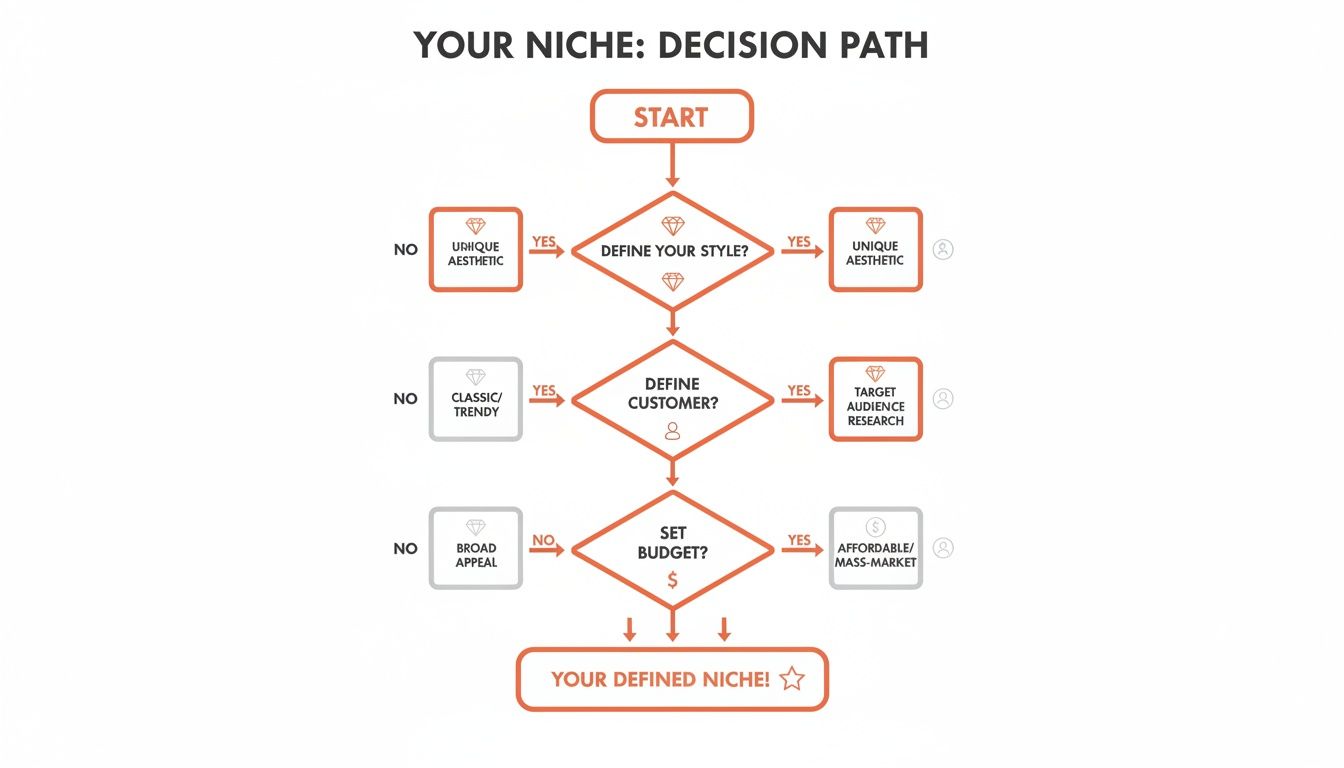
This flowchart really drives home the point: every sourcing decision you make has to stem from a solid understanding of your brand identity and what you can afford.
The Vetting Process: A Deeper Look
Okay, so you've got a shortlist of potential suppliers. Now the real work begins. Vetting is your systematic deep-dive to confirm a supplier meets your standards for quality, reliability, and price before you commit to a big order. Rushing this step is a recipe for business disaster.
Your supplier isn't just a vendor; they are your partner in quality control. A great partner will be transparent about their materials and processes, helping you build a brand that customers trust and return to.
Start by doing some online sleuthing. Go beyond their slick website or B2B profile. Search for independent reviews on forums or in retailer Facebook groups. Are other business owners singing their praises, or are there consistent complaints about shipping delays, poor communication, or shoddy products? And pay close attention to how a supplier responds to negative feedback—or if they even bother to respond at all.
For a great list of vetted partners, you can also explore our guide on the best wholesale jewelry suppliers.
Essential Questions for Every Potential Supplier
Don't be shy about asking tough, detailed questions. Any supplier worth partnering with will welcome your diligence. I recommend creating a standard checklist of questions so you can easily compare vendors when evaluating potential sources for high-quality fashion accessories.
A good starting point for your questionnaire includes:
- Materials and Plating: What base metals do you use—brass, sterling silver, stainless steel? Crucially, what is the thickness of the gold or rhodium plating in microns? Thicker plating is essential for durability and perceived value.
- Stone Quality: What grade are your cubic zirconia or crystal stones (e.g., AAA, AAAAA)? Are they machine-cut for maximum sparkle?
- Manufacturing Process: Can you walk me through your manufacturing and quality control steps? Do you have any certifications, like from SGS, to back up your claims?
- Business Credentials: Can you provide a copy of your business license and any necessary export licenses? This simple step verifies they're a legitimate, operational company.
To help you stay organized during this crucial stage, here’s a checklist I've used to evaluate potential partners.
Wholesale Supplier Vetting Checklist
| Vetting Criteria | What to Look For | Red Flags to Avoid |
|---|---|---|
| Communication | Prompt, clear, and professional responses. Willingness to answer detailed questions. | Vague answers, long response times, language barriers that lead to misunderstandings. |
| Product Quality | High-quality materials, consistent plating thickness, securely set stones. | Flimsy clasps, uneven color, visible glue, reports of tarnishing or skin irritation. |
| Reputation & Reviews | Positive independent reviews, a solid B2B marketplace rating, transparent business history. | Numerous complaints about shipping or quality, no social proof, a brand-new or unverifiable profile. |
| Business Legitimacy | Provides business licenses and certifications upon request. Clear company address and contact info. | Refusal to provide documentation, P.O. box address only, no verifiable company information. |
| Pricing & Terms | Clear pricing structure, reasonable MOQs, fair payment and shipping terms. | Prices that seem too good to be true, unusually high MOQs, pressure for upfront wire transfers. |
| Sample Policy | Willing to sell small sample orders at a reasonable cost. | No sample orders allowed, charging exorbitant prices for samples. |
This checklist isn't exhaustive, but it covers the non-negotiables. A supplier that ticks all the right boxes here is likely a solid bet for a long-term business partnership.
The Final Test: Ordering Samples
No amount of emails or photos can replace actually holding the product in your hands. This is the final, non-negotiable step: always order samples before placing a bulk order. It’s a small investment for your business that can save you thousands of dollars and protect your brand from the fallout of selling low-quality goods.
When your samples arrive, inspect them thoroughly for:
- Durability: Gently tug on the clasps, chains, and links. Do they feel secure or flimsy?
- Color Integrity: Is the plating rich and even, or does it look thin, streaky, and cheap?
- Craftsmanship: Are all the stones set securely? Look for sloppy details like excess glue or rough, unfinished edges.
The ultimate test? Wear the pieces yourself for a few days. See how they hold up to real life. Does the color fade after a shower? Does it turn your skin green? This hands-on testing is your final line of defense and the key to sourcing products you can proudly stand behind.
Navigating Prices and Minimum Order Quantities
Talking money and order sizes is where your profit is made or lost. Getting good at negotiating with bling bling jewelry wholesale suppliers is a skill that separates successful businesses from those constantly struggling with cash flow. It's about finding that sweet spot where both you and the supplier feel like you're getting a good deal.
This isn't about hardball tactics. Think of it as starting a business partnership. A supplier is far more likely to be flexible with a buyer who is professional, serious, and looks like they'll be a source of repeat business.
Don't Forget Your True Landed Cost
Before you even start a conversation about price, you absolutely have to know your landed cost. This is the real, all-in price you pay to get one single piece of jewelry from their factory floor to your business, ready to sell. The wholesale price is just one part of the equation.
Getting this number wrong is a surefire way to kill your margins. Your actual cost per piece needs to include everything:
- Cost of Goods: The base price of the jewelry.
- Shipping & Freight: International shipping isn't cheap, especially for bulkier, heavier pieces.
- Customs, Duties & Taxes: These import fees vary based on your country and the shipment's value. Don't let them be a surprise.
- Payment Processing Fees: Most payment platforms take a small cut, which adds up on large orders.
Once you have that total cost, and only then, can you determine your profit potential and set a smart retail price.
How to Talk Down an MOQ
Minimum Order Quantities (MOQs) are probably the biggest roadblock for new or smaller businesses. A supplier might list an MOQ of 100 units for a single necklace, but you only want to test the market with 20. Don't let that stop you. MOQs are often negotiable.
The key is how you frame the request. Instead of just asking, "Can I order less?" frame it as a business strategy. Explain that you're testing new styles for your audience and that you plan to place a much larger, recurring order for the designs that sell well. This shows you're thinking long-term.
A supplier’s willingness to work with you on your first order speaks volumes. If they're flexible and see your business potential, that’s a great sign. A partner who is completely rigid from day one might not be the right fit for a growing business that needs to stay agile.
Here's another great tactic: offer to pay a slightly higher price per piece for a smaller order. For example, if the price is $2 per piece for 100 units, you could offer to pay $2.25 for just 30 units. The supplier still makes a good profit, and you drastically lower your upfront investment and business risk. To dive deeper, our guide on sourcing factory-direct jewelry has some great insights.
Lock in Secure Payment Terms
Last but not least, let's talk about protecting your business's money. When working with a new supplier, avoid payment methods that offer zero protection, like a direct bank wire. For your first few orders, insist on using a secure system that protects your investment.
Look for platforms that offer services like Alibaba's Trade Assurance. It holds your payment in escrow until you've confirmed that your order arrived and is exactly what you paid for. PayPal Goods & Services is another solid choice that offers a similar safety net.
As you build a solid history and trust with your supplier, you can discuss other payment options. But in the beginning, always put financial security first. This simple step is what lets you source amazing, affordable fashion accessories with total confidence.
Managing Quality Control and Your Inventory
That moment when your first big shipment of bling bling jewelry wholesale arrives is a huge thrill. But once the boxes are at your door, the real work begins. This is where you switch from being a buyer to a business owner, and where solid quality control (QC) and smart inventory management become your most important tools.
Skipping this part is a rookie mistake that can cost your business dearly. It only takes one customer getting a piece with a loose stone or a faulty clasp to spark a negative review that damages your reputation. A consistent inspection process is your front-line defense, ensuring every item you ship is something you're proud to sell.
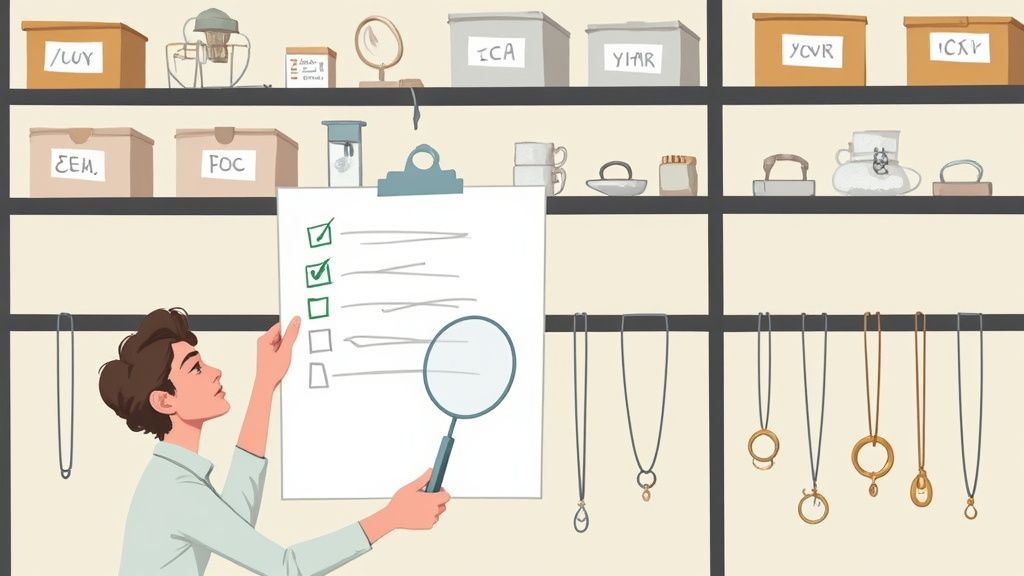
Your Post-Delivery QC Checklist
Don't just open a box and assume everything is perfect. You need a simple, repeatable system to check your order the moment it lands. The trick is to spot-check effectively. Pull a few random pieces from each style—about 5-10% of the total should do it—and give them a serious inspection.
Here's what I always check for:
- Clasps and Closures: Work them. Open and close every clasp a few times. Is it smooth and secure, or does it feel flimsy and cheap?
- Stone Security: Gently run your finger over any pavé or prong-set stones. Anything wiggling or loose? A magnifying glass is your best friend here for spotting missing stones.
- Plating Consistency: Get under a bright light and look for streaks, dull spots, or areas where the plating is obviously thin or uneven. The color should be uniform.
- Structural Integrity: Give chains and bracelets a light tug to test the links. You're looking for weak solder points or any hint of fragility that could lead to a quick break.
If your defect rate is higher than 2-3%, contact your supplier immediately. Send clear photos and describe the issues. A good business partner will make it right, whether that means a partial refund, a credit on your next order, or replacements.
Smart Inventory Strategies for Fashion Accessories
Once your new jewelry passes inspection, it’s time to get organized. For fast-moving fashion accessories, effective inventory management isn't about fancy software; it’s about a clear system for tracking what you have, what's selling quickly, and what's tying up your capital.
Inventory is just cash sitting on a shelf. Your goal is to turn it back into cash as quickly as possible. Overstocking on a trend that dies overnight ties up your money and stops you from investing in the next big thing for your business.
Categorize and Track for Maximum Efficiency
Start simple. Organize your stock in a way that makes sense for your business—by product type (rings, necklaces), by collection (bridal, streetwear), or even by supplier. A basic spreadsheet is all you need to get started.
For each SKU (Stock Keeping Unit), you need to track a few key data points:
- Quantity on Hand: The exact number of units you have right now.
- Sales Velocity: How many units are selling per week or month? This tells you what's hot and what's not.
- Cost of Goods Sold (COGS): Your total landed cost for each piece.
- Reorder Point: The lowest your stock should get before you place another order.
This data is gold. It removes the guesswork from reordering and helps you avoid selling out of a bestseller while you're sitting on piles of something nobody wants. To keep your system sharp, it's worth brushing up on proven inventory management best practices. This is how you stay lean, profitable, and ready for whatever trend comes next.
Pricing and Merchandising Your Jewelry for Profit
You’ve done the hard work of sourcing incredible, high-quality fashion accessories. That's a huge win, but it’s only half the battle. Now, you have to turn that inventory into sales and profit for your business.
This is where your pricing strategy and merchandising skills come into play. It’s how you’ll transform your inventory of bling bling jewelry wholesale finds into a collection people can't resist—and that actually makes you money.
Smart pricing is much more than just adding a markup to your cost. It’s about finding the sweet spot that balances what a piece cost your business, what your customers perceive its value to be, and what your competitors are doing. Get it right, and you’ll not only cover your expenses but build a healthy margin to grow your business.
Setting Prices for Maximum Profitability
Many new business owners start with the keystone model: take your landed cost and double it. So, if a necklace cost you $5 total, you’d sell it for $10. It’s a simple starting point, but it often leaves money on the table.
To really optimize your pricing, you need to think a little deeper.
- Perceived Value: How much do your customers feel this piece is worth? A necklace with brilliant, AAA-grade stones and thick, durable plating feels more premium. You can—and should—charge more for that high-quality piece than a basic alloy item, even if your cost difference is small.
- Brand Positioning: Who is your business? Are you the go-to for trendy, fast-fashion finds, or a boutique specializing in higher-quality, tarnish-resistant pieces? Your prices need to reflect your brand's story.
- Competitor Analysis: Look at what similar businesses are charging for comparable items. The goal isn't to copy them, but you must know the market rate to position your products effectively.
If you want to go even deeper on this, we've put together a full guide on https://www.jewelrybuydirect.com/blog/how-to-price-jewelry?articleId=610805940310 that’s worth a read.
Merchandising to Make Your Collection Irresistible
Once your prices are set, it's all about presentation. Merchandising is how you display your products to the world and create an experience that makes people want to buy.
It starts with great visuals. You don't need a professional photo studio. Your smartphone, some good natural light, and a clean background can produce incredible results. Be sure to get shots from multiple angles, a close-up to show off the details, and a photo of the piece being worn so customers can get a feel for its size and scale.
Crafting Product Descriptions That Convert
Think of your product description as your silent salesperson. This is your chance to sell the piece, highlighting all the features that make it special and justify the price tag.
Your product description should answer the questions a customer has before they even think to ask them. Is it hypoallergenic? Will it tarnish? What makes these stones so sparkly? Answering these builds trust and drives conversions.
Don't just say "gold necklace." Try something like, "A radiant, 18k gold-plated chain featuring hand-set, AAA-grade cubic zirconia stones for maximum fire and brilliance. Tarnish-resistant for long-lasting shine." One is a label; the other paints a picture and communicates quality.
The demand for this kind of jewelry is exploding. The imitation jewelry market is projected to grow from USD 17.95 billion in 2024 to around USD 38.70 billion by 2035. That's a massive opportunity for any business that can merchandise its products well.
Boost Sales with Bundles and Upsells
Finally, use your merchandising to increase your average order value. Grouping related items together, like a matching necklace and earring set, is a classic for a reason—it works. Offer a small discount for buying the bundle, and you’ll encourage shoppers to add more to their cart than they originally planned.
After setting your initial prices, you should always be looking for ways to improve profit margins on Shopify. By pairing a smart pricing strategy with merchandising that wows, you’ll build a powerful engine that turns your wholesale finds into consistent, reliable profit for your business.
Your Top Questions About Sourcing Wholesale Jewelry, Answered
Jumping into the world of bling bling jewelry wholesale can feel overwhelming for a new business. You're dealing with suppliers halfway across the world, trying to decipher shipping terms, and hoping the quality is what you were promised. It’s completely normal to have a ton of questions.
Let's clear things up. Here are straight-up answers to the most common hurdles business owners face when sourcing high-quality, affordable fashion accessories, so you can start with real confidence.
How Do I Actually Talk to International Suppliers?
Communicating effectively with international suppliers is critical to the sourcing process. When you factor in different languages and time zones, clear communication isn't just nice to have—it's everything.
The secret is to be relentlessly clear and professional. Use simple, direct language. For example, don't just say, "I want a gold necklace." Instead, get specific: "I need a brass chain necklace with 18k gold plating at a 1 micron thickness." The second request is unambiguous.
A few pro tips for your business:
- Pictures are your best friend. Send photos, mark them up with notes, draw simple sketches. A visual leaves zero room for misinterpretation.
- Get it in writing. Always follow up any calls with an email summarizing important details—pricing, MOQs, lead times. This creates a paper trail that protects your business.
- Patience is a virtue. Remember, they're likely in a different time zone. A response might take a full business day. Patience and professionalism will build a much stronger business relationship.
What’s the Real Difference Between Plating Types?
If you want to sell high-quality fashion accessories that don't tarnish quickly, you must understand plating. This is the thin layer of precious metal covering a base like brass or stainless steel, and it's what gives the piece its look, feel, and durability.
Here's the breakdown of what your business will most often encounter:
- Gold Plated: The classic choice. A thin layer of gold is electro-deposited onto the base metal. For decent fashion jewelry, look for 0.5 microns or higher. Anything less is "flash plating" and won't last.
- Rhodium Plated: A member of the platinum family, rhodium gives a super bright, silvery-white finish. It's incredibly reflective and resists tarnishing, making it a high-quality option.
- PVD (Physical Vapor Deposition): This is a modern and highly durable process. The coating is bonded to the base metal inside a vacuum. PVD plating is far more resistant to scratches and corrosion, making it an excellent choice for items that see a lot of wear, like rings and bracelets.
Here's a key takeaway: Always ask your supplier for the exact plating method and its thickness in microns. A supplier who is transparent about this is usually one you can trust to deliver quality products for your business.
How Do I Handle International Shipping and Customs Without Losing My Mind?
International logistics can seem intimidating, but it's really just a process. Your supplier will offer several shipping options, usually a trade-off between speed and cost. You'll see names like DHL, FedEx, and UPS for air freight (faster, pricier) or other logistics companies for sea freight (slower, cheaper for bulk orders).
The part you absolutely cannot ignore is customs and import duties. These are the taxes your country charges for importing goods. The final bill depends on the product type and the total value of your order.
Your shipping carrier (like DHL) typically acts as your customs broker. They'll handle the paperwork and then send you an invoice for the duties. To avoid a costly surprise, ask your supplier for the HS (Harmonized System) code for your jewelry. You can use this code on your government's customs website to estimate the duty rate. You must factor this into your landed cost from day one to protect your profit margins.
What Happens if I Get Damaged or Defective Items?
Even with the most reliable suppliers, mistakes happen. A piece gets crushed in transit, or a clasp is faulty. The mark of a professional supplier is how they handle these problems. Make sure you discuss their policy for defects before you place a large order.
When your shipment arrives, inspect it right away. If you find any issues:
- Document Everything. Take clear, well-lit photos of the damage. Make a list of the specific SKUs and how many units are affected.
- Contact Them Immediately. Send an email to your sales rep within their required timeframe (usually 3-7 days after delivery). Attach your photos and explain the problem clearly.
- Propose a Solution. Don't be vague. State what you need to make it right for your business. Common options are a refund for the defective items, a credit toward your next order, or having them ship replacements.
A good partner will want to make it right, and quickly. How they respond when things go wrong tells you everything you need to know about the long-term health of your business partnership.
Ready to find high-quality, affordable fashion accessories for your business without the hassle? JewelryBuyDirect offers over 120,000 styles with no minimum order, factory-direct pricing, and free shipping on orders over $150. Start sourcing with confidence today at https://www.jewelrybuydirect.com.