






Jennifer Lopez | Sun Oct 18 2026
Bar Pendant Necklace Guide for Retailers and Buyers
You're comparing supplier catalogs, and both bar pendants look promising. One is inexpensive but vague about its metal; the other costs more and comes with clear specifications. The choice isn't just which necklace looks better. It's which one customers will wear, trust, and buy again, and which one you can reorder without surprises.
A bar pendant necklace can earn space as a core item, not merely an add-on. Its simple shape supports personalization and everyday styling, but the assortment still needs sound decisions on material, chain, closure, landed cost, and product claims. Treat it as a complete stock-keeping unit, and it becomes easier to merchandise, price, and replenish with confidence.
Why the Bar Pendant Necklace Belongs in Your Assortment
A buyer scrolling through two supplier catalogs can easily mistake a bar pendant for a low-risk basic. The silhouette looks simple, the styling is familiar, and the price may fit an impulse-purchase display. But a good assortment decision starts with why shoppers want the piece: it's easy to personalize, works with everyday outfits, and makes a practical gift when the engraving marks a name, date, or meaningful place.
That combination gives the bar pendant more than one route to a sale. A shopper might buy a plain silver-tone bar to wear daily, choose an engraved version for a gift, or add a second chain to create a layered look. For the retailer, the same basic shape can serve fashion, personalized, and more premium collections, provided the material and finish are clearly differentiated.
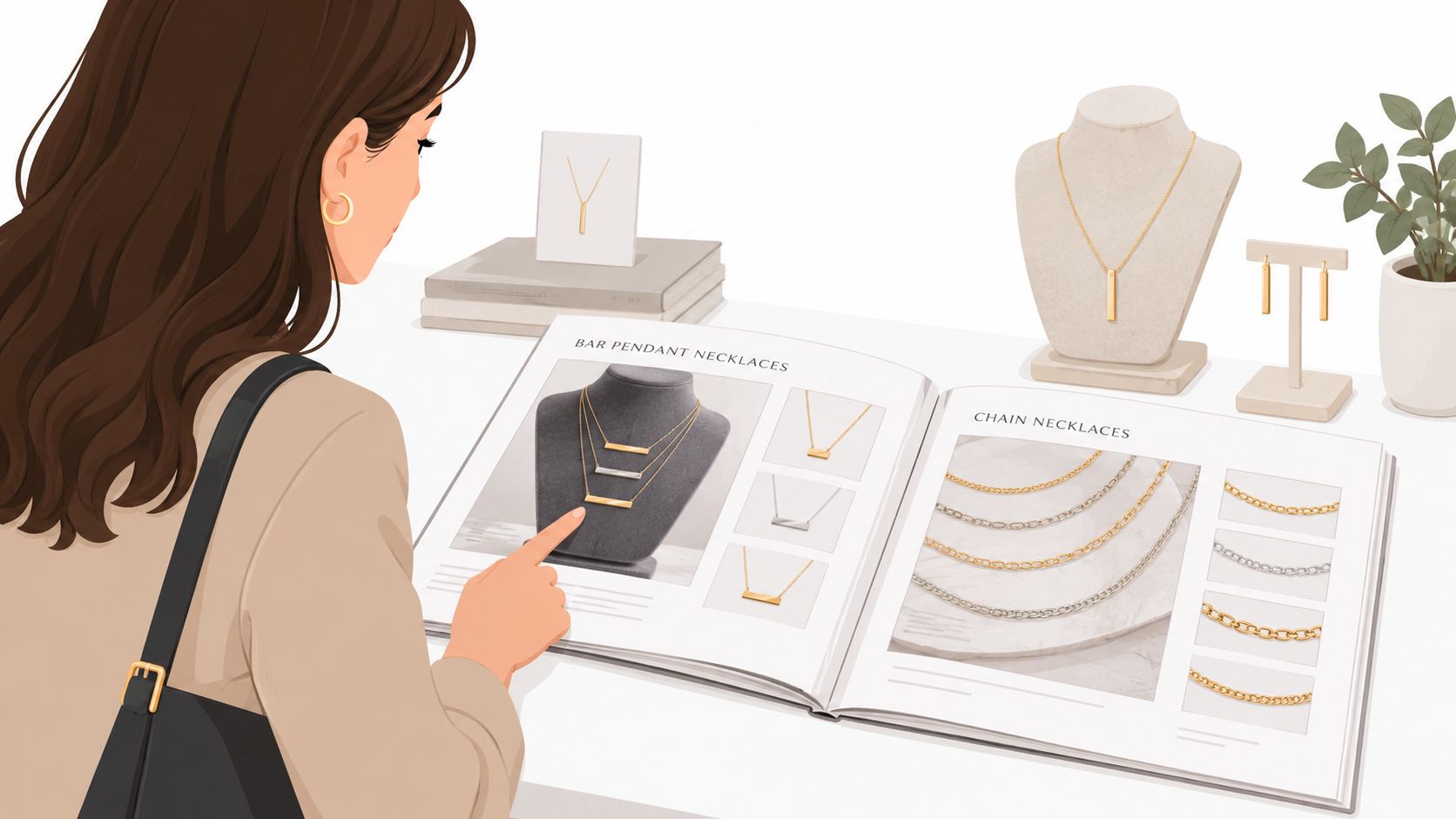
The broader category offers useful commercial context. A 2026 industry forecast projects pendant necklaces to make up 34.6% of the global necklace market; it estimates the overall necklace market at $47.6 billion in 2025, with a projection of $86.6 billion by 2035 and a 6.2% compound annual growth rate (market forecast for necklaces). Those figures cover necklaces broadly, not bar pendants specifically. They support the case for evaluating pendant styles, but they don't guarantee that any particular design will sell.
Buyer's rule: Give the bar pendant a defined role. Decide whether it's a personalization staple, a fashion basic, or an entry point to a higher-quality metal collection before choosing a supplier.
The rest comes down to execution. A compelling pendant still needs a readable engraving surface, a comfortable chain, a closure customers can manage, and documentation that backs up the material description. If it's easy to reorder and its quality stays consistent, the category can serve both gift shoppers and repeat customers without relying on a single trend.
What Defines a Bar Pendant Necklace
Think of the pendant as a small stamped envelope. Its flat face holds a short message, while the chain carries it against the wearer's chest. That surface is the reason a bar behaves differently from a round charm: the engraving has a clear direction, and the metal's length, width, thickness, and finish affect whether the piece looks delicate, bold, or difficult to read.
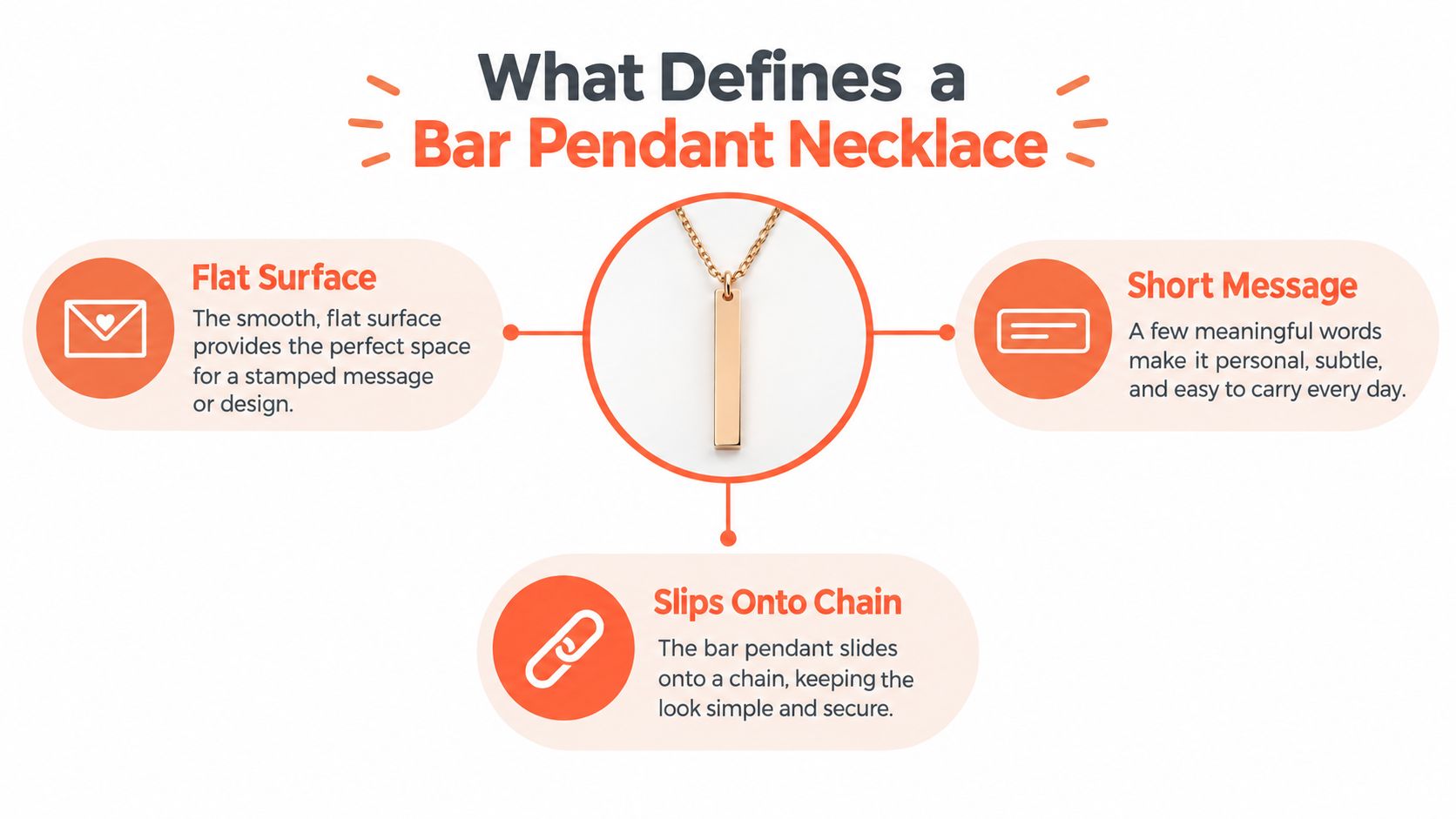
Start with the bar's proportions. Length determines how much room there is for initials, a date, or a short line of text. Width and thickness influence how substantial the pendant looks and feels. A long, narrow bar can make a message appear cramped if the lettering is too large; a thicker bar may look weightier, but can feel less discreet against lightweight clothing.
Next, inspect the edges and finish. Square edges create a sharper, more architectural look, while rounded edges tend to read softer and may sit more comfortably against skin. A polished surface reflects light and makes the pendant feel dressier. Brushed finishes reduce glare and give the piece a quieter appearance. Hammered texture can make a blank bar interesting on its own, but may compete with fine engraving.
Orientation changes the impression, too. A horizontal bar reads as a linear accent and gives text a wider path. A vertical one feels closer to a tag and changes how the pendant hangs against a neckline. Don't rely on the hero image alone. Check the spec sheet for dimensions, thickness, metal, finish, and whether the chain passes through a bail or attaches at the ends.
Thin horizontal bars reportedly appeared in stores in Los Angeles, Brooklyn, London, and Paris by 2014, moved into the mid-market by 2016, and reached mass production through Eastern Europe and Asia by 2018 (history of the bar necklace format). For today's buyer, the practical lesson is straightforward: the familiar silhouette has become easy to source, so your differentiation has to come from better specifications, trustworthy materials, and a useful retail offer.
Materials Compared from a Buyer's Perspective
Choose material by matching the expected price, wearing experience, and evidence you can provide. Don't assume a gold-colored finish means a solid gold pendant, and don't treat “hypoallergenic” as proof of a specific metal composition.
The FTC defines sterling silver or 925 as at least 925 parts per thousand, or 92.5%, pure silver. The remaining alloy helps improve strength because pure silver is relatively soft (FTC guidance on precious-metal jewelry). Ask suppliers to use precise descriptions such as “925 sterling silver bar pendant” or “brass pendant with gold plating.” A listing that says only “gold bar pendant” doesn't tell you what the product is made of.
| Material | Typical Wholesale Price | Tarnish Risk | Hypoallergenic | Best Retail Fit |
|---|---|---|---|---|
| 925 sterling silver | Confirm current supplier quote; cost varies by design and weight | Can tarnish and needs appropriate care | Don't assume; request composition and test documents | Engraved gifts and a clearly identified precious-metal tier |
| Stainless steel | Confirm current supplier quote | Generally chosen for everyday wear, but verify finish and coating | Verify the specific alloy and components | Durable-looking fashion basics and frequent-wear styles |
| Titanium steel | Confirm exact composition and quote | Depends on finish and any coating | Verify supplier documentation | Modern, minimal styles where the supplier can substantiate the material claim |
| Gold-plated alloy | Confirm base metal, plating type, and karat separately | Surface wear depends on plating and use | Depends on substrate and coating; testing matters | Gold-tone fashion and gift options at an accessible price |
| Brass | Confirm quote and any plating details | Can tarnish or change appearance, especially if uncoated | Don't assume; verify composition | Color-forward fashion styles when the finish is disclosed |
| Copper | Confirm quote and finish | Can darken or change with wear | Skin response varies; make no unverified promise | Distinctive designs for shoppers comfortable with copper's changing appearance |
Use the table as a request-for-information checklist, not a substitute for supplier quotes. A “fraction of the price” comparison only helps if the quality, plating, dimensions, and chain are comparable. Likewise, don't advertise a precise retail price based on metal alone; the engraving, presentation, workmanship, and shop positioning affect what customers will pay.
For a clearer comparison of two common everyday options, review the difference between sterling silver and stainless steel. Then request complete specifications for the actual pendant and chain you intend to sell. A material label should answer what the base is, what coating is present, and what evidence supports the claim.
Sizing, Chain Lengths, and Closure Options
Sell the necklace as a system. Chain length controls where the bar sits, pendant size changes how much attention it draws, and the closure determines whether the wearer can put it on without help. A pendant that looks good in a catalog can disappoint if the chain lands awkwardly or the clasp is frustrating.
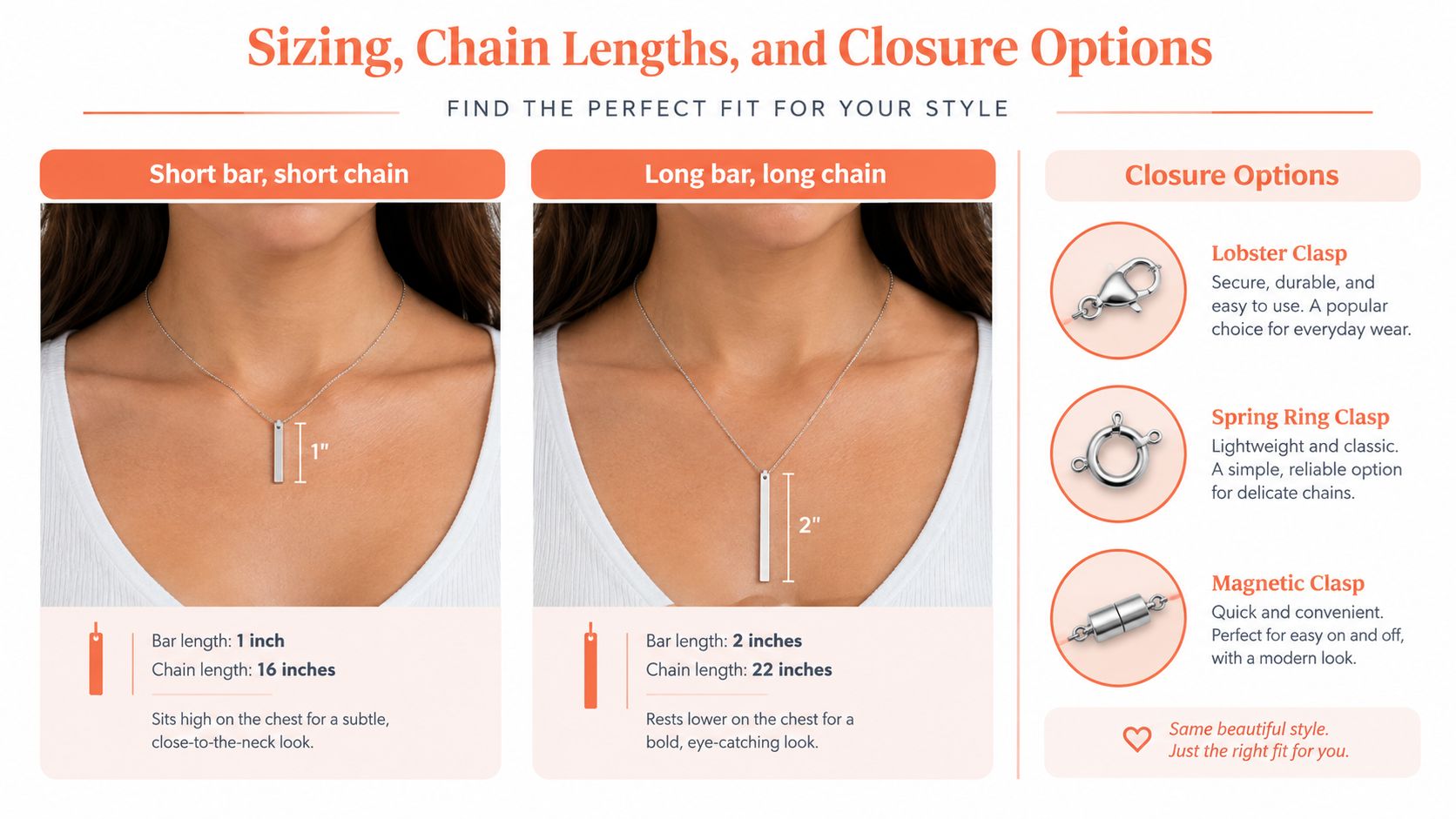
Use common length options as merchandising cues, not a promise that every chain will sit identically on every customer. A 16-inch chain is often selected for a choker-style layer, 18 inches is a familiar everyday option, and 20- to 24-inch chains create a longer fashion look. Pendant width and the wearer's neckline both affect the final position, so show the dimensions and a clear scale reference wherever possible.
Chain style changes the look and practical use. Cable and box chains offer a clean frame for a narrow bar. Rope chains add texture; snake chains create a smooth line but may feel more dressy. Paperclip chains make the chain itself a stronger style feature. Check sample pieces against hair and clothing, especially if links have edges or the bar's bail can catch.
Closures deserve the same attention as appearance. Lobster clasps are a familiar choice, while spring rings are small and can be harder to manipulate. Magnetic closures or front-fastening designs may suit customers with reduced dexterity or limited shoulder mobility, but don't assume every magnetic product is secure enough for daily wear. Adjustable slider chains give the wearer control over drop length; test whether the slider holds its position.
For more detailed merchandising guidance, use this necklace chain length guide. Then write the SKU to include the chain type, length, pendant dimensions, adjustability, and closure. That's more useful to customers than calling a necklace “versatile” and leaving them to guess.
Styling, Layering, and Engraving Use Cases
A bar pendant sells best when the customer can picture how it fits into an outfit and what makes it personal. A horizontal bar can sit neatly above a V-neck, add a focal point to a scoop neckline, or bring a simple accent to a button-down. On a boat neckline, check the chain drop carefully so the pendant doesn't compete with the broad neckline.
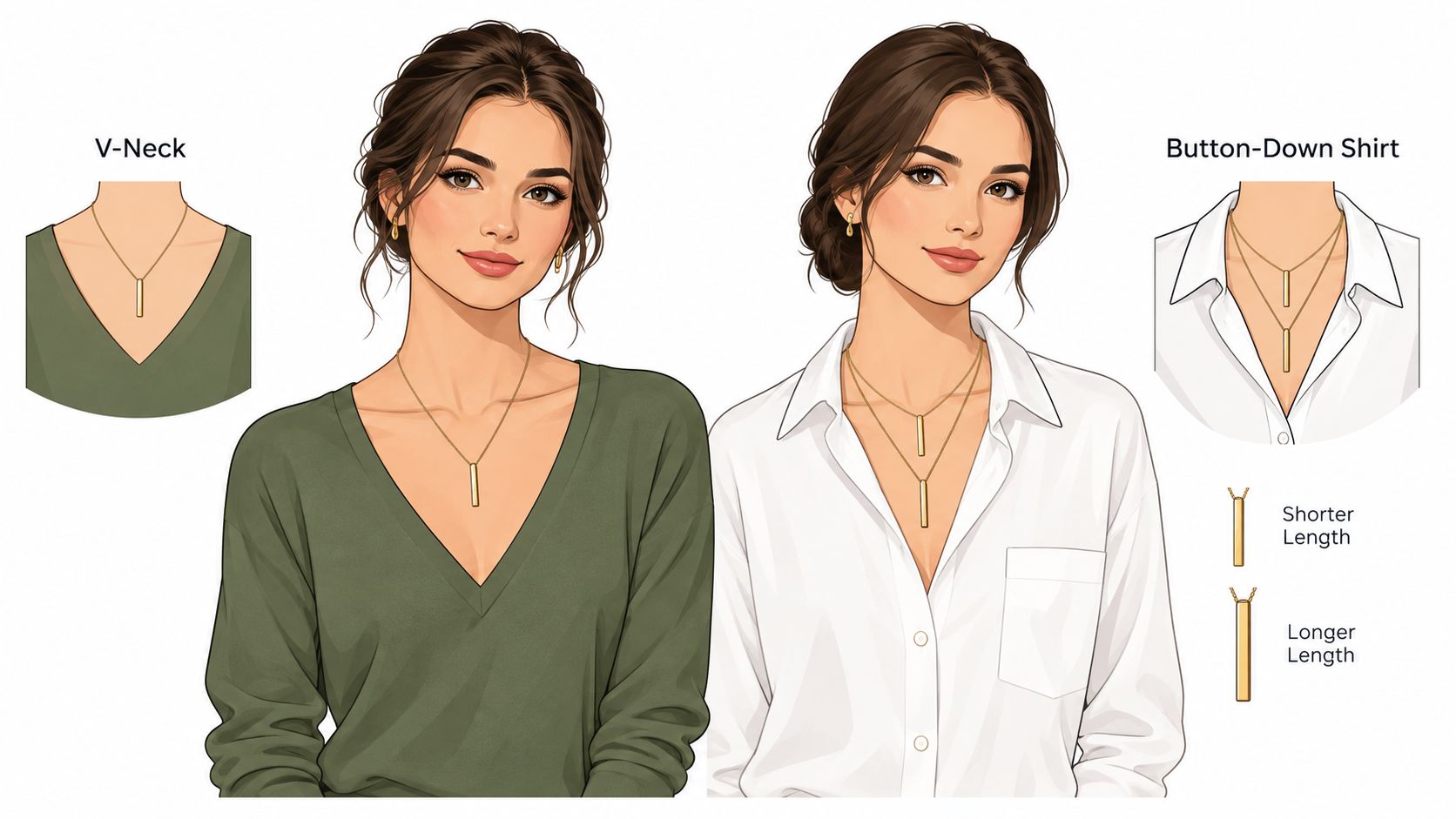
Layering works when each chain has space to move. Pair a shorter, simpler chain with a longer bar pendant, and avoid placing two pendants at the same point on the chest. Mixed metals can look deliberate when one tone leads and the other appears as a smaller accent; random proportions make the combination look accidental. Show a styled pairing in-store rather than expecting shoppers to assemble it from separate product cards.
Engraving is a merchandising choice, not an afterthought. Fine lettering on a narrow bar can become hard to read, so check the supplier's engraving area and proof process before promising a name or message. Initials, dates, coordinates, and short words are easier to lay out than long phrases. Offer practical character guidance based on the actual dimensions and font, not a generic limit copied across every design.
A blank bar may also suit shoppers who prefer understated jewelry, while an engraved piece works for bridal-party gifts, graduations, family occasions, and self-purchase. For a different example of how material and pendant design can create a more distinctive gift, Astro West's pallasite meteorite necklace with olivine offers a useful point of comparison.
Customers who value easier fastening need a recommendation that accounts for their hands as well as their outfit. If one-handed wear matters, show how the closure opens and closes, and let the shopper try it when practical. A useful reference for the metal-focused side of this category is this guide to engravable stainless steel.
The video below can help staff discuss styling and fit visually. Pair it with a clear explanation of the specific chain and closure on the product you're selling.
Compliance and Material Claims You Should Demand
Treat material claims as purchasing terms, not copywriting flourishes. A supplier's product page can say “nickel-free,” “silver,” or “gold plated,” but you need records that identify the actual components and support those words. If the supplier can't explain the base metal and surface coating, don't repeat the claim in your own listing.
ASTM F2923-20 sets a nickel migration limit of no more than 0.5 micrograms per square centimeter per week for jewelry intended for direct and prolonged skin contact, including necklaces and chains. When a non-nickel coating serves as the protective barrier, the standard requires it to maintain that limit for at least two years of normal use (ASTM F2923-20 jewelry standard). A necklace can stay against skin for long periods, and its clasp, chain, bail, and pendant back may experience different levels of contact and abrasion.
Ask for a test report that identifies the tested components, coating system, test method, and result. A general statement about a factory or a different product family doesn't establish the performance of the necklace in your order. For plated items, require the plating type and karat to appear separately from the substrate. For example, “brass with 14K gold plating” tells a buyer more than “gold necklace.”
Don't approve vague invoice language: “silver tone,” “hypoallergenic,” and “gold” should be clarified before you order. Ask what the metal is, what coating is used, and what document supports any safety or precious-metal claim.
If you sell into multiple markets, request documentation relevant to your destinations, including applicable lead and cadmium requirements. Sustainability language needs the same discipline: recycled content alone doesn't establish labor practices, low-impact plating, or the scope of a supplier's certification. For a practical perspective on the traceability advantages for SMBs, consider how product records can make verified information easier to retain and share.
Sourcing Bar Pendant Necklaces at Wholesale
A bar necklace can look consistent in a supplier's photos and still vary in length, finish, or clasp quality from piece to piece. Treat it as a repeatable product category: check the specification, test the finished necklace, and price the order using its landed cost.
- Shortlist suppliers by documentation and fit. Request pendant dimensions, metal composition, plating details, chain specifications, closure type, and documents relevant to the product and your destination market. Check that each document identifies its issuing body and product family, and includes validity information where applicable.
- Test samples before placing a bulk order. Industry guidance recommends requesting at least 3 to 5 samples, wearing them for two weeks to check tarnishing, and opening and closing clasps 50 times to assess durability (wholesale jewelry sampling and testing guidance). Apply these checks to the whole necklace. Inspect the chain, clasp, bail, engraving, and finish during ordinary wear, and note whether the clasp is easy to operate with one hand. A necklace that looks good but is awkward to fasten can create avoidable returns.
- Calculate landed cost. Include unit price, shipping, duties, packaging, and a reserve for returns or defects. Compare equivalent products, such as plated alloy with plated alloy or sterling silver pieces with similar weight and workmanship. A low quote can lose its appeal once freight, rework, or customer complaints are included.
Wholesale guidance places sourced jewelry at about 30 to 50 percent gross margins, compared with 60 to 80 percent for handmade jewelry. Treat these as broad planning figures, not a promise of what your shop will earn. Landed cost, retail price, markdowns, payment fees, and returns determine your actual margin.
Before approving an order, check for counterfeit or misrepresented alloys, undisclosed gemstone treatments, nickel reactions, fast plating wear, and copied designs. Match any supplier report to the exact product family. A general factory certificate does not establish that every necklace uses the same materials or coating.
For new sellers, a supplier with no minimum order quantity can make it easier to test a small assortment before buying deeper stock. JewelryBuyDirect is one option to compare; its B2B catalog includes bar-necklace styles and offers no minimum order quantity. Apply the same sample and document checks with any supplier.
Bringing It All Together for a Profitable Bar Pendant Category
A healthy bar pendant assortment depends on three decisions. First, choose the material tier that anchors the range: sterling silver for a clearly specified precious-metal offer, stainless steel for an everyday fashion line, or plated alloy when the price and finish suit your customer. Second, choose closure designs that expand usability without making the assortment harder to manage. Third, insist on evidence for every material and safety claim you put on the product page.
Your next supplier call should answer practical questions: What is the base metal? What coating and plating details apply? Which components were tested? Does the report cover this exact product family? What are the pendant dimensions, chain length, and closure details? Can you reorder the same specification?
The display has a job, too. Keep the pendant visible and the chain untangled so shoppers can compare finishes and read engraving options. These tray tips from Grainmark Leather can help you think through how presentation supports the product without replacing good specifications.
A bar pendant doesn't need to be a hero product to earn its shelf. It needs a clear customer, consistent construction, sensible landed cost, and claims you can defend. Make those decisions before ordering, and the category has a better chance of becoming a dependable part of your assortment rather than forgotten stock.
JewelryBuyDirect offers wholesale necklaces and fashion accessories across materials including sterling silver, stainless steel, copper, and plated styles, with no minimum order quantity for buyers testing an assortment. Compare its bar pendant options and other wholesale jewelry at JewelryBuyDirect.