





Jennifer Lopez | Tue Nov 03 2026
Om Gold Necklace: Grades, Meaning, and How to Stock
The usual advice for buying an Om gold necklace is to choose the richest gold color and the highest purity your budget allows. That's a poor wholesale buying rule. A beautifully colored pendant can hide an undisclosed base metal, while a clearly labeled plated necklace can be exactly the right product for an affordable fashion assortment. Buy verified construction, not yellow shine.
Why an Om Gold Necklace Is Two Products
A shopper typing Om gold necklace might want something for prayer, a meaningful gift, or an inexpensive chain for everyday styling. Those customers share a search phrase, not necessarily a budget, a religious practice, or an expectation of durability. Your assortment needs to separate those intentions before your product titles bring them together.
You're selling a meaningful symbol and a metal product. Om, also spelled Aum, is a sacred sound associated with Hinduism and used in Buddhist and Jain ritual. Its significance deserves more care than a generic charm description, but cultural sensitivity doesn't replace a complete material specification.
The stocking mistake is simple: buying a yellow pendant and publishing it under the title gold necklace. That title leaves customers to imagine the construction, often according to whichever interpretation makes the price look most attractive.
Buying principle: A solid-gold keepsake and an affordable plated fashion chain can both be honest products. An ambiguous material claim cannot.
Match the product to the promise
Before approving a supplier quote, decide what your customer is buying:
- A keepsake: Prioritize documented metal content, a dependable chain, and a pendant that can withstand handling.
- An accessible fashion accessory: Prioritize disclosed construction, clean finishing, comfortable edges, and realistic care instructions.
- A meaningful gift: Add accurate symbol context and packaging that doesn't substitute vague spiritual claims for useful product details.
The grade-and-construction table below is a practical comparison sheet for supplier quotes. Match every candidate to a row, then identify what evidence is missing.
For boutiques, marketplace sellers, and social-commerce vendors, affordable sourcing shouldn't mean accepting vague metal claims. It means choosing which compromises suit your customer, stating them plainly, and photographing the actual necklace without cropping away the symbol or concealing its construction.
Gold Grades and Finishes Compared
Om necklace gold grades and constructions
The purity mappings below follow the World Gold Council's gold jewellery guide: 24K corresponds to fineness 999, 22K to 916, 18K to 750, and 14K to 585; the guide also identifies 10K as the United States minimum gold standard.
| Construction | Gold content | Best retail use | Label must say |
|---|---|---|---|
| Solid 24K / 999 | About 99.9% gold, very soft | Ceremonial or collector pendant | 24K Gold or fineness 999 |
| Solid 22K / 916 | 91.6% gold by fineness | Traditional high-purity pendant | 22K Gold or 916 |
| Solid 18K / 750 | 75% gold and 25% alloy | Everyday solid-gold Om | 18K Gold, karat immediately before Gold |
| Solid 14K / 585 | 58.5% gold by fineness | Daily wear with chain friction | 14K Gold or 585 |
| Gold-filled | Bonded gold layer over a base metal | Longer-wear affordable fashion | Gold-filled plus the karat of the layer |
| Gold-plated | Thin gold coating over copper, brass, steel, titanium, or alloy | Trend and impulse price points | Base metal and gold-plated, not solid gold |
| Gold-tone under 10K | Little or no gold throughout | Costume only | Gold-tone or the base metal, not gold |
Read purity and construction separately
Karat and fineness describe gold content in different formats. International suppliers may use fineness where a domestic buyer expects a karat designation. Your purchasing sheet should record both, so a change in notation doesn't become a mistaken change in grade.
Alloying metals such as copper or silver make soft gold more practical for jewelry and can change its color. For an Om pendant with narrow strokes, moving chain contact, and frequent handling, choose an everyday alloy rather than assuming that maximum purity means maximum durability. The World Gold Council identifies the familiar midrange grade in the table as the most popular choice in the United States.
Solid gold means gold alloy throughout the metal, not necessarily a physically solid, non-hollow shape. A hollow pendant can still be made from solid-gold alloy. Ask about the material and the physical construction separately.
Gold-filled and gold-plated describe layered products. The gold grade of a surface layer doesn't establish the gold content of the entire necklace, and a pendant's specification doesn't automatically describe its chain.
Make the supplier quote comparable
Request a material breakdown for the pendant, chain, clasp, and connecting rings. For layered pieces, require the base metal, gold-layer karat, application method, and available thickness documentation. A polished sample isn't a substitute for those details.
Ask for a legible photograph of any applicable mark and compare it with the supplier's specification and testing documentation. Some hallmark systems also identify an assayer or responsible maker, so don't treat every tiny stamp as equivalent evidence.
Use the gold-plated versus solid-gold comparison when deciding which construction belongs at each price tier. Then keep that choice consistent across your purchase order, receiving checklist, product title, and packaging.
What Om Means for the Wearer
A gift customer asks whether an Om pendant would suit a friend who meditates. Don't answer with a promise of luck. Ask whether the friend knows and respects the symbol, then explain its religious associations without assigning that person a faith.
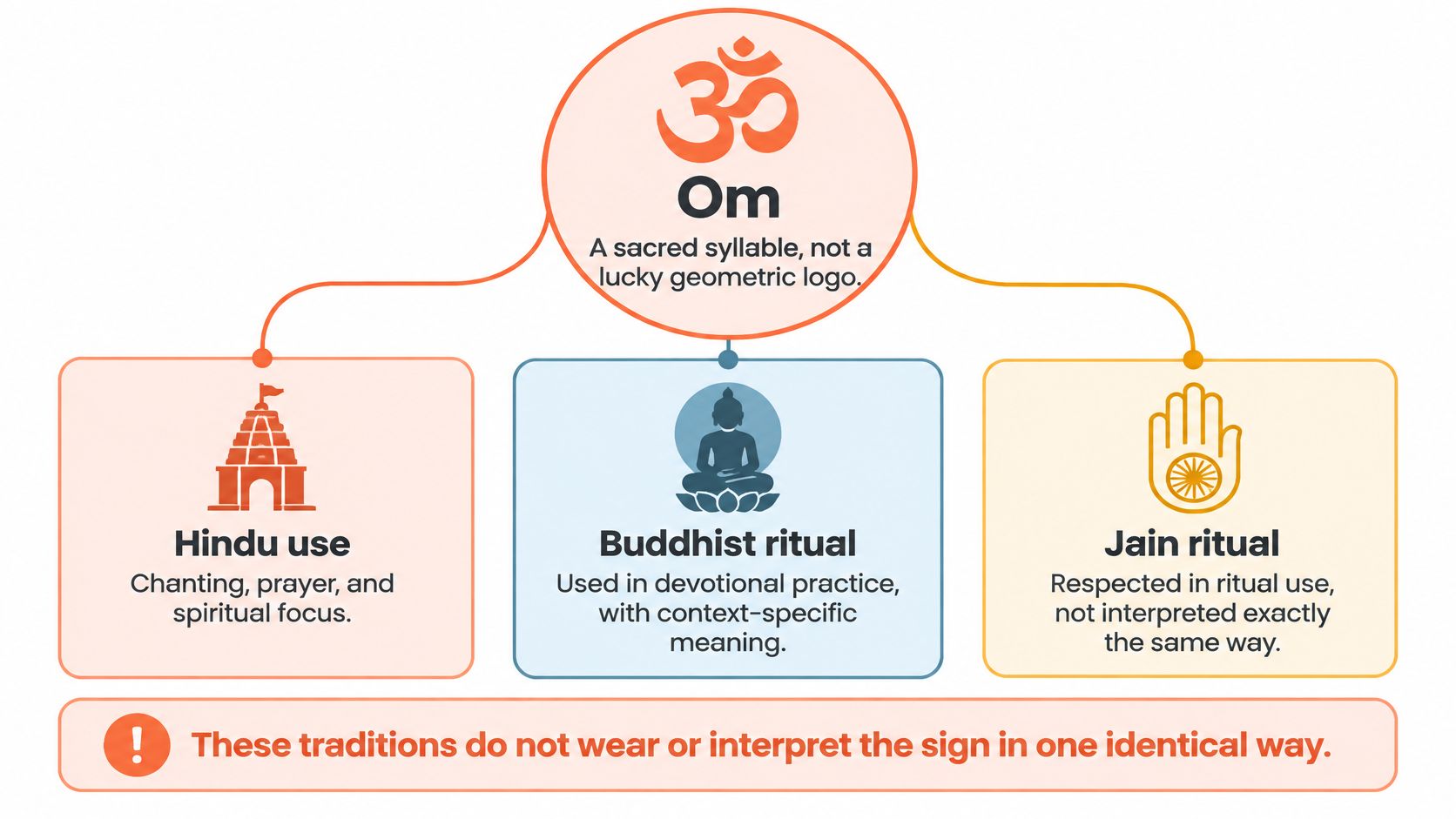
Treat Om as a sacred syllable with religious associations, and present it accordingly. In Hindu practice, it's associated with chanting, prayer, and spiritual focus. Buddhist and Jain traditions also use it in ritual, while each tradition brings its own context to the sign.
One retail analogy is enough: the pendant can work like a short prayer the wearer carries. That is why jokey packaging, magical-benefit claims, or “good vibes” copy reads careless on a product page.
The concept map preserves that distinction.
Give customers context without prescribing belief
The sound is often taught as A-U-M, with its parts connected to ideas such as earth, atmosphere, and heaven, or thought, speech, and action. Present these as common interpretations, with room for tradition and individual practice.
Marketplace browsing, including the AliExpress gold Om necklace category, is useful for assortment discovery. Use it to compare motifs, chain styles, and price bands; write your own religious context instead of copying marketplace shorthand that flattens the symbol into generic fortune.
For a product page, use neutral editorial wording:
Om, also spelled Aum, is a sacred sound associated with Hinduism, Buddhism, and Jainism, and with ideas of the universe and spiritual unity. Its significance varies across traditions and individual practice.
Both Om and Aum are acceptable transliterations. Pick a primary spelling for your titles and packaging, and keep it consistent so customers aren't left wondering whether they describe different products.
Make gifting respectful
A pendant can be an appropriate birthday, wedding, or personal-practice gift when the giver knows the recipient appreciates the symbol. It's a weak choice for a joke present or an assumption about someone's beliefs based on their clothing.
Build listing copy with the same discipline you use for construction: name the syllable accurately, keep claims modest, and publish wording that matches the physical product.
- Avoid guaranteed luck: Don't promise protection, prosperity, or spiritual results.
- Avoid flattened meaning: Good vibes only isn't an adequate explanation of a sacred syllable.
- Avoid presumed identity: Wearing an Om necklace doesn't establish that every wearer belongs to the same religion.
- Avoid disrespectful presentation: Keep the symbol away from feet in styling photographs and away from mocking slogans on cards.
Name the sacred sound, name the traditions, and keep the meaning open.
Pendant Designs That Survive Daily Wear
Inspect an Om pendant for thin strokes, sharp internal corners, and a weak bail junction before you consider its styling potential. A narrow stroke can crack, a notched corner can deform, and a poorly joined bail can separate from an otherwise attractive pendant. These are buying problems, not details to leave until customers report damage.
Use a close product view to examine the vulnerable areas.
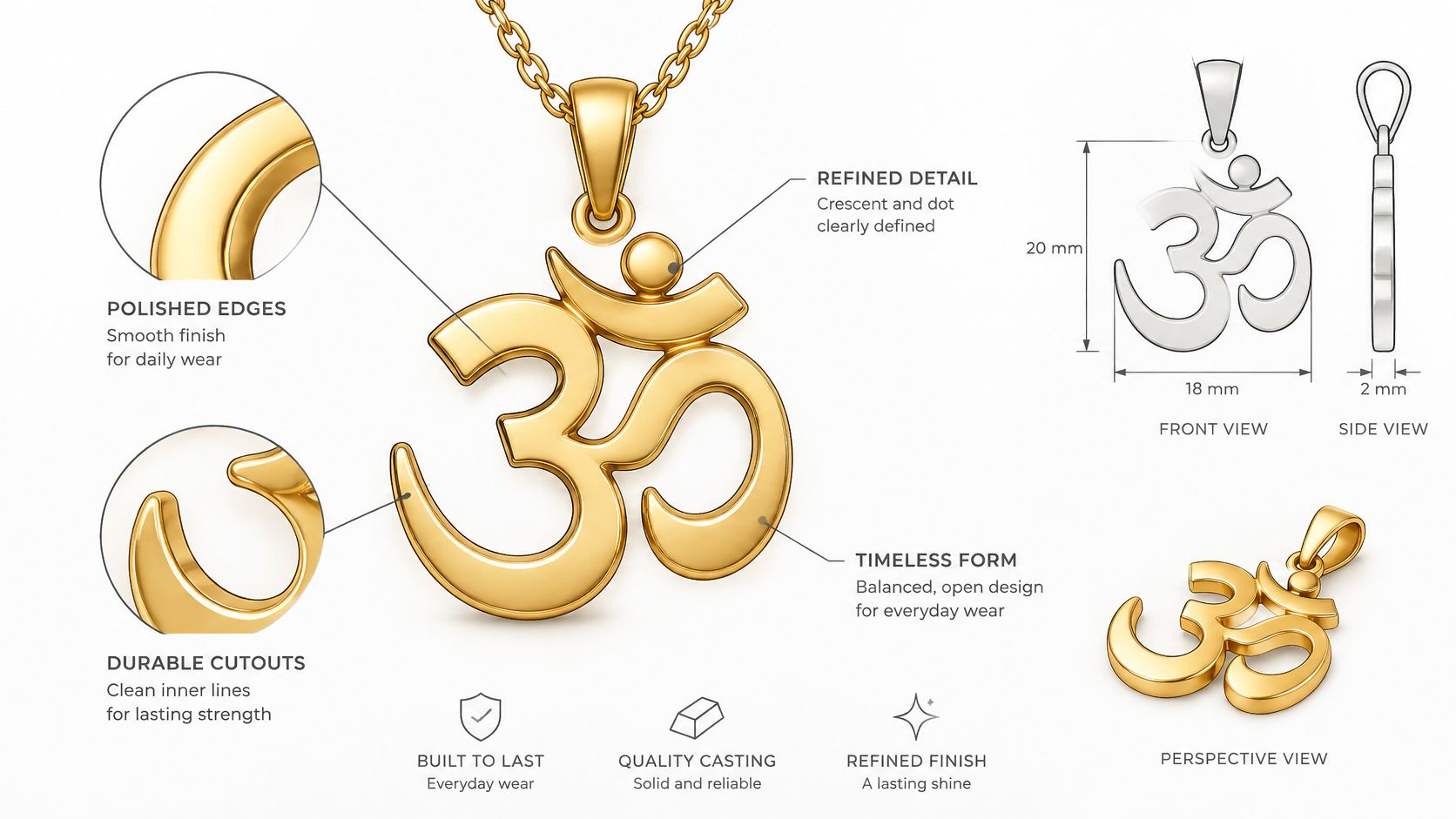
The symbol's curl, crescent, dot, and open spaces create a more demanding shape than a plain disc. Preserve the recognizable form while asking the factory to increase minimum stroke thickness, round tight internal corners, and reinforce the bail-to-pendant connection.
The cultural reason for preserving that form matters too: Britannica's account of Om describes a sacred syllable used across religious traditions, not an interchangeable decorative outline. Don't let a supplier simplify the symbol beyond recognition just to make production easier.
Choose a design family that fits the sale
| Design family | Selling situation | Sample inspection priority |
|---|---|---|
| Small script Om on cable or box chain | Quiet daily styling and fine-chain layering | Smooth strokes, readable shape, secure connections |
| Larger flat Om on curb or rope chain | Statement display and counter visibility | Balanced hanging position and a strong bail |
| Hollow or openwork Om | Lower metal weight with visual presence | Supported edges and resistance to denting |
| Bolder geometric Om on a shorter chain | Men's or unisex clavicle styling | Comfortable back surface and chain clearance |
Treat high polish, satin, and sandblast as surface choices, not construction grades. High polish makes small scratches more visible; textured finishes can make light wear less conspicuous, but they don't prevent plating from wearing through.
Run a fingernail gently around the sample's edges and inspect the reverse under magnification. Reject burrs, rough joins, obvious pits, and a bail that binds against the chain.
This video can accompany the design review, but the actual sample and its measurements should determine approval.
Check fit before styling
Build a hypothetical sample request around 16 to 18 inches for a daily pendant and 20 to 24 inches for a longer layered or men's option. Those are proposed assortment ranges, not universal fit rules. Request the actual chain length, extender length, and bail inner diameter, then check whether the chain's end fitting can pass through the bail.
A shorter clavicle chain can also suit a men's or unisex design, so don't make gender the sizing rule. Show where the necklace sits and give customers measurements.
Style a fine script Om with a second thin chain in the same metal, or let a larger flat pendant sit on a single bold chain. Keep plated pendants from repeatedly rubbing against neighboring chains. If the inner strokes look hair-thin in the supplier photo, ask for measured thickness before ordering dozens.
Checks That Separate Real Gold from Color
A low price and a gold-colored surface are reasons to inspect the specification, not automatic reasons to reject the product. Start with the seller's construction claim, then decide what evidence would establish it. Don't use a home screening test to approve a valuable solid-gold order.
The checklist below separates useful clues from proof.
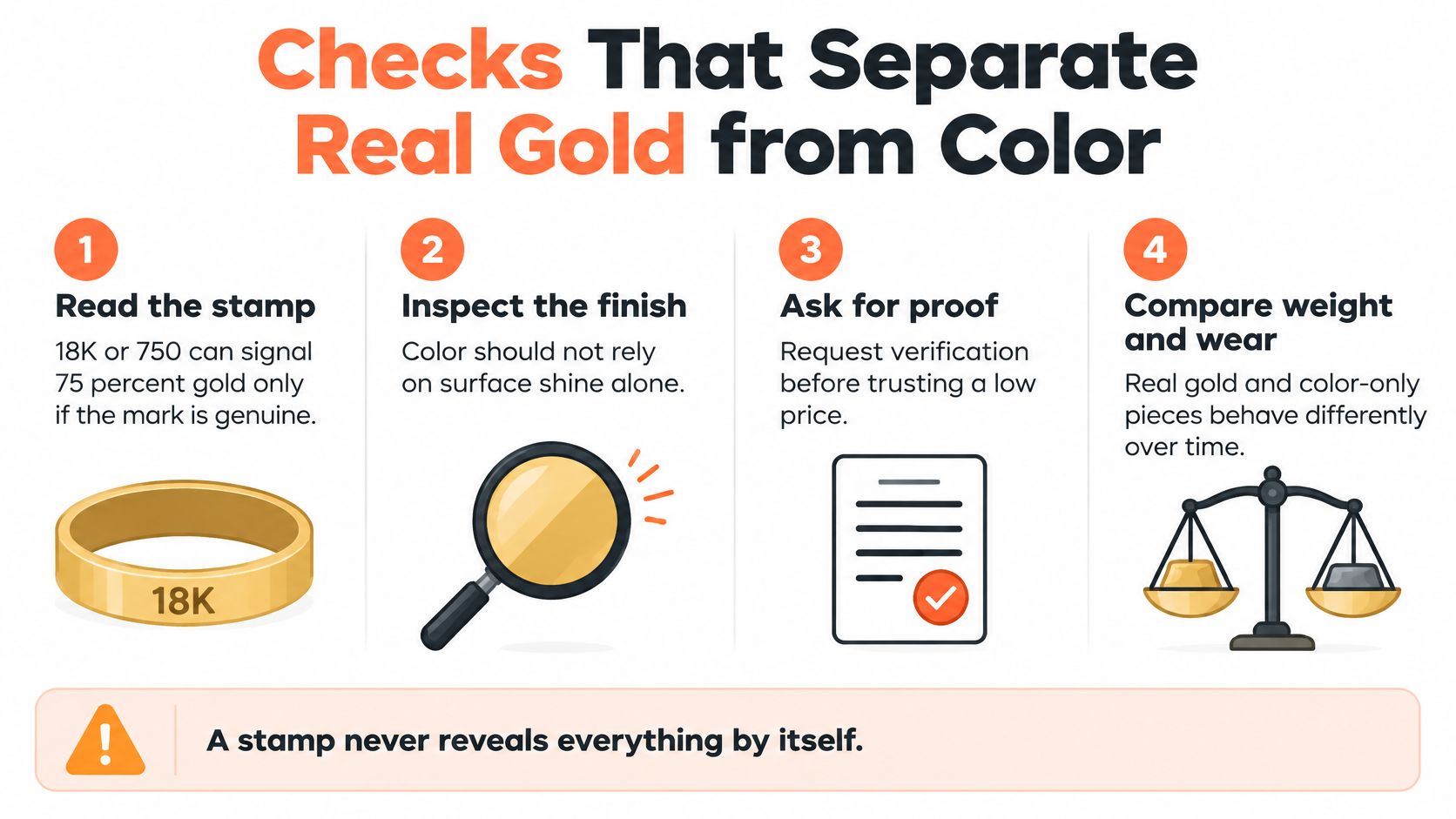
Read the claim, then test its limits
What each gold check can and cannot prove
Purity stamps express a claimed grade, not independent proof; DermNet's jewellery allergy guidance also explains why appearance alone cannot reliably establish composition and why worn plating can expose allergenic metals.
| Check | A pass suggests | It cannot prove |
|---|---|---|
| Stamp 14K or 585 | Claimed gold-alloy grade if authentic | That an assay office applied the mark |
| Stamp 18K or 750 | Claimed gold-alloy grade if authentic | What metal sits under plating |
| Stamp 24K or 999 | Claimed high-purity gold if authentic | That the soft pendant suits daily chain wear |
| Color or magnet test | Only a rough screen | Real composition, because color is easy to imitate |
| Independent assay | Metal content when the price justifies it | How long a plated finish will last |
| Supplier specification | Stated base metal, karat, and solid, filled, or plated | That the claim matches the piece without comparing it to the mark |
Compare the stamp with the paperwork under a loupe. Then examine high-contact areas, including the bail, chain junctions, and clasp, for exposed substrate or uneven finish.
Color, hand weight, and magnet response are weak screens. Hollow construction changes how a piece feels, many base metals aren't magnetic, and clasp components can behave differently from the pendant. None of those observations establishes the composition of the entire necklace.
Verify value and disclose care
For a meaningful solid-gold purchase, commission an independent assay suited to the construction. Tell the tester if plating is suspected, because a surface-focused result needs careful interpretation. Use this guide to testing gold purity to prepare questions rather than improvising destructive tests on saleable stock.
For fashion pieces, obtain a written specification naming the base metal, layer grade, construction, available plating-thickness information, and care requirements. Don't infer nickel-free or hypoallergenic from a gold-colored finish.
Give plated pieces a clear care line: remove before swimming, applying perfume, and sleeping; wipe gently and store separately. Sweat, water exposure, cosmetics, and repeated friction make care relevant to the purchase.
Affordable plate isn't a failed version of solid gold. It's a different product, and it can be the better choice for trend retail when its limits are visible before checkout.
Buy Construction and Publish Compliant Listings
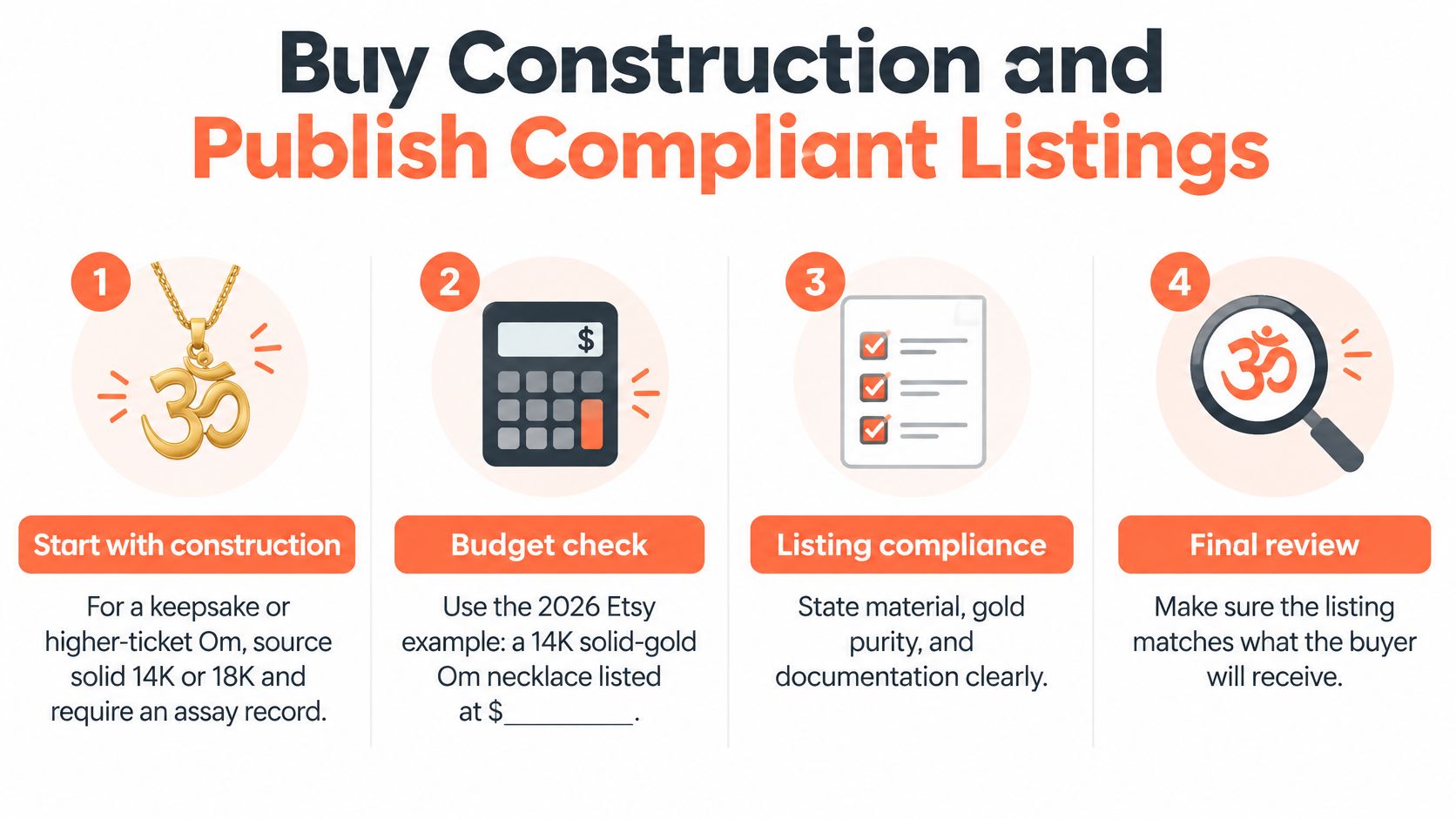
Start with the construction decision, then choose the keyword. For a keepsake or higher-ticket Om necklace, source a documented everyday solid-gold alloy and require an assay record tied to the product. For impulse purchases and social-commerce stock, plated or gold-filled construction works, provided the material specification is complete.
Keep marketplace prices in perspective. In 2026, Etsy's Om gold chain marketplace page showed a necklace described as 14K solid gold at $35.99, marked 20% below $44.99. A single listing tells you what one seller charges. It says nothing about authenticity, wholesale cost, or whether another supplier can match that construction at that price.
Put the material into the purchase order
Record the pendant and chain specifications separately, including construction, stated grade, base metal where relevant, finish, dimensions, and documentation. Attach the approved sample photographs so your receiving team compares the delivered necklace against images and measurements rather than a product name. When the shipment arrives, check high-contact points against the sample before the stock goes live.
For solid-gold sourcing, the wholesale gold buying guide provides a useful purchasing starting point. Attach the acceptance criteria to the order itself so they survive staff changes and lost chat threads.
Affordable plated necklaces belong in a different budget comparison. Our Minimalist Irregular Bean Shape 18K Gold Plated Titanium Steel Necklace is $1.07; the Fashion 18K Gold Plated Good Luck Letter Necklace Titanium Steel Short Clavicle Chain for Men is $1.57; and the Luxury Minimalist Butterfly Sandblasted Titanium Steel Necklace 18K Gold Plated Irregular Pendant Choker is $2.91. None is an Om product or a solid-gold comparison. The point is that disclosed construction should set the budget; gold color alone proves nothing about value.
Write the title without hiding the material
The FTC Jewelry Guides materials require marketers to describe gold quantity, fineness, plating, and application method accurately, and on a solid gold-alloy piece the karat designation must immediately precede the word Gold at equal prominence. A plated title names the actual material, as in "gold-plated brass Om pendant necklace." For the full karat and fineness wording rules, apply the grade rows from the comparison section above.
Use the publication workflow as a final review.
What a compliant listing states
| Listing element | What to publish | What to drop |
|---|---|---|
| Title | Karat or plating term directly beside the word gold | Bare gold on plated or gold-tone pieces |
| Cover photo | Centered Om at the 383:204 ratio | Framing that clips the symbol or bail |
| Material line | Named base metal and layer grade | Hypoallergenic claims inferred from the finish |
| Description | Care instructions and construction details | Disclosures pushed to the bottom of the page |
Approve the crop before publishing
Prepare the cover image at 383 by 204 pixels, or a larger size with the same 383:204 ratio; Shopify's media-editor guidance explains that display areas can crop images to fit their assigned proportions. Center the Om and leave margin around the pendant and chain. Then preview the actual placement, because the template can clip the symbol, clasp, or chain ends even when the uploaded file looks complete.
Once the material facts are correct, use Outrank's a seller's guide to marketplace optimization to refine search relevance and product-page organization. Optimization earns its place after the listing is accurate: it raises the visibility of claims you can already defend.
Write the construction into the purchase order, match the received piece to its grade row, approve the centered crop, and only then publish.
JewelryBuyDirect offers wholesale jewelry for boutiques, marketplace shops, and social-commerce assortments, including clearly identified plated styles for affordable fashion ranges. Visit JewelryBuyDirect to compare material descriptions and build your shortlist, then approve each Om necklace against a written construction specification before you list it.