





Jennifer Lopez | Wed Oct 28 2026
How to Judge High Quality Cubic Zirconia Jewelry in 2026
Stop buying cubic zirconia on sparkle alone. That's the popular advice, buy the brightest stone and pay extra for a higher letter grade, and it's exactly how boutiques end up with returns for missing stones, worn plating, and irritated skin. If you're sourcing high quality cubic zirconia jewelry for resale, I would judge the setting, metal, and paperwork first, then judge the stone.
Cubic zirconia has been built for scale from the start. The GIA history of cubic zirconia notes that commercial diamond imitation CZ entered the market in 1976 and estimated output reached approximately 60 million carats by the end of 1980. That scale gives you calibrated sizes and repeatable cuts, but it doesn't guarantee a durable ring, earring post, or clasp.
The Quality Scorecard for Cubic Zirconia Jewelry
High quality isn't one grade. It's a set of seven checks you can repeat on every sample, every reorder, and every supplier. A piece can score well on fire and still fail as a product because one loose prong, one thin plated edge, or one missing nickel test creates the complaint your customer remembers.
Cut matters because it's what the shopper sees first. Look for symmetrical facets, a centered table, and bright, even flashes when you turn the piece under daylight. Clarity is next, and I judge it at 10x for a simple reason. A stone that's eye clean on a white card is usually clean enough for fashion and bridal inspired assortments, while any visible black spot, bubble cluster, or cloudy zone is a downgrade before you even price it.
Score the whole piece not just the center
Color should read colorless against white paper, with no yellow or grey drift between stones in the same batch. That's critical for tennis bracelets, halos, and pairs, where one off color stone breaks the pattern. If you're training staff on visual matching, you can compare silver horse pendant designs as a side by side exercise in how metal tone and finish change what a shopper perceives, even when the design category is different.
| Criterion | What good looks like | Red flag | Quick check |
|---|---|---|---|
| Cut | Symmetrical facets, centered table, bright even fire | Lopsided facets, dull center, doubled reflections | 10x loupe, face up under daylight |
| Clarity | Eye clean at normal distance, no visible black spots or haze | Cloudy zones, dark inclusions, rough girdle | 10x loupe with the stone tilted |
| Color | Colorless against a white card, consistent across the batch | Yellow or grey tint, stones that differ within one pair | Side by side against a colorless reference |
| Setting | Prongs tight and even, stones seated flush | Glue set stones, rocking stones, uneven prongs | Gentle tweezer press on each stone |
| Metal and plating | Base metal named, plating thickness given in microns | Vague gold look claims, worn edges on the sample | Ask for specs, inspect high contact points |
| Durability | Matched to wear, scratch resistant, impact aware | Sold for daily wear with no care guidance | Confirm intended use on the listing |
| Documentation | Test reports for plating, nickel and lead | No reports offered for the SKU | Request reports before the first order |
Setting, metal and plating, durability, and documentation carry the same weight as the first three rows. Don't average a bad score away. A supplier who can't name the base metal or won't provide a test report for a specific SKU hasn't given you enough to make a confident listing.
Practical rule: Score every row before you decide, because a weak prong or thin plating can outweigh a perfect stone.
Use the scorecard on samples, not catalog photos. Photographs hide girdle chips, uneven seats, and plating that's already thin at the edges. Your sample tray tells the truth faster.
How to Inspect Cut, Clarity and Color by Hand
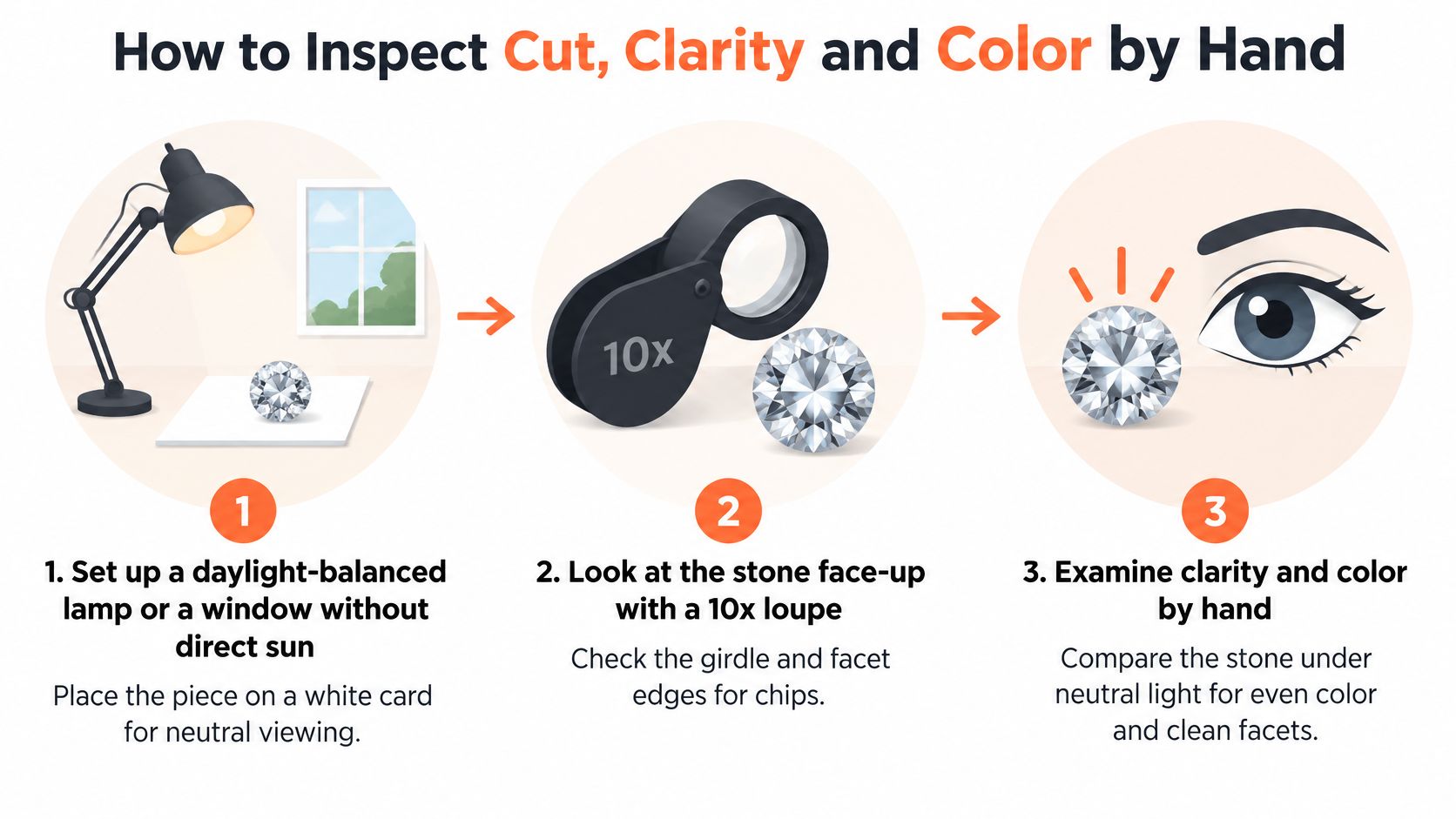
A bright, clean-looking cubic zirconia can still be a poor piece of jewelry. Inspect the stone under consistent conditions, but judge it alongside the setting and finish: a lively sparkle will not compensate for a loose seat or plating that wears at the edges. Use neutral light, a white card, a 10x loupe, tweezers, and a known colorless reference stone. Repeat the same checks on each sample so supplier comparisons stay useful.
Five checks in order
- Set up neutral light: Use a daylight-balanced lamp or a window without direct sun, with the piece on a white card. Warm display lights and direct sun can flatter a weak stone or mask a grey or yellow cast. Keep the setup consistent from sample to sample.
- Check for damage at 10x: View the stone face up, then inspect the girdle and facet edges for chips, nicks, and rough spots. CZ handles scratches better than sharp knocks, so damage near a prong contact point is a concern for setting and shipping. Reject a sample with chips where the prongs will press.
- Turn the piece slowly: Watch the reflections move across the table. Uneven dark patches, a pale central window, doubled reflections, a tilted outline, or an off-center culet can make a stone look tired even when it is clean. Check from several angles rather than relying on one face-up view.
- Compare at an angle: Tilt the stone toward the white card and place it beside your colorless reference. Haze and dark spots may be easier to see from the side, while tint is clearer against white. For pairs or multi-stone pieces, line the stones up together; inspecting them one at a time can hide a mismatch.
- Judge fire in context: Compare the stone with one of the same millimeter size, then view it under ordinary room light as well as your lamp. CZ is dense and produces strong rainbow fire. A noticeably light stone for its size may be glass or another imitation, while excessive rainbow flashes can look cheap on a large center stone intended to read as bridal.
What to record
Note the millimeter size, chips, color variation, and matching issues against the SKU. Keep an approved physical sample sealed for reorders. Comparing later production with that sample gives you a practical reference that memory and catalog photos cannot provide.
For a mixed assortment, tailor inspection notes to each material rather than applying the same criteria to every piece. The Bohemian Minimalist 925 Sterling Silver Teardrop Baroque Pearl Earrings Asymmetric Design is listed as Stud Earrings for Women, with a Bohemian, Minimalist style and 1 variant. Pearl, silver, and CZ call for different checks, so keep each product's inspection notes specific.
Judging Setting, Metal and Everyday Wear
A bright CZ can still become a poor purchase if its setting loosens, its metal bends, or its plating wears through. Those failures drive complaints after sale, so inspect the parts that touch skin and take daily wear before judging sparkle. Look closely at joins, edges, and moving parts, not only the polished face shown in a product photo.
Start with prongs. They should be even, secure, and flush over the girdle, with the stone level and no rocking under gentle pressure from tweezers. A loose prong risks stone loss; a raised one can snag knitwear or catch hair. Before choosing a ring head for everyday wear, compare wholesale ring setting styles and construction details. The design affects how well the stone is held and how much the setting is exposed to knocks.
Glue and pavé need stricter rules
Treat glue set stones as a repair risk. Adhesive can suit inexpensive fashion jewelry worn occasionally, but avoid glue set CZ for daily wear rings or children's items that are likely to be pulled or washed often. Heat, water, and ultrasonic cleaning can weaken many adhesives. A lost stone can cost more to replace than the margin on the sale.
Pavé and micro pavé need close inspection. Use a loupe to check each seat for even setting and consistent height, and look for gaps in the metal between stones. The Justop Jewelry guide to making cubic zirconia jewelry last notes that CZ resists scratches but can chip under hard impact, while glue set stones and closely packed pavé settings are more vulnerable to stone loss. A missing stone in a halo can make the entire piece look damaged, so set a tighter acceptance standard for pavé than for a solitaire.
Metal, plating and honest wear claims
Get the base metal and plating thickness in microns in writing. Thin flash plating tends to wear first on ring shank edges, earring posts, pendant bails, and clasp tongues. Inspect these high-contact areas on the sample and check for uneven coverage or exposed base metal.
Match the product claim to its intended use. CZ rates about 8 to 8.5 Mohs (Justop Jewelry guide to making cubic zirconia jewelry last), so it resists scratches better than many fashion stones, but it can still chip under impact. An office ring, an evening earring, and a bracelet worn at the gym need different care and wear descriptions. Use specific wording such as occasional fashion wear, daily office wear, or not suitable for high impact activity. Support stronger durability or safety claims with documentation.
Give customers practical care instructions. Keep lotions, perfume, and chlorine off the jewelry, store pieces separately so metal edges do not scratch stones, and avoid steam or ultrasonic cleaning on glue set or pavé designs. You can adapt this advice on safe storage for gold plated jewelry for care cards, adjusting it to the piece's base metal and setting method.
A brilliant stone in a weak mounting becomes a return with good photography.
Test Reports and Thresholds to Request Before You Buy
A bright, well-cut CZ can still become a poor product if its metal or finish fails in wear. Ask for test reports tied to the SKU and the materials used, not just a polished sample or a general certificate. That helps separate stone appearance from the risks in plated bases, posts, chains, and clasps.
Ask which tests apply to the metal, plating, and setting materials in each SKU. The SGS jewelry testing services overview identifies tests covering REACH Annex XVII limits for nickel release, lead and cadmium content, corrosion, tarnishing, durability, allergens, and California Proposition 65 compliance. Not every fashion accessory needs every test, but each omitted test should have a clear reason based on the product and destination market.
Thresholds you can put in a purchase order
For U.S. adult jewelry, the SGS summary of ASTM F 2999-13 identifies sterling silver as at least 925 parts per 1,000, or 92.5% silver. It lists lead limits of 6.0% for electroplated metal, 1.5% for unplated metal, and 200 parts per million for plastic or rubber materials, including acrylic and plastic stones.
| Requirement | Threshold or scope | Why it matters for CZ |
|---|---|---|
| Sterling silver (ASTM F 2999-13, US) | At least 925 parts per 1,000 (92.5% silver) | The 925 stamp should match the tested metal |
| Electroplated metal, lead (ASTM F 2999-13, US) | Up to 6.0% lead | Relevant to CZ pieces with plated bases |
| Unplated metal, lead (ASTM F 2999-13, US) | Up to 1.5% lead | Relevant to unplated alloy components such as clasps |
| Plastic or rubber parts, lead (ASTM F 2999-13, US) | Up to 200 ppm lead | Covers acrylic and plastic stone settings |
| Nickel release (REACH Annex XVII, EU) | Limit of 0.5 µg/cm² per week for prolonged skin contact | Applies to components worn against skin |
| California Proposition 65 (US) | Warning rules for listed chemicals | Relevant to U.S. listings |
These categories matter because a single CZ design may combine a stone, plated or unplated base metal, and components from different material lots. Put the applicable category and destination-market requirement into the purchase order. Require results for the relevant components rather than accepting an average that hides differences between a clasp, chain, or post.
How to review a report
Check that each report names the SKU, material tested, lab, and test date. It should reflect the current materials and process: a supplier can change a plating bath, alloy supplier, or earring-post vendor without changing the product photo. A lead result for plating does not establish nickel-release compliance for an earring post, so match the test scope to the parts in the item.
Use the scorecard's documentation row as the decision point: incomplete reports mean the SKU is not ready to order at scale. Resolve gaps before placing a larger purchase order, while the paperwork can still be matched to the exact materials and product.
Labels and Claims That Need Proof
A brilliant CZ stone can still be a poor product if the metal, setting, or label disappoints. Claims such as hypoallergenic, nickel free, and 5A need support from details that match the finished piece, not just the stone.
Treat 5A and AAA as the seller's own grading scale unless the supplier documents its basis. Those labels do not provide a universal standard for comparing factories. Ask how the grade is assigned, request unedited photos under neutral light, and compare them with a physical sample.
Separate stone haze from metal problems
Haze on CZ is usually a surface or residue issue rather than chemical breakdown. Soap, lotion, and handling can leave residue, while micro scratches can reduce sparkle and will not disappear with cleaning. The Alibaba comparison of zircon and cubic zirconia offers one reference point on surface haze and wear. Gentle cleaning may clear residue, but it cannot reverse abrasion or secure a loose stone.
Discoloration and irritation call for a closer look at the chain, posts, clasp, alloy, and plating. Check those parts as carefully as the stone: a loupe can reveal worn plating around edges and joints, while the product specification should identify each component that touches skin. A more expensive stone grade will not correct a metal or finish problem.
For sensitive-skin assortments, use guidance on what hypoallergenic jewelry means for material claims alongside the test reports for the actual SKU. Before listing a piece, confirm which component the report covers. A claim that applies to one metal part may not describe the posts, chain, or clasp.
| Claim on the label | What it usually means | Question to ask the supplier |
|---|---|---|
| 5A or AAA grade | Seller's own scale, with no universal standard | What is the grading basis, and can you send unedited photos? |
| Hypoallergenic | Marketing term, not a test result in most markets | Which nickel or allergen test supports this claim? |
| Nickel free | Nickel release is below a stated limit, if it was tested | Is there a release test report for this SKU? |
| Stainless steel | Steel base, often with no plating needed | Which grade is used, and is it the same across colors? |
| Gold plated | Plating over a base, thickness varies widely | What is the plating thickness in microns, and what is the base metal? |
Stainless steel identifies the base material; silver-tone versions may need no plating, but colored versions can use coatings that should be disclosed. Gold plated alone tells shoppers little about durability. State the base metal and plating thickness in the product sheet, where buyers can check the details before ordering.
Clear labels set realistic expectations about wear and skin contact. Disclose what the supplier can document, and leave out claims that the product specifications or reports do not support.
Wholesale Sourcing Checklist and Landed Cost Math
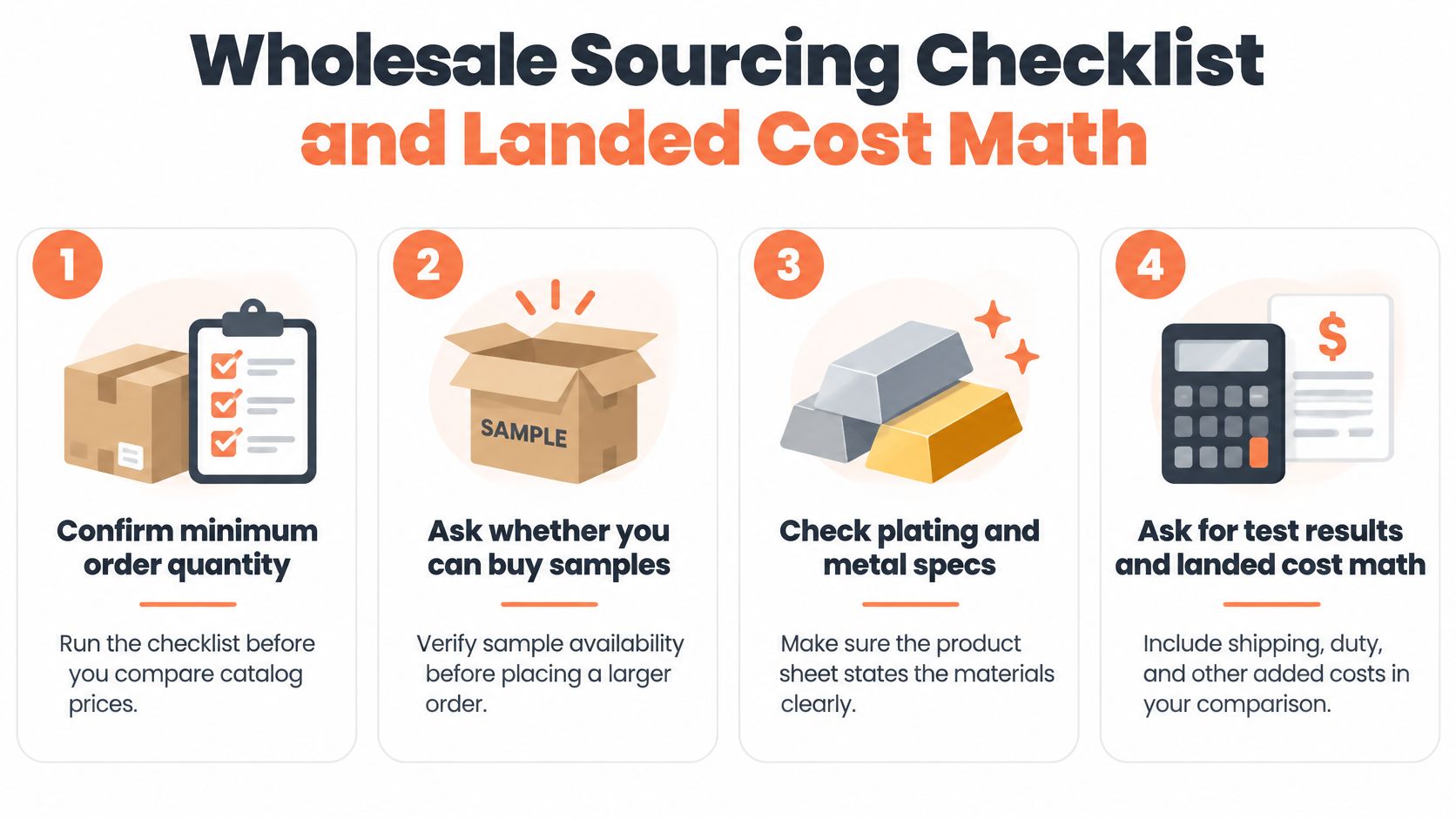
Price on landed cost, not the invoice. A low catalog price stops looking low after freight, packaging, marketplace fees, and replacement stock for pieces that fail inspection. Run your quality checklist first, then run the math on SKUs that passed.
Confirm before you compare prices
- Order terms: Confirm minimum order quantity, sample availability, lead time, and whether repeat orders come from the same batch so colors match.
- Material specs: Get base metal, plating thickness, stone size in millimeters, and setting method written into the product sheet.
- Compliance: Request test reports for each SKU and confirm labeling requirements for your destination market.
- Failure terms: Check return, damage, and missing stone terms before you need them, including who pays return freight.
Platforms such as JewelryBuyDirect offer wholesale CZ assortments alongside other fashion accessories, which can simplify consolidation, but you should still apply the same sample and document checks by SKU. For category planning, compare your shortlist against wholesale cubic zirconia jewelry sourcing options and your own sell through data by shape, metal color, and price band.
Worked example with illustrative figures
The Grow Your Boutique wholesale jewelry pricing guide estimates fashion jewelry commonly supports a 2.5x to 3x markup on landed cost, equivalent to roughly a 60% gross margin, while packaging can add approximately $0.20 to $1.50 per piece. Landed cost in that guide includes the wholesale unit price plus inbound freight and per unit packaging such as display cards, poly bags, gift boxes, or pouches.
| Line item | Amount |
|---|---|
| Wholesale unit price | $4.00 |
| Inbound freight per piece | $0.60 |
| Packaging per piece | $0.80 |
| Landed cost | $5.40 |
| Shelf price at 2.5x landed cost | $13.50 |
| Shelf price at 3x landed cost | $16.20 |
Say a boutique buys a CZ pendant for $4.00, pays $0.60 freight per piece, and adds $0.80 for a display card and pouch. The piece lands at $5.40, so a 2.5x to 3x markup gives a shelf price between $13.50 and $16.20. Those are illustrative figures for the math, not a quote for any specific SKU.
Recheck packaging on every reorder. A gift box upgrade that helps holiday conversion can reduce margin on a low price earring if you keep the same shelf price. I would review landed cost whenever freight, plating spec, or packaging changes, not once a year.
Confirm Your First Supplier Order
Start with a sample set of five to ten SKUs from the categories you plan to sell. Include a pavé piece, a ring, and an earring with a post. A simple solitaire pendant alone will not show how the supplier handles different settings and styles.
Use the inspection steps above, then compare each sample with its test report. Order a second batch only for approved SKUs, and confirm the batch reference so the colors stay consistent.
For product photos, use a clean white background and keep the jewelry and any text clear of the edges. Save a high-resolution master file for channel-specific crops. The Pixofix marketplace image guidelines notes that Amazon and Walmart commonly use square images, Etsy uses 4:3, and some international marketplaces require portrait images in 3:4. Cropping can otherwise cut off the stone or branding.
Order samples and score them before increasing your commitment.
Browse high quality cubic zirconia jewelry and affordable fashion accessories for your boutique, marketplace shop, or live selling assortment at JewelryBuyDirect. Choose samples across rings, earrings, and pavé styles, then build your first reorder from pieces that pass your checks and make sense at landed cost.