





Jennifer Lopez | Thu Oct 29 2026
Gold Plated Jewelry Tarnish: Causes, Fixes and Durability
Keeping gold plated jewelry dry helps, but it won't save a thin coating from friction. Most care advice treats water as the main enemy and stops there. If you're handling returns in a boutique, answering marketplace complaints, or buying a ring you'll wear daily, that advice misses the main failure point, which is how long an extremely thin gold layer can protect the metal underneath it.
Why Gold Plated Jewelry Tarnishes When Gold Does Not
Gold rarely tarnishes on its own. When customers report gold plated jewelry tarnish, the dark or dull color almost always comes from the metal under the coating, or from contamination sitting on top of it. The gold itself is usually the most stable part of the piece.
A plated ring works like a thin coat of varnish over a wood table. Scratch the varnish, wear an edge thin, or leave pores in the finish, and the wood underneath stains. Nobody blames the varnish for the stain color. Plated jewelry fails the same way, except the protective layer is far thinner than a human hair and has to survive skin, clothing, desks, clasps, and other jewelry.
Two Ways the Barrier Fails
Friction removes gold. Constant rubbing physically strips the coating until copper, brass, or another base metal shows through.
Pores expose the base. Even an unworn coating can carry microscopic openings that let sweat and moisture reach the metal underneath.
Each failure leaves a different signature. Wear that starts on high-contact spots like ring undersides and bracelet edges points to abrasion. Darkening that spreads beneath a surface that still looks intact points to the base metal corroding below, with its reaction products migrating back toward the top. Reading where the color change begins tells you which mechanism is at work before you spend money on care products or a replating quote.
A well-made plated piece can look bright for months of daily wear. Thin flash plating can show wear much sooner, even if the owner never gets it wet.
That gap is why two pieces with the same gold color can age so differently. A pendant worn twice a month faces almost no abrasion. A ring worn at a keyboard, in the gym, and during handwashing takes constant contact. Boutique owners, marketplace sellers, and daily wearers all need the same starting question. How thick and continuous is the coating, and how much rubbing will it take?
Plating Thickness Tiers and How Long They Last
Start with the tier, not the karat label. The UPA plating thickness guide states that 1 micron equals 0.001 millimeter, distinguishes decorative flash below approximately 0.175 microns from standard plating around 0.5 to 1.0 micron and heavier coatings of 2.5 microns or more, and notes that a 0.5-micron layer may begin visibly dulling after months of daily wear while a 2.5-micron layer can resist fading substantially longer.
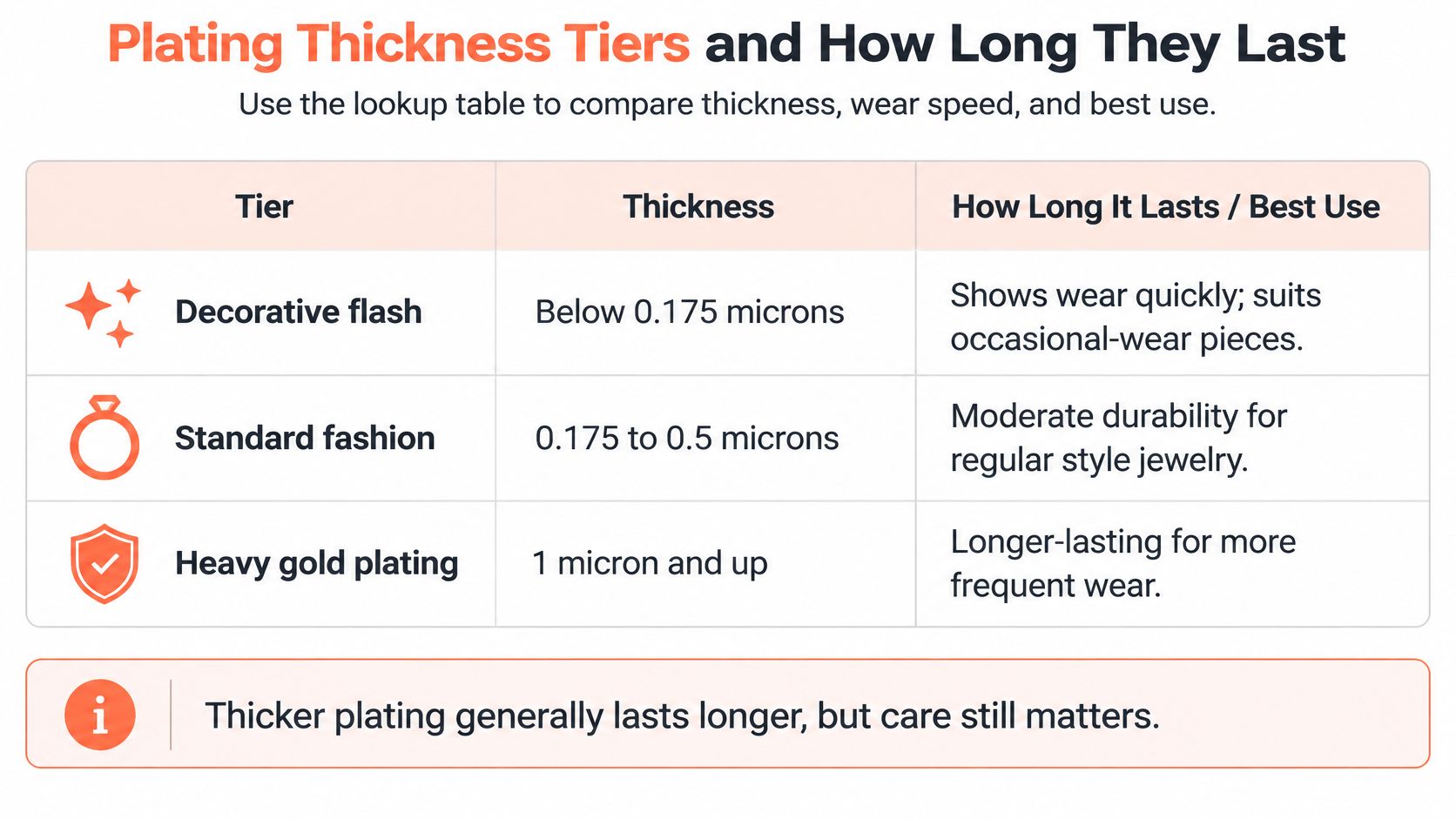
| Plating tier | Thickness | Typical wear outcome | Best fit |
|---|---|---|---|
| Decorative flash | Below 0.175 microns | Visible wear appears quickly, mainly on occasional-wear pieces | Fashion pieces worn a few times a month |
| Standard fashion plating | 0.5 to 1.0 microns | A 0.5-micron layer may begin to dull after months of daily wear | Everyday pieces with moderate skin contact |
| Heavy plating (vermeil class) | 2.5 microns or more | Resists fading substantially longer under comparable wear | Higher-value daily wear, gifts and rings |
How to Read the Tiers
Flash plating sells color, nothing more. It can look perfect in a product photo and still wear quickly at a clasp or edge. Sell it as occasional wear, and customers won't judge it against a daily ring standard.
Standard plating is the broad middle. I treat roughly 0.5 to 2.5 microns as the workable fashion band, which means the thin end needs much tighter expectations than the top. A 0.5-micron coating and a 2.5-micron coating can sit under the same vague product description while performing very differently, so the micron figure matters more than any marketing word attached to it.
Heavy plating buys time. The vermeil class sits at the top of this band, and our guide to what vermeil jewelry is covers how that category differs from ordinary plating. Even a heavy layer will eventually thin at high-contact points.
An 18K or 24K label won't make a thin coating last longer. Karat describes the gold alloy. It says nothing about how much of it the supplier applied. A lower-karat piece with a thicker, more uniform layer can outlast a higher-karat flash piece, so I'd always ask for microns before paying more for a karat number.
For a concrete check, take Bohemian Geometric Earrings for Women with Copper Base Plated in 18K Gold and Enamel-Set Zirconia, offered in 3 variants with the copper base and 18K gold plating named in the product title. The listing states karat and base metal but no micron figure, which is the gap worth closing before pricing it as everyday stock. Earrings generally see less rubbing than rings or bracelets, so a mid-tier coating can be a reasonable match here, provided the supplier can put a number in writing.
Practical rule: Match the tier to contact frequency. Rings and bracelets need the heaviest tier you can source, pendants and earrings can carry a lighter one.
When a supplier only says "premium" or "long-lasting," the table gives you one follow-up. Ask for the micron figure, in writing, and slot the piece into its tier yourself.
What Really Causes the Dark Spots
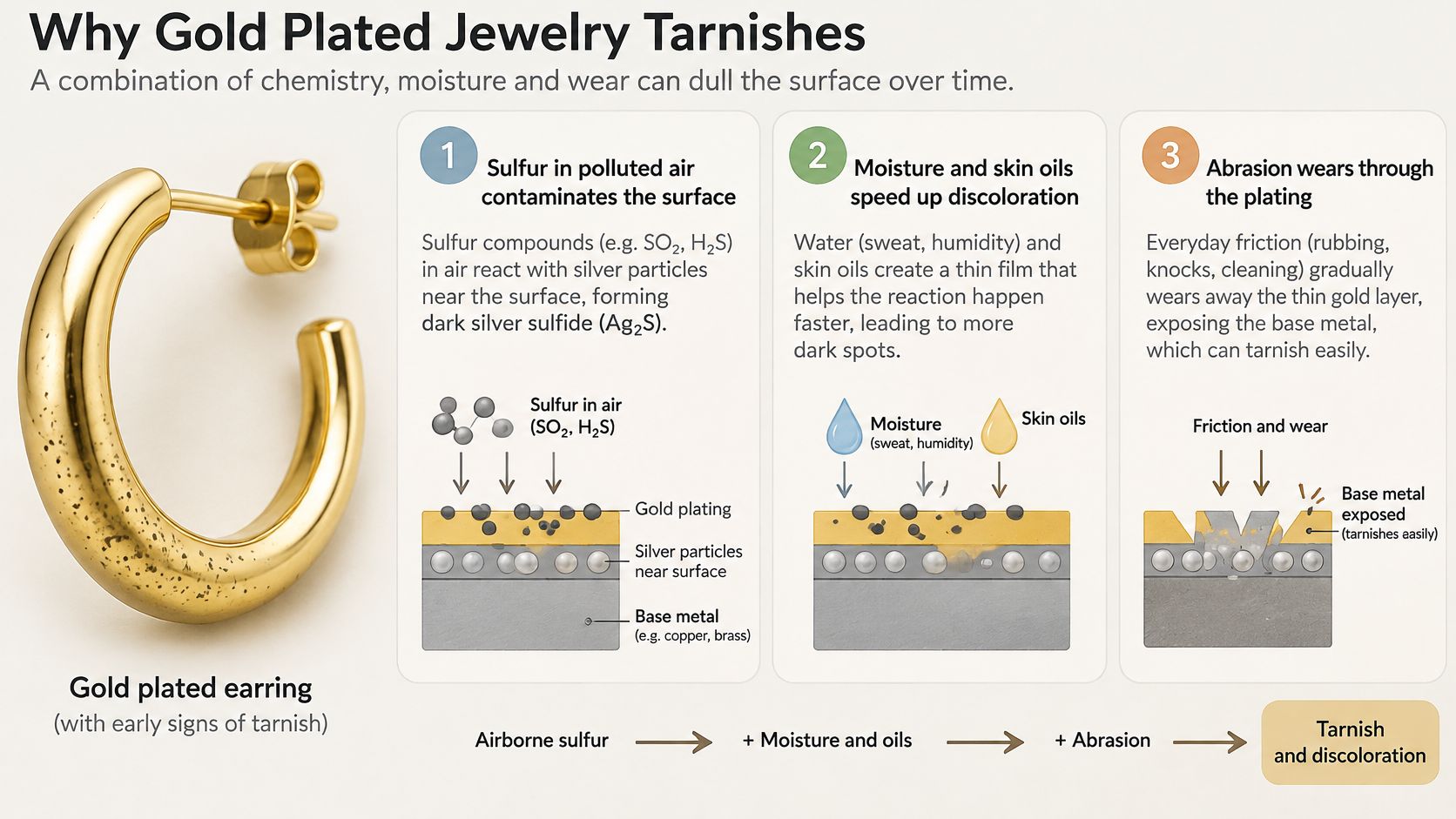
A GIA investigation of tarnish spots on high-purity gold jewelry examined apparently tarnished 99.9% gold jewelry, detected silver and sulfur in the discoloration, and found the sulfur confined to a layer less than 12 nm thick. The proposed mechanism was sulfur-containing air pollution reacting with silver particles left on or near the surface.
Contamination Sitting on the Surface
That finding changes how you judge a spotted piece. Polishing residue, handling contamination, or a silver-rich underlayer can mark a brand new item while the gold layer stays chemically intact. If near-pure gold can show sulfur-driven spots, a thin plated layer certainly can.
This also explains why darkening so often appears as isolated spots instead of an even film. The reaction needs a specific trigger at a specific site: a residue deposit, a pore, or a break in the coating.
Sulfur Sources in Storage and Handling
Polluted air is only one supply line. Rubber, paperboard, cosmetics, and household chemicals all release sulfur compounds that reach a stored or worn piece, and a necklace kept in a rubber-lined box or on a cardboard display card sits next to the source for weeks at a time.
For retailers, this is an inventory issue as much as a customer care issue. Stock that darkens on the shelf has never been worn, so friction can't explain it. Low-humidity storage, sulfur-reduced packaging, and distance from rubber and paperboard remove the trigger before the piece reaches a buyer.
Base Metal Reaching Through Pores and Scratches
The third route starts underneath. Moisture slips through pores and scratches, reaches copper, brass, or zinc, and corrosion products migrate outward until they show on the surface. The gold hasn't failed chemically. The coating is too thin or too discontinuous to seal the reactive metal below.
Three implications follow from these mechanisms:
- A spotted new piece isn't automatically worn out. Residue or a silver-rich underlayer can mark it before first wear.
- Under magnification, a scratch reads as a line and a pore reads as a pit. Linear damage points to abrasion in wear, while scattered pinpoints point to a coating that left the factory porous.
- Aggressive polishing backfires. It strips the decorative layer you're trying to save and widens every weak point.
Read the spot before you scrub it. Surface contamination can often be lifted gently, while corrosion pushing up from below is a coating problem that no cloth will fix.
Reading the Clues Tarnish Leaves Behind
Location tells you more than color alone. Use this diagnostic table first, then confirm with the wear history before you decide whether you're looking at normal abrasion, bad storage, or a coverage defect.
| Visible clue | Likely cause | Where to inspect |
|---|---|---|
| Yellow fading at ring edges or clasp | Abrasion has removed the gold layer | Contact points on rings, bracelets and clasps |
| Green or brown tint on skin or metal | Base metal reacting through pores | Whole piece, especially under pendants |
| Dark spots after storage in rubber or paper | Reactive sulfur from packaging | Storage box, pouch and tray |
| Pink or copper-toned patches | Alloy exposed where the coating is thin | Clasp interiors and ring undersides |
| Localized failure at edges | Insufficient coverage or poor adhesion | Edges, raised lettering and chain links |
Why Location Separates Wear From Defect
Industry technical discussion on plating porosity, diffusion, and barrier layers makes the point that thickness alone isn't sufficient, because porosity, diffusion, adhesion, the base metal, and an intermediate barrier layer can all determine whether discoloration appears. In practice, that means a ring underside fading before the top usually shows friction and sweat at work, not a bad batch. The underside rubs desks, handles, and other fingers all day.
Failure concentrated at sharp edges, raised lettering, or clasp interiors on a lightly worn piece points the other way. Those are the hardest areas to plate uniformly, so early breakdown there suggests thin coverage or weak adhesion. Green or brown tints spread across a pendant back suggest the base metal is reacting through pores, which is a continuity problem rather than simple abrasion.
The common mistake is treating water avoidance as a complete prevention plan. Rings and bracelets face far more friction than pendants or earrings, so identical care routines produce very different outcomes. A customer who kept a ring dry can still wear through it, and telling her she must have gotten it wet damages trust without fixing anything.
A Three Question Check for Any Complaint
- Where is the discoloration? Edges and undersides suggest abrasion. Broad tinting suggests pores. Spots after storage suggest sulfur.
- How often was it worn, and for what? Daily gym and keyboard wear explains fast edge fading. Occasional wear doesn't.
- How was it stored? Rubber, paperboard, or a humid bathroom points to packaging and environment, not the coating.
If a lightly worn piece fails at the edges while flat surfaces stay bright, suspect coverage. If a daily-worn ring fades underneath first, suspect friction.
Those three answers separate a wear problem from a coverage problem in most cases. Retailers who ask them before offering a refund or blaming care end up with cleaner supplier claims and fairer customer outcomes.
Daily Care Routine That Slows Tarnish
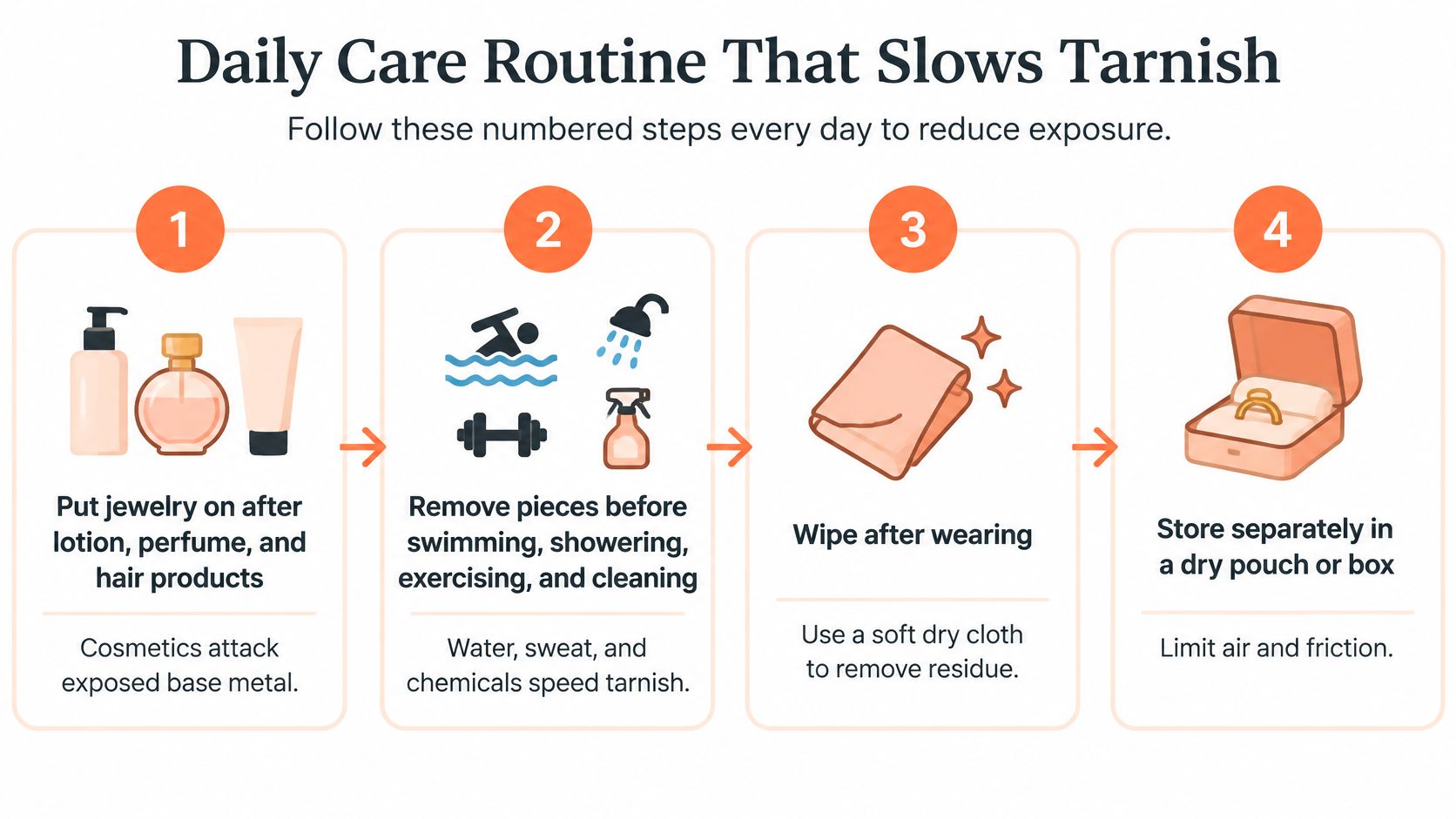
A pendant can survive a humid summer and still dull in weeks if perfume lands on it every morning. Care manages how fast the coating gets spent, and each step below removes one specific accelerant: chemicals reaching the base metal through pores, sulfur sitting against the surface, or friction grinding the edges and undersides.
The Six Step Routine
- Put jewelry on last. Apply lotion, perfume, and hair products first and let them dry before the piece goes on. Cosmetics attack exposed base metal at worn spots and leave residue that dulls intact areas. The common slip is spraying perfume over a necklace that is already on.
- Remove pieces before water, sweat, and cleaning. Take them off before swimming, showering, exercising, and housework. Sweat, chlorine, and household chemicals enter pores and reach the base metal. Rings and bracelets pay for skipped removals far faster than pendants or earrings, because friction stacks on top of the moisture. Wearing rings through gym sessions is the quickest way to combine both.
- Wipe after every wear. Use a soft, dry cloth and a light hand to lift sweat and skin oils before they sit against the coating overnight. A heavy hand turns the wipe into polishing, so keep the pressure gentle and the motion quick.
- Store pieces separately and dry. Use soft individual pouches or a lined box, and keep the storage spot out of humid rooms.
- Skip abrasive cloths and dips. Polishing cloths made for solid silver and chemical dips strip thin decorative layers. On plated jewelry, vigorous polishing is wear, concentrated into one sitting.
- Inspect high-contact areas monthly. Check ring undersides, clasp faces, bracelet edges, and chain links under good light. Early fading at one spot tells you to rotate the piece out of daily wear before the base metal shows, which stretches its wearable life considerably.
Store teams can run the same routine on inventory and print the short version on the care card: on last, off before water and workouts, wipe dry, store separately.
Keep chemicals, sulfur, and needless friction away from the coating.
Sell the routine as part of the product. A customer who understands the coating is thin by design treats it differently from the first day.
Cleaning and Restoring Tarnished Plated Pieces
Decide what's on the surface before you touch it. A thin film from skin oils or sulfur on an intact coating usually responds to gentle cleaning. Yellow edges or pink, copper-toned patches mean the gold is gone at those spots, and cleaning only makes the exposed base metal look worse.
Gentle Cleaning for an Intact Coating
- Mix mild soap and lukewarm water. A few drops of mild dish soap is enough.
- Dampen, don't soak aggressively. Use a soft cloth, or soak the piece for no more than a few minutes.
- Wipe gently, rinse, and dry completely. Rinse with clean water and finish with a soft dry cloth so no moisture sits in crevices.
- Skip the harsh tools. Ultrasonic cleaners, baking soda pastes, and commercial dips can strip thin coatings.
Our step-by-step guide to cleaning tarnished jewelry covers the same gentle approach for other finishes.
Where the coating has worn through, no polish restores the color, because the decorative layer itself has failed. The practical options are to accept the wear, ask a jeweler to assess re-plating, or replace the piece with a heavier tier matched to the wear pattern. For inexpensive fashion pieces, replacement is usually more practical than re-plating.
Store teams should inspect and photograph a returned piece, and note where the discoloration sits, before any cleaning. Cleaning first can erase the evidence that separates a documented coverage defect from a care problem. Offer exchange or credit for coverage defects, and keep care-related returns as a training record for staff.
When Tarnish Is Also a Skin Safety Question
A bright gold finish is not proof of a nickel-free build, and tarnish is not proof of danger. Appearance and skin safety are separate questions, and treating shine as a safety test fails customers in both directions.
What the Limits and Testing Show
A retailer guide to EU nickel rules for jewelry states that EU rules limit nickel release to 0.5 micrograms per square centimeter per week for prolonged skin contact and 0.2 for articles inserted into pierced ears, and that coated items require wear simulation before release testing. The same guide reports a study of 10 gold-plated earrings that detected nickel release in every sample, with values from 0.00032 to 10.0 micrograms per square centimeter and a median of 2.1, frequently exceeding the applicable EU limit.
Earrings deserve stricter scrutiny than necklaces or bracelets for a simple reason. Posts and wires sit inside pierced tissue, they face the lower threshold, and a coating that looks intact can still release nickel from beneath. Wear simulation matters because a brand new coating tests differently from one that has been rubbed and sweated on.
Our overview of nickel allergy and jewelry explains how those reactions present, which helps staff separate irritation complaints from appearance complaints at the counter.
What to Ask and What to Record
- Ask for documented test results. Material declarations and compliance testing mean something. The word "hypoallergenic" on a listing, on its own, doesn't.
- Treat green skin marks as a prompt, not a verdict. Check the base metal and plating condition before concluding anything about safety.
- Log irritation separately from discoloration. A faded bracelet and an itchy earlobe need different responses and different supplier conversations.
Act on documented testing, not on the look of the metal. Shine can't certify what's under the coating.
Specs to Demand When Sourcing Plated Pieces
The words on the listing won't protect your margins. The FTC Jewelry Guides notice retained an example requiring gold of at least 10-karat fineness and a minimum thickness equivalent to 7 millionths of an inch, or approximately 0.175 microns, of fine gold, so "gold plated" alone says little about durability.
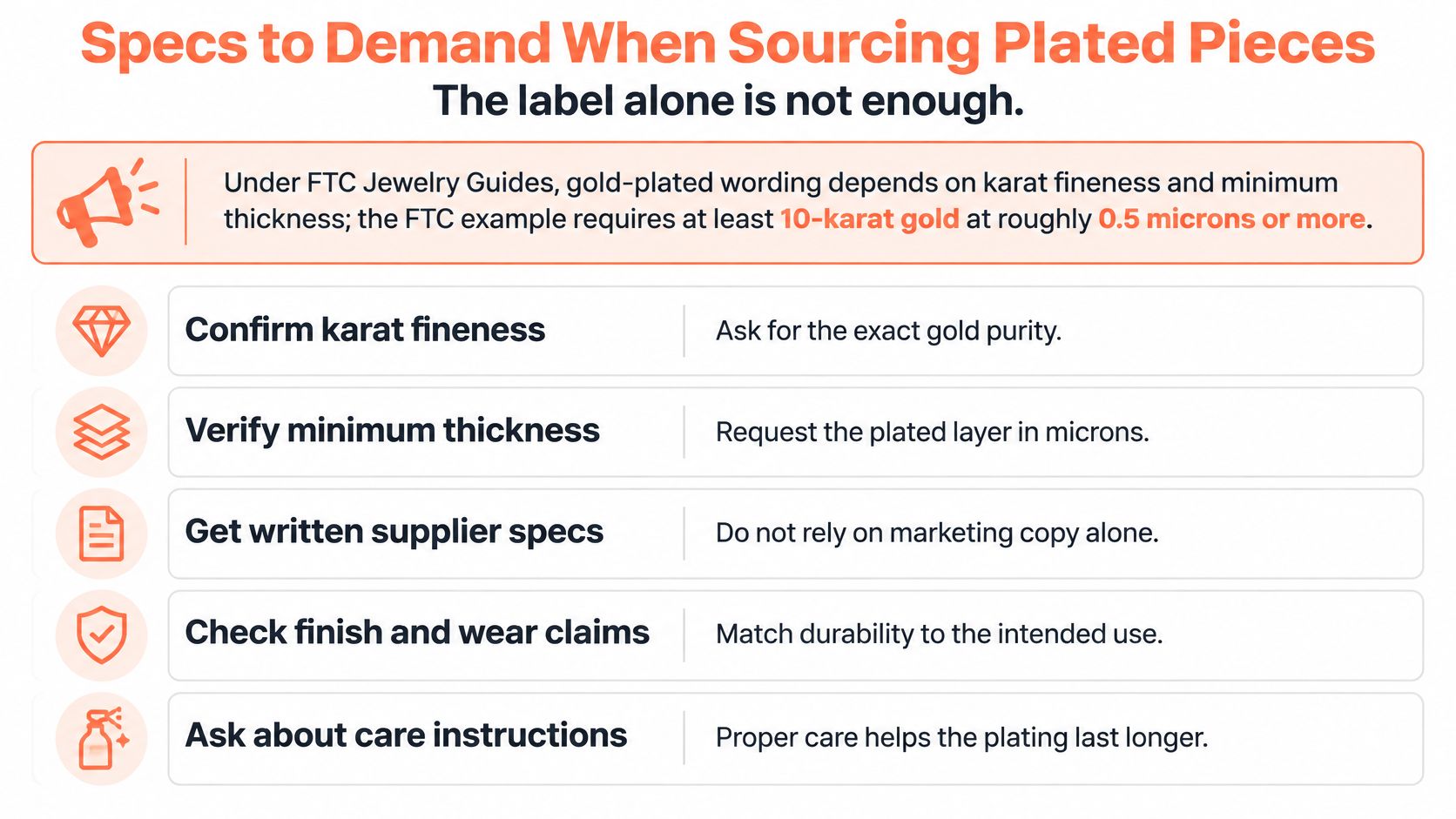
Request this spec sheet from every supplier:
- Plating thickness in microns, stated as a minimum across significant surfaces.
- Karat rating of the gold layer.
- Substrate alloy and any barrier layer.
- Thickness uniformity at clasps, ring undersides, and edges.
- Documented nickel release test results for earrings and skin-contact items.
Verify rather than trusting a bright sample, since shine doesn't prove uniform coverage. Inspect clasp interiors, chain links, and pendant edges, and ask whether the supplier can provide cross-sectional SEM/EDS lab reports for representative pieces, because exact thickness may require destructive analysis. Ask how surfaces are cleaned and prepared before plating, too. Extra thickness can't compensate for a poorly prepared substrate.
When you compare wholesale sources, including JewelryBuyDirect, send the same written spec request to each one. Compare the documents you get back, not the marketing copy.
Confirm Plating Specs Before Your Next Order
Each reader has one decision to make before the next purchase, sale, or complaint lands.
Boutique owners and marketplace sellers should treat the five-point spec sheet above as a reorder tool, not a one-time screen. A supplier who met spec on the first run can drift on the next, so send the same written request before every reorder. The question most listings leave unanswered: does the quoted micron thickness hold on ring undersides, clasp interiors, and chain links, or only on flat surfaces? A minimum stated across significant surfaces is the only number worth comparing.
Customers should decide which pieces earn daily wear before choosing a tier. Put heavier plating on rings and bracelets worn constantly, and keep lighter tiers for pieces that come out a few times a month. A flash-plated ring worn daily is the wrong tier for the job, and no care routine fixes a mismatch that starts at purchase.
Store teams handling complaints should set two rules: a photo rule and a threshold. Photograph every returned piece before anyone cleans it, because cleaning erases the color and location clues that identify the cause. Then decide in advance when a repeat return on the same style stops being a refund and becomes a supplier conversation, with those photos attached.
None of this requires laboratory equipment on day one. It requires asking for numbers in writing, inspecting the right places, and writing down what you find. A plated piece lasts only as long as its coating, its contact points, and its owner's habits allow, so verify the coating before you promise a lifespan.
Source your next plated collection at JewelryBuyDirect, where you can compare gold plated rings, earrings, necklaces, and fashion accessories for your business in one wholesale catalog. Bring your spec checklist to every listing, confirm thickness, substrate, and test documentation before you order, and build an assortment your customers can wear with realistic expectations.