






Jennifer Lopez | Thu Nov 05 2026
Cheap Wholesale Jewelry Websites: How to Choose a Supplier
You are staring at three cheap wholesale jewelry websites, and the $0.80 pendant looks like the obvious winner. The photo is clean, the cart accepts 300 pieces tonight, and the unit price is the only number that feels easy to compare. Two weeks later the finish has dulled, refunds start, and the savings are gone.
I would not start with the lowest unit price. That figure is the easiest number on the page and the weakest signal of what a piece costs after freight, defects, and returns. Rank a supplier on landed cost, plating proof, and written order terms. A verified source is often worth a slightly higher unit price, because the pieces you can sell cost less.
Supplier Scorecard at a Glance
A 50-piece test order exposes a weak supplier faster than a 500-piece order protects a strong margin. It shows whether the carton's materials match the listing, whether tracking updates in real time, and how returns get handled, all before the full buy.
Score every candidate on five criteria before you compare any price. A supplier who looks strong on three or more is worth a paid test order. One who wins only on price is not.
| Criterion | What to Check | Strong Signal | Red Flag |
|---|---|---|---|
| Product range | SKU count, categories, named materials | A catalog in the six figures across clear categories, with materials named on every listing | Vague alloy or metal labels only |
| Pricing | Unit price plus shipping, duties and fees | Wholesale prices visible before ordering, with enough detail to build a landed-cost estimate | Prices only after account sign-up |
| Quality assurance | Plating thickness, base metal, test records | Written finish specs per line, including waterproof or anti-tarnish claims backed by documents | Hypoallergenic or premium claims with no documents |
| Order terms | Minimum order, sample policy, returns, damage cover | No minimum order quantity and returns or damage cover stated in writing before checkout | Returns at the supplier's discretion |
| Fulfillment | Shipping times, tracking, variant-level stock | Real-time tracking on cross-border shipments and stock data per size or length | Tracking only available on request |
Product range fails when every listing says only "alloy" or "fashion metal." Named materials such as 925 sterling silver, titanium steel, stainless steel, copper, gold-plated brass, and gemstone are the strong signal.
Pricing fails when numbers appear only after you create an account. Quality assurance fails on a hypoallergenic claim with no lab sheet. Order terms fail when returns sit "at the supplier's discretion." Fulfillment fails when tracking is something you have to request by email.
Run the five rows on a catalog you can inspect line by line. JewelryBuyDirect lists 120,000+ SKUs across named materials, shows wholesale prices before ordering, requires no minimum order quantity, and provides cross-border shipping with real-time tracking. That clears four rows before price enters the decision. Plating thickness and batch test records still belong on the questions you send.
Practical rule: Do not rank two sites by unit price until each one has a score on all five rows.
How Cheap Wholesale Supply Really Works
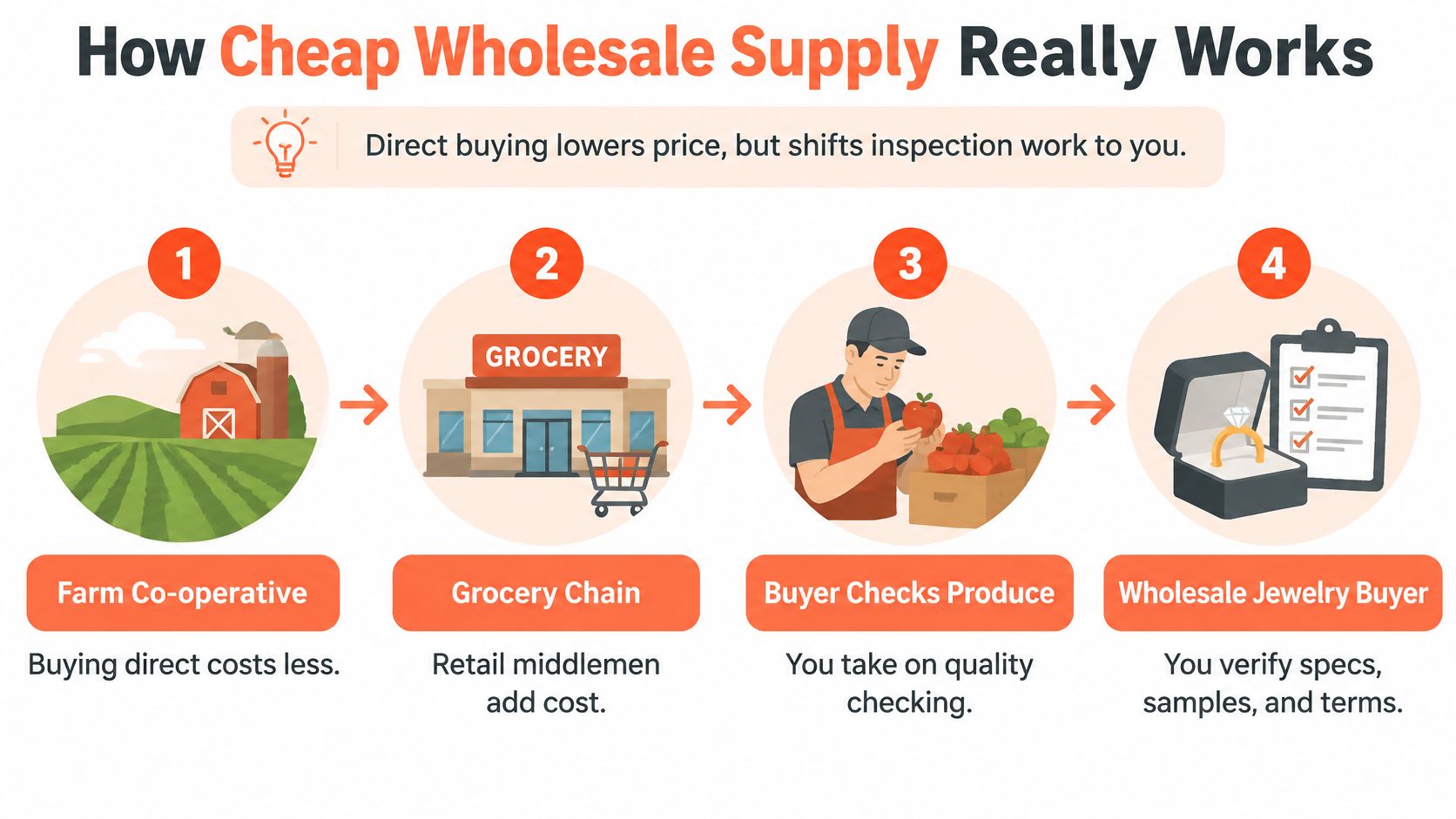
Buying direct from a farm co-operative costs less than buying the same produce through a grocery chain. You also take on the job of checking the produce yourself. Cheap wholesale jewelry websites work the same way. The chain runs from factory or manufacturer, to a wholesale platform, to the retailer or reseller. Fewer middlemen sit between the bench and your shelf, so the sticker can drop. The inspection work moves onto you.
Where the savings come from
Three things usually create the discount.
- Pooled buying: Many small orders are combined, so the factory runs a larger batch than any one boutique could place alone.
- Factory-direct pricing: The platform sells from the manufacturer instead of a local distributor who has already marked the goods up.
- Tighter logistics: Shared cartons and scheduled export cuts the freight that a one-off import would carry.
At JewelryBuyDirect, we source from factory-direct manufacturers through an Asian supply chain. Ask any site which manufacturer stands behind each product line, and whether it can name that factory. A platform that cannot name its maker is only a catalog.
The online path those goods travel is already a normal retail channel, not a side hobby. The U.S. Census Bureau's Annual Retail Trade Survey tracks electronic-shopping and mail-order jewelry sales by merchandise line from 1999 through 2022, with annual estimates such as $13.533 billion and $7.149 billion in different years, adjusted using final 2022 Economic Census results. That long record is why searchable catalogs and small-order fulfillment matter as much as a low factory price. If you want the plain mechanics of how goods, makers, and sellers connect, these supply chain concepts for ecommerce founders are a useful primer before you commit cash.
What you give up
The cheaper path has real trade-offs. Finish and weight can shift from batch to batch. The cheapest lines often carry thinner plating. Hands-on support is thinner too, and a wrong shipment can take longer to dispute when the factory is several time zones away.
Direct buying lowers the price and shifts the inspection onto the buyer. Capture the savings only if you are ready to do that checking.
Matching Product Range to Your Business Model
The right catalog matches how you sell: stable core lines for a boutique, fast trend turnover for social sellers.
A boutique needs core collections that can sit on a tray for months and still reorder cleanly. A social-commerce seller needs trend pieces that turn over in weeks. A maker needs components and findings alongside finished jewelry. A dropshipper needs listings that ship without a minimum order. If the range does not match that job, a low price just fills a drawer.
Run a catalog test before you buy volume
Count the SKUs in each category you plan to stock. We organize ours as Necklaces, Earrings, Bracelets, Rings, Body Jewelry, and Jewelry Making, with 120,000+ curated SKUs and trend-driven inventory, in materials that include 925 sterling silver, titanium steel, stainless steel, copper, gemstone, and pearl. Those names are different products. Sterling, stainless, gold-plated brass, and pearl do not share a durability profile or a skin-contact profile, so a listing that only says "alloy" has not told you which one you are buying.
Then check three more things.
- New arrivals: See how often fresh designs land, and whether a proven style stays available for a reorder. Our catalog adds 100+ new arrivals daily, which suits a social seller. A boutique should also confirm that last season's core line is still orderable.
- Variants: Confirm the same design comes in the chain lengths or ring sizes your customers ask for.
- Stricter categories: Men's and body jewelry should carry their own material notes, because prolonged skin contact and piercing posts face tighter expectations than a brooch. Our Wholesale Men Jewelry collection, for example, covers stainless steel chains, signet rings, leather bracelets, and stud earrings, and each of those materials wears differently against skin.
Depth matters more than spread in the categories you sell. Thirty styles in one category you can reorder serve a new store better than a thin sample across six, because reviews, repeat photography, and customer questions concentrate on the same pieces.
A named product page tells you more than a homepage banner. The Bohemian Minimalist 925 Sterling Silver Teardrop Baroque Pearl Earrings Asymmetric Design states the metal in its title, is priced at $70.04, and shows one variant across its options. Read a listing the same way you would read a spec sheet. If the material, category, and variant count are missing, the photo is not enough.
Order two or three pieces from the range you plan to sell. Compare them with the listing photos and the stated materials before you commit to volume. The difference between fine metal and fashion plating is easier to judge in your hand than on a grid, which is why a short read on fine jewelry versus fashion jewelry belongs in that check.
Pricing Through Landed Cost Before Markup
The supplier's unit price is the start of the calculation, not the end. Freight per unit, duties and taxes at the destination, payment and platform fees, packaging, and an allowance of about 5% for breakage, tarnish, and returns all sit on top of it. Skip any of those lines and the "cheap" piece is the one that loses money.
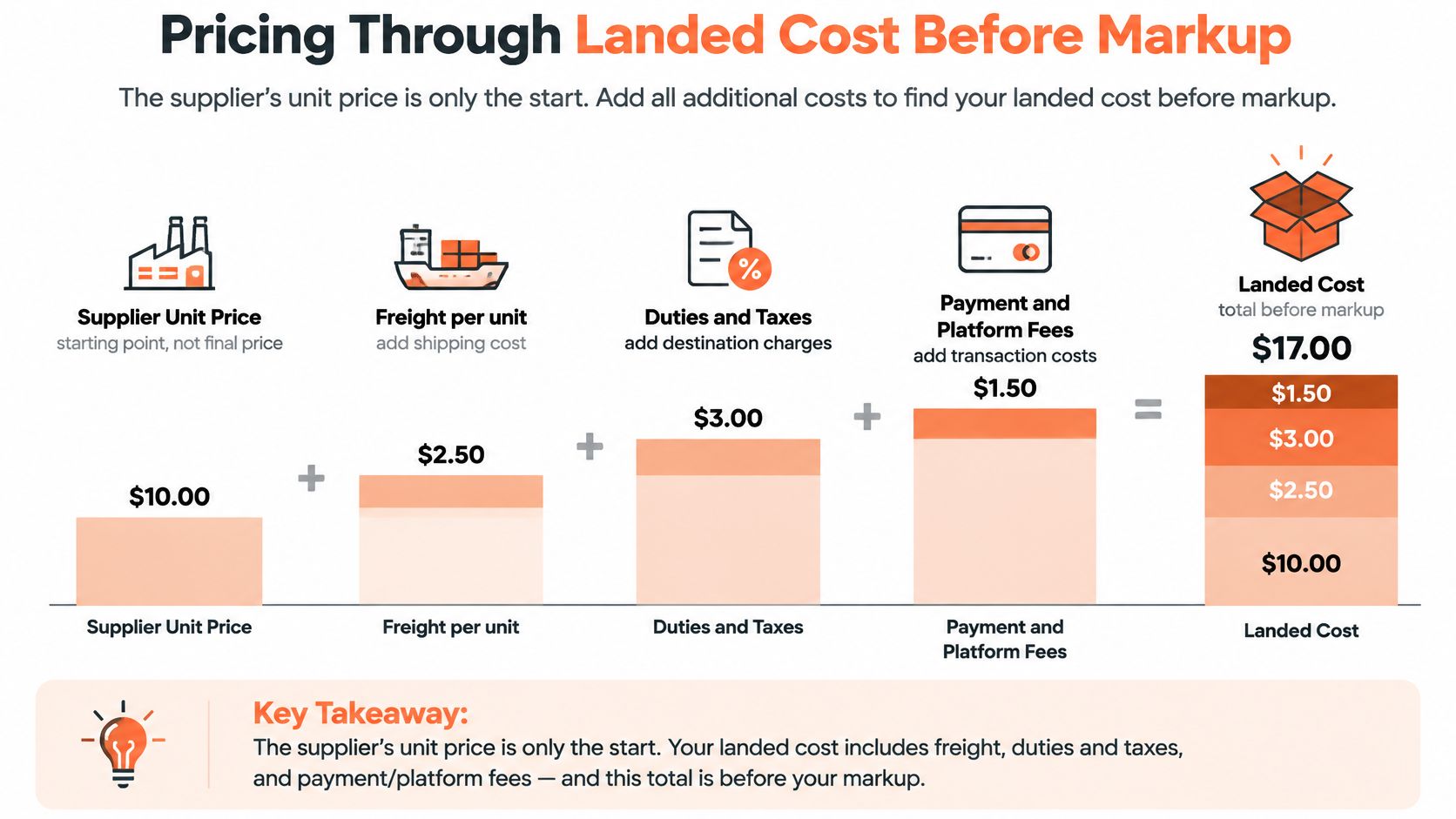
One industry pricing reference describes a general retail standard of approximately 3 times cost, a 200% markup, and notes that actual multiples vary by category and positioning. In its example, an all-in landed cost of $4 points to a $12 retail target, while a $2 wholesale price can still fail if freight and defect-related costs add $2 per unit. That 3x figure is a guideline, not an audited universal standard. Check it against your own channel fees and sell-through.
A $1.20 piece that lands at $2.45
Walk one affordable fashion piece. The supplier advertises $1.20. After the lines below, all-in landed cost is $2.45. Three times that landed cost is a $7.35 target retail price. Three times the unit price alone is $3.60, which leaves $1.25 of hidden cost unrecovered on every piece you sell.
| Cost Line | Notes |
|---|---|
| Supplier unit price | $1.20 in this example |
| Freight per unit | $0.55 as this carton's per-piece freight share |
| Duties and taxes | $0.30 for this destination and product code |
| Payment and platform fees | $0.18 for card processing and marketplace commission |
| Packaging | $0.16 for pouches, cards, and boxes |
| Defect and return allowance (about 5%) | $0.06 set aside for breakage and tarnish |
| All-in landed cost | $2.45 per piece |
| Target retail at 3x landed cost | $7.35 |
| Target retail at 3x unit price only | $3.60, so $1.25 of cost stays unrecovered |
What to confirm before you order
Wholesale prices should be on the page before you build an account. Ours are shown on the site before ordering, and factory pricing runs 15-30% below market average through bulk procurement and efficient logistics. That gap is still only a unit-price gap. Run the landed-cost lines for each candidate, then compare suppliers on landed cost per sellable piece, not on the lowest sticker. A fuller pass at fees, returns, and rework sits in this guide to reducing total cost of ownership.
Checking Plating, Metals and Test Records
Plating is a measurement you can request in writing. A low unit price often means a thinner coat or a weaker base-metal stack, and that shows up later as tarnish, abrasion, refunds, and replacements. The supplier who quotes a thickness and a test method is easier to reorder from than the one who quotes an adjective.
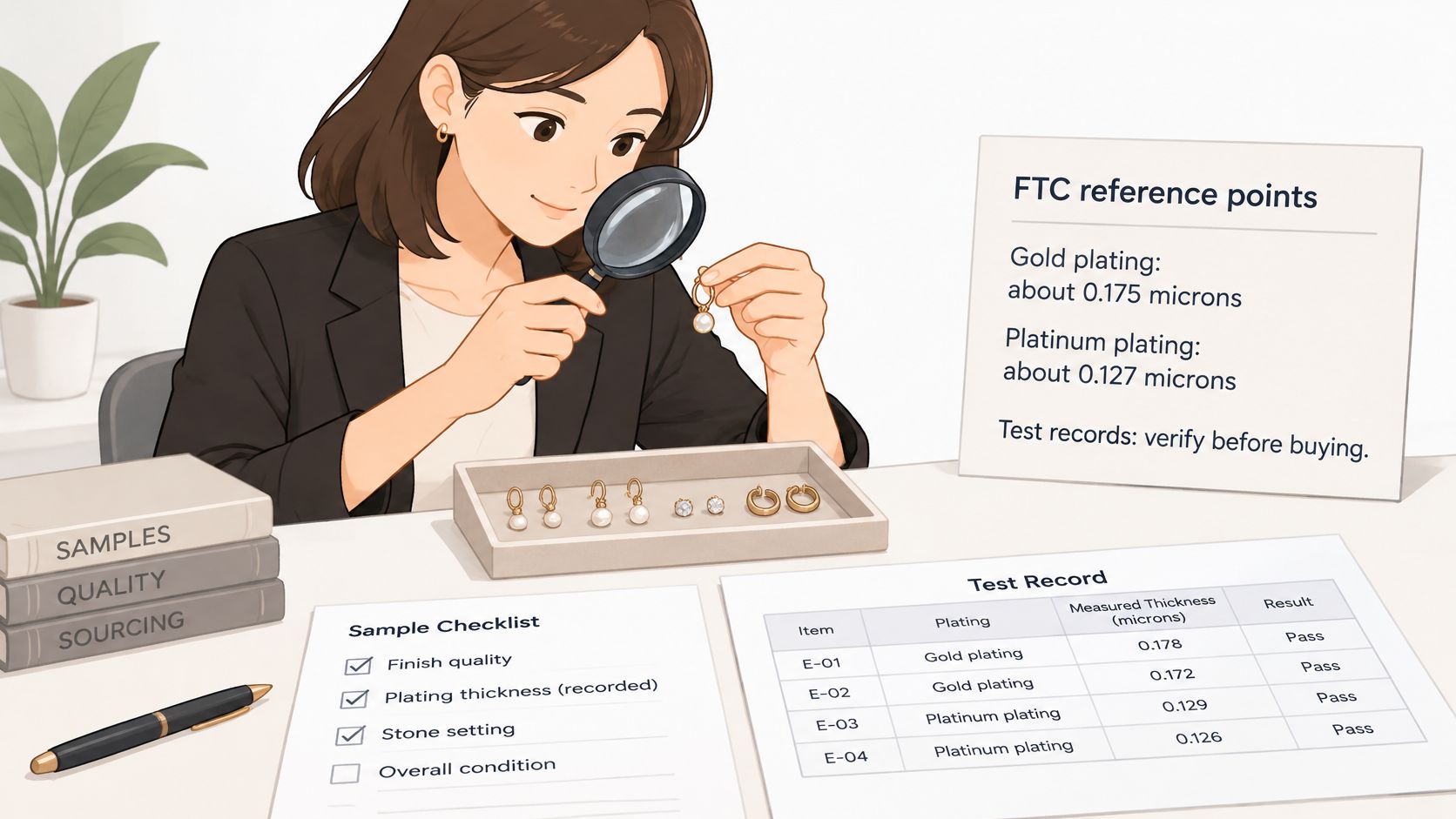
U.S. Federal Trade Commission guidance sets reference durability minimums for gold and platinum plating and warns that thinner layers may not support the durability consumers reasonably expect. The same guidance says rhodium on the surface must be disclosed when an item is marketed as precious metal. Product pages should separate solid metal, filled or bonded construction, plating, and an unspecified coating, and your marketplace listings should use those same words.
Thresholds worth putting in the purchase order
Selling into Europe adds legal limits on top of the durability references. EU REACH Annex XVII limits give you numbers to request instead of a "hypoallergenic" slogan, covering cadmium content, lead content, and nickel release. The figures below collect both sets of thresholds in one place so they can go straight into a purchase order.
| Requirement | Threshold | Applies To |
|---|---|---|
| Gold plating durability | About 0.175 microns (7 millionths of an inch) | Gold-plated items (FTC reference) |
| Platinum plating durability | About 0.127 microns (5 millionths of an inch) | Platinum-plated items (FTC reference) |
| Cadmium content | No more than 0.01% by weight | Applicable jewelry components (EU REACH) |
| Lead content | Below 0.05% by weight | Applicable jewelry components (EU REACH) |
| Nickel release, piercing posts | Less than 0.2 micrograms per square centimeter per week | Posts inserted into pierced ears or body parts |
| Nickel release, prolonged skin contact | No more than 0.5 micrograms per square centimeter per week | Earrings, necklaces, bracelets, chains, anklets, rings |
Release tests, base metals, and empty claims
Nickel compliance is measured as a release rate. UK trading-standards guidance explains that a piece may contain more nickel overall when a protective coating keeps release under the limit, provided the coating remains effective for at least two years of normal use. Posts intended for pierced ears are held to the stricter release limit in the table. Ask every supplier for the base metal, the plating or coating system, and the test method. A low advertised price does not prove the finished piece will pass a skin-contact rule.
Inexpensive gold-plated brass can look right on day one and wear through at the edges. Stainless steel and titanium steel put more of the durability into the base metal, so the coat is less of the whole story. Before a volume buy, request four documents: coating thickness, base-metal composition, plating method, and an independent test report for the batch.
Treat a waterproof or anti-tarnish line as a test case, including our Zoe collection, which is described as waterproof and anti-tarnish. The words still need a record behind them. How long a plated surface holds up depends on coating thickness and daily wear, and this guide to how long gold plating lasts shows what shortens it.
A claim without a test record counts as no claim.
Order Terms, Returns and Shipment Tracking
Written terms are what turn a cheap supplier into one you can reorder from. Unit price is the least reliable number on a wholesale site, because the terms decide what that price costs once a parcel ships. A verbal promise needs to be in writing. Put this checklist to every site before the first purchase, and keep the answers in email or on the order page.
| Term | Question to Ask | Why It Matters |
|---|---|---|
| Minimum order quantity | Can I buy one to two pieces to test a new style? | Limits cash tied up in untested stock |
| Test or sample order | Is a paid sample available before a bulk order? | Confirms plating, sizing, and finish |
| Return window | How many days, and who pays return freight? | A short, written window reduces risk on a first order |
| Damage protection | Who covers breakage in transit? | Protects against losses on fragile items |
| Payment flexibility | Are buy-now-pay-later or deferred options offered? | Improves cash flow for growing stores |
| Free-shipping threshold | What order value sets free freight? | Changes the landed cost per piece |
| Shipment tracking | Is tracking real-time on every cross-border parcel? | Answers customer where-is-my-order questions |
We set no minimum order quantity, so a small test order and a growing wholesale order run through the same account, and wholesale prices are shown on the site before you commit. Free air shipping applies to the Wholesale Men Jewelry collection. On other orders, run the freight line against the order total before you scale a style, because freight on a small batch can erase the unit-price edge you saw in the listing.
Tracking and stock that match the variant
Cross-border parcels need tracking you can forward to a customer, plus a written path for a lost or damaged box. A real process names who covers the loss, how a trace runs, and when a reshipment goes out.
Variant-level stock matters because ring sizes and chain lengths look identical in a product title and differ in the bin. GS1 guidance says product-identification systems should provide accurate, complete, and shareable product data, and its 2D-retail guidance recommends tracking stock at batch, lot, date, or serial level because a bare SKU misses those differences. For jewelry, an SKU-only feed creates overselling and bad replenishment when metal color, plating, or stone differs inside one style name. Ask for a unique machine-readable identifier, a variant-level stock feed, standardized attributes, and an update timestamp.
We ship cross-border with real-time tracking on the parcel, so a where-is-my-order question does not wait on a manual lookup, and a stalled shipment can go straight to our staffed WhatsApp Business channel. If you are promoting through a peak week, confirm restock timing on that exact size or length before you push the listing. A feed that only shows the parent style as "in stock" will oversell the 16-inch chain while the 18-inch sits unsold.
The test that matters most is simple. Prices, freight, return window, and damage terms should all be visible in writing before checkout. If they appear only after you pay, you do not have terms yet.
Choose Your Supplier and Confirm the Order
Take two listings for the same pendant style. Supplier A is $0.80 a unit, with no plating specification and no return terms. Supplier B is $1.05, with documented plating, batch test records, and a written return window. Now add freight, fees, and breakage.
For Supplier A, add $0.60 of freight and $0.32 in payment and customs fees to the $0.80 unit price. Each shipped piece costs $1.72. At a 12% defect rate, only 88 of every 100 pieces can sell, so the landed cost per sellable piece is $1.72 divided by 0.88, about $1.95. For Supplier B, add $0.45 of freight and $0.25 in fees to the $1.05 unit price, which puts each shipped piece at $1.75. At a 3% defect rate, the landed cost is $1.75 divided by 0.97, about $1.80 per sellable piece. The cheaper listing costs more, and it still carries the refund risk.
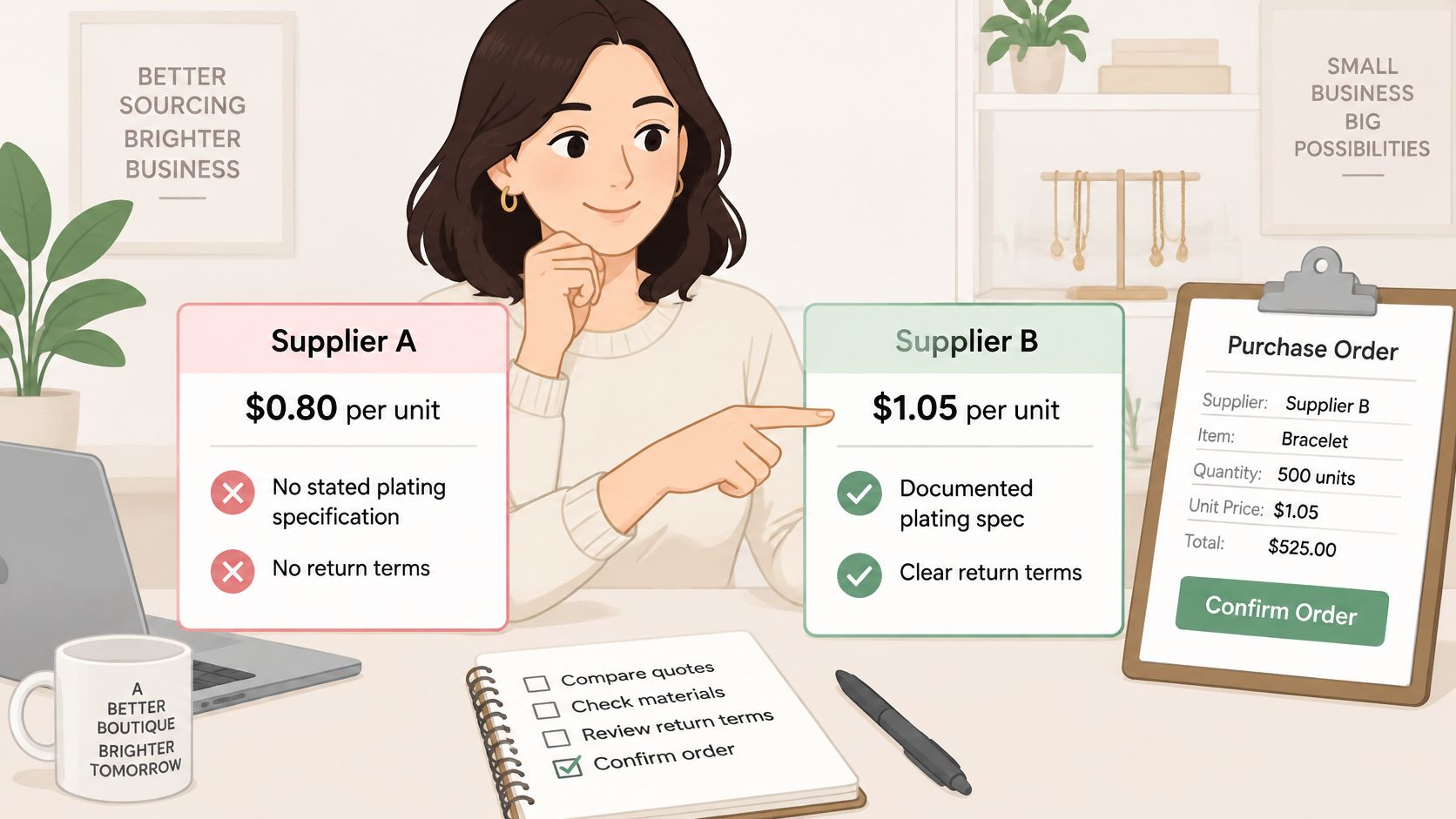
I would pay the extra quarter on the unit price for Supplier B, then prove it with a small batch before any reorder.
- Shortlist suppliers that pass the scorecard on at least three criteria.
- Request plating specifications and test documents in writing.
- Calculate landed cost per sellable piece, defects included.
- Place a small test order with no minimum commitment. Wholesale retailers can order online directly on our website.
- Check the received pieces against listing photos and stated materials.
- Confirm return and damage terms before you scale.
Check the business, not only the product
Before you pay, confirm a registered company name, a physical address, a working contact channel, secure checkout, and reviews on platforms the supplier does not control. We keep strategic partnerships with 58+ trusted manufacturers and vet those partners before a line goes live. Questions can go through our WhatsApp Business Account at wa.me/14088212778, a channel you can test with a real question before any money moves.
Pay for a verified test batch first. Scale only after the pieces, the paperwork, and the tracking match what the site promised.
We run a factory-direct wholesale catalog for boutiques, marketplace sellers, and small brands that want named materials, prices on the page, and no minimum order. If you are done guessing from unit price alone, compare plating notes, landed cost, and written terms on JewelryBuyDirect, then place a small test order before you scale.