





Jennifer Lopez | Sun Nov 01 2026
Chain Bracelet Stainless Steel Buying Guide
Stop listing a chain bracelet stainless steel style as rust-proof and hypoallergenic. Those aren't specs, they're return reasons. A low unit cost only works for your boutique or online shop when you've nailed down the grade, the plating, the clasp, and the proof behind any skin claim. Buy the spec first, then the price.
Why Stainless Chain Bracelets Earn a Shelf
Stainless steel resists corrosion better than ordinary carbon steel, and that resistance still shifts with grade, finish, chloride exposure, and factory quality. Promise more than that and you'll pay for it in returns and one-star reviews.
The reason this category earns shelf space is chromium. The British Stainless Steel Association history of stainless steel notes research in 1911 identified a major improvement when iron alloys contained at least 10.5% chromium, and on August 13, 1913, Harry Brearley produced an alloy with 12.8% chromium and 0.24% carbon. That chromium forms a thin, self-renewing passive oxide film that helps the surface handle sweat and skin oils. Treat 10.5% as a benchmark, not a guarantee every chain performs the same.
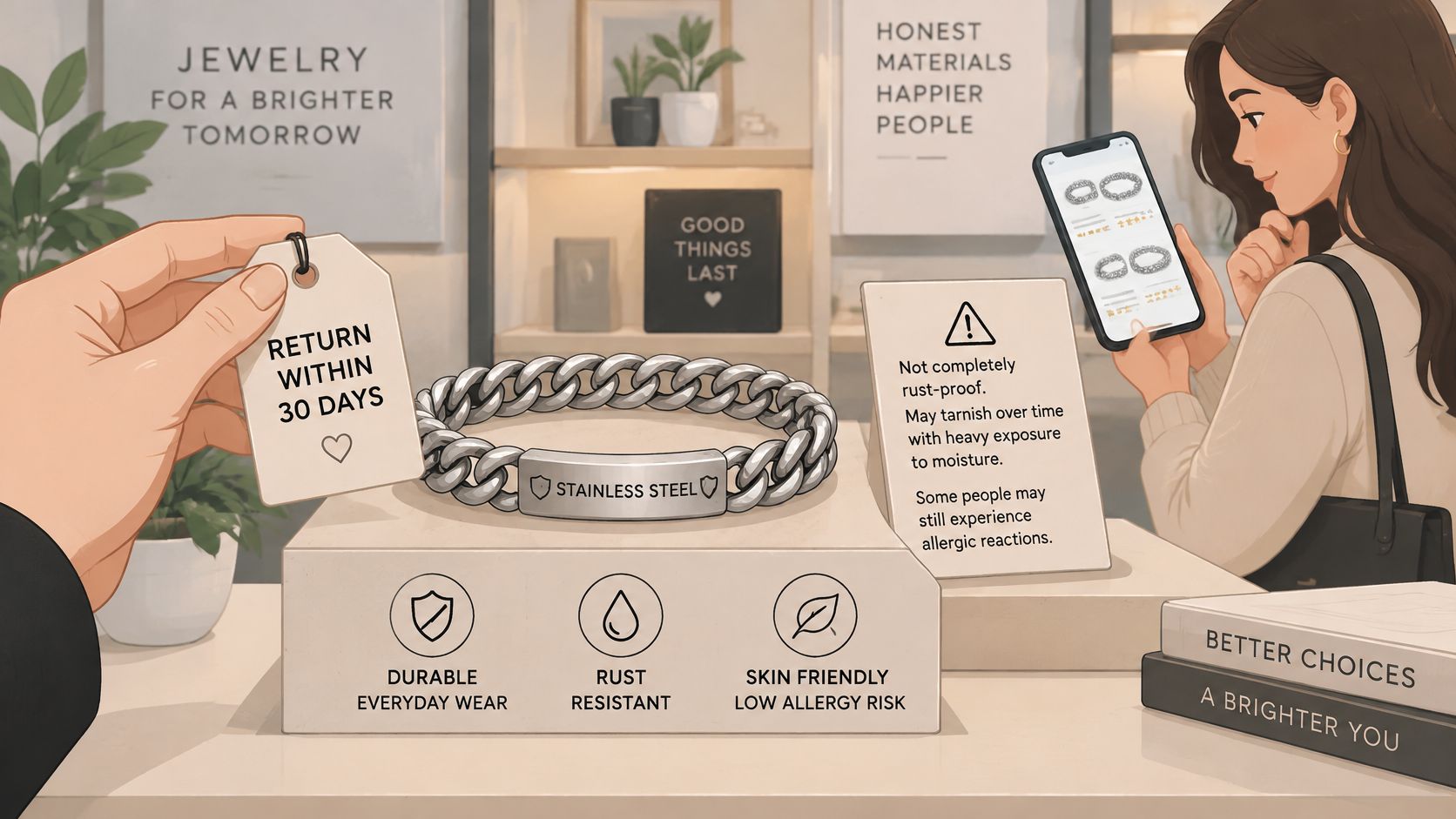
Write your order in this sequence. Match the grade to the wear you'll claim in the listing, then check link construction, wrist sizing, and clasp build, then plating claims, then care and nickel-release copy, then run a verification pass before the wholesale PO. Styling matters at retail too. Advice on mixing rings for a balanced look shows customers how a simple chain fits a layered set, and it keeps your product pages honest about what the metal does.
304 and 316L Compared for Real Wear
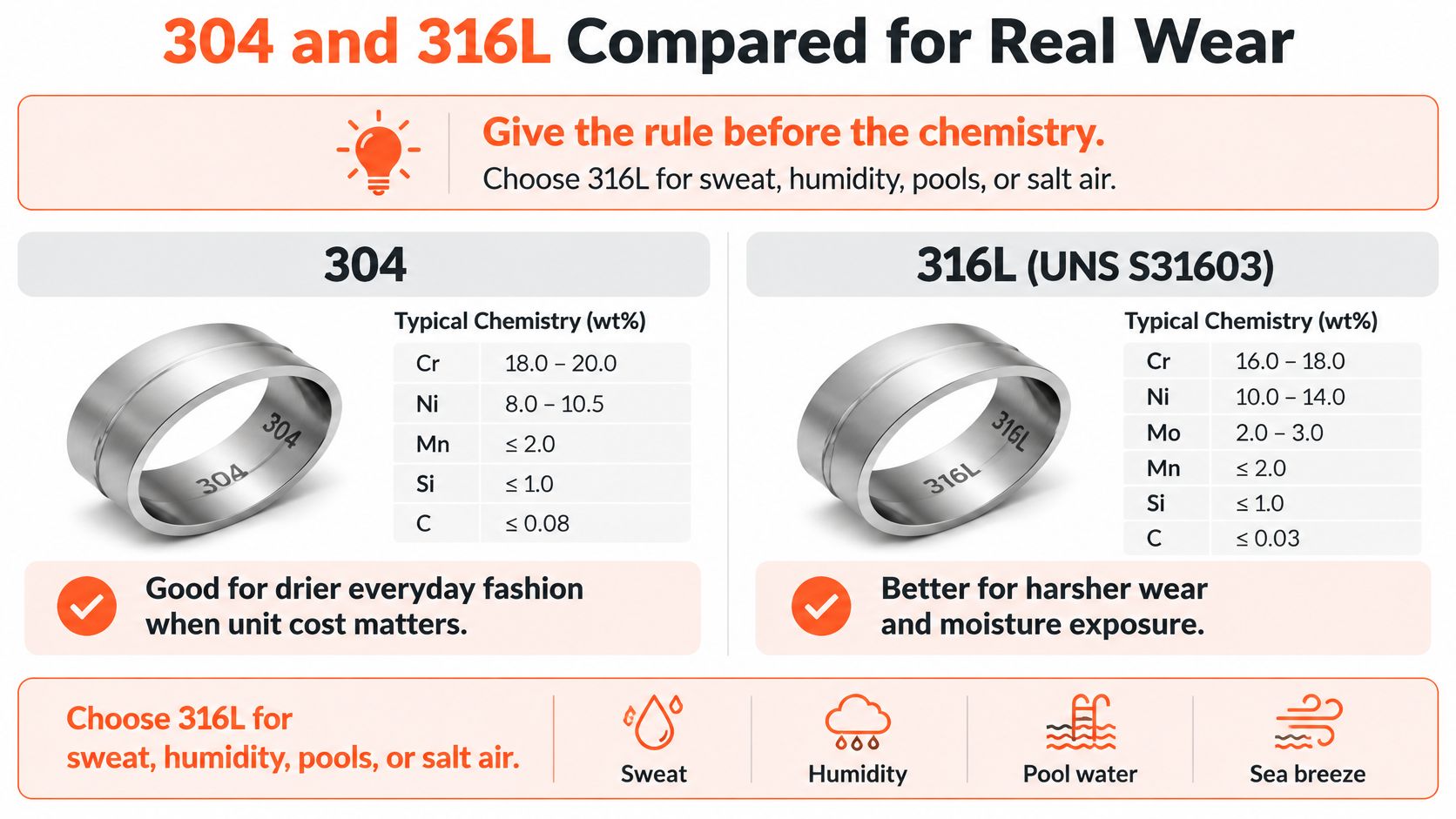
Here's the rule before the chemistry. Specify 316L for sweat, humidity, pools, or salt air. Accept 304 for drier, everyday fashion when unit cost matters and your listing won't promise water wear. If a quote just says "stainless steel," send it back.
The figures below track the Hobart Brothers 316 and 316L datasheet, which puts 316L at approximately 16.5 to 18.5% chromium, 10 to 13% nickel, and 2 to 2.5% molybdenum, with carbon capped at 0.03% and a Pitting Resistance Equivalent Number of about 24.2 against 19.0 for 304. Keep the table open when a quote lands in your inbox.
The Table to Put on Your Purchase Order
| Grade | Chromium | Nickel | Molybdenum | Carbon max | PREN | Specify it for |
|---|---|---|---|---|---|---|
| 304 | 18 to 20% | 8 to 10.5% | none | 0.08% | about 19.0 | drier everyday fashion at a lower cost |
| 316L (UNS S31603) | 16.5 to 18.5% | 10 to 13% | 2 to 2.5% | 0.03% | about 24.2 | sweat, humidity, pools, and salt air |
Read those numbers as a way to compare alloys. They don't prove a bracelet will never stain.
What Each Column Does for the Wearer
Chromium builds the passive film in both grades, so it isn't your deciding factor. Nickel shows up in both, which is why neither grade earns a nickel-free claim on composition alone. The column that earns 316L its place is molybdenum.
- Molybdenum: 316L carries it, 304 doesn't, and it improves resistance to chloride pitting and crevice corrosion from sweat and seawater.
- Carbon: The low cap in 316L reduces corrosion risk along welds after heating during manufacture, which matters at link joints and clasp attachments.
- PREN: A higher score points to better pitting resistance on paper, and a scratched, poorly finished, or unrinsed chain can still mark.
Watch grade differences explained in plain terms before you commit a claim to a listing.
Even 316L needs a rinse and a dry after chlorine or seawater. Salt deposits trapped between links create tight crevices where corrosion starts, and no grade number fixes a chain left damp in a gym bag. Write that care line into the listing instead of calling the piece waterproof.
Purchase-order line: 316L (UNS S31603), solid links, polished finish, stainless steel lobster clasp. Four fields, no adjectives, nothing for a factory to interpret loosely.
Reject any supplier who won't state the grade plainly, because you need an alloy you can verify on a mill certificate or quote, and defend when a customer asks what they're wearing.
Chain Constructions That Survive Resale
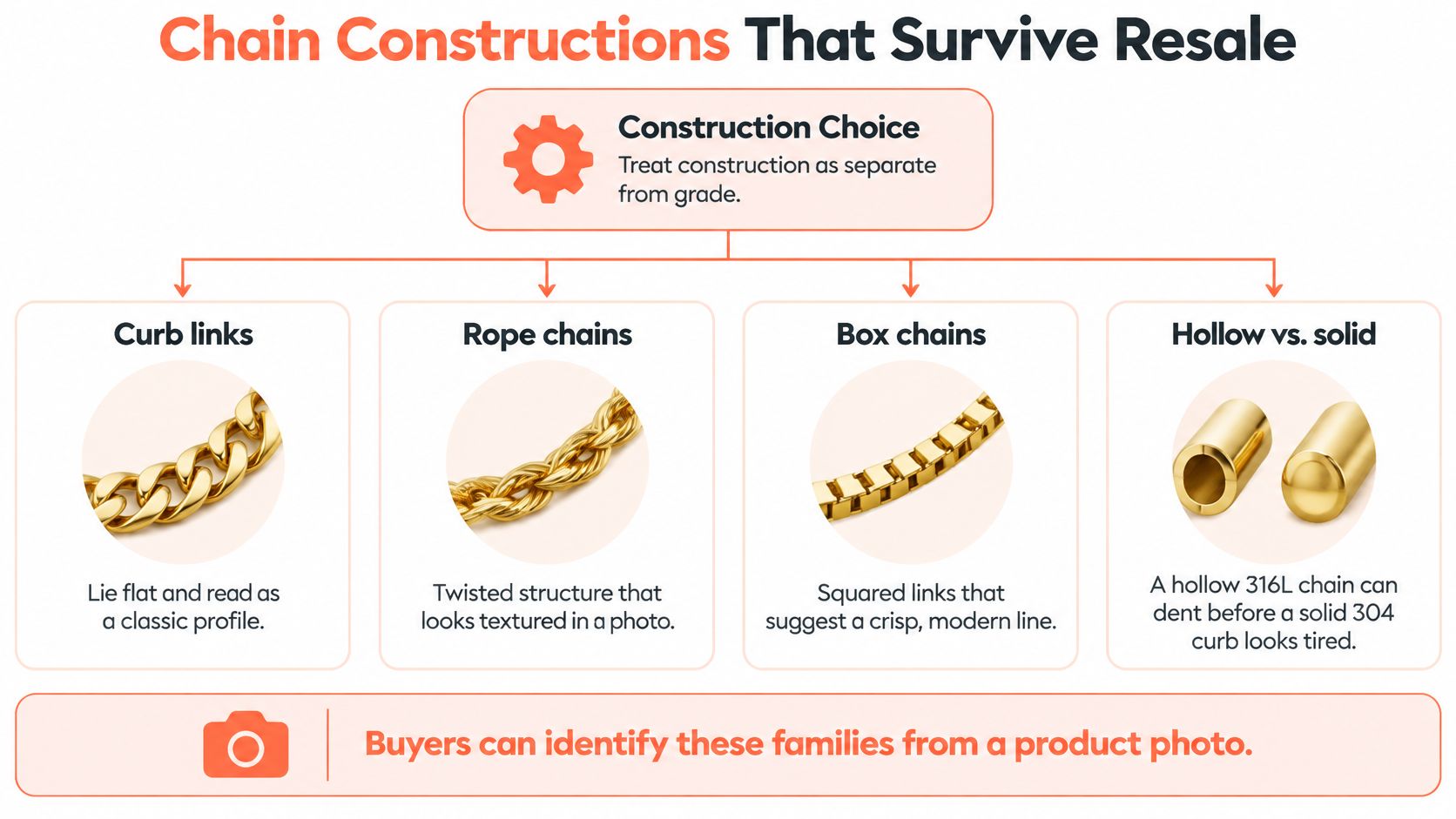
Grade gets the attention; construction decides whether the bracelet survives daily wear. A hollow 316L chain can dent on a door frame before a solid 304 curb shows wear, and “rust-proof” or “hypoallergenic” on a supplier page is not a spec. Put construction beside grade, plating wear, and clasp build before a low unit cost earns a listing.
This hierarchy shows the families you can identify from a product photo before you order samples.
Read the Chain From the Photo
Curb links lie flat and read as classic unisex, so they carry a core assortment on their own. Cable is round and simple, the safest fine chain for a starter range. Figaro alternates long and short links and suits a men's edit where curb feels too plain.
Box chain is square and relatively stiff, so it sits well under a small charm without rolling. Rope twists light across the wrist and photographs beautifully, but it snags hair and knit cuffs. Tell customers that before they discover it.
Snake chain is smooth and fluid, which is why it shows up in minimalist sets. A catalog example is the Bohemian Irregular Sunstone Pendant Necklace with Stainless Steel Snake Chain for Women, listed at $5.65 with 4 variants across its options. Franco or wheat chain is dense and looks more expensive at the same metal grade, because there's more metal in view.
Check the Failure, Not Just the Shine
Every style has one weakness your sample should be tested for.
- Hollow links: Press and roll them between hard surfaces, because a dented hollow curb can't be polished back.
- Thin snake chain: Bend it into a tight curve and release it, then look for a kink that won't relax.
- Rope chain: Drag it lightly across knit fabric to confirm how badly it catches.
- Welds and jump rings: Tug each end fitting firmly, since an open jump ring loses the whole bracelet.
Don't launch with one hero chain. Stock a width ladder instead.
Fine 2 to 3 mm for women, 4 to 5 mm unisex, and 6 to 8 mm for men's curb or box gives every shopper a step up without multiplying your suppliers.
Ask the factory for three things before any style goes live: a link close-up, a weld photo, and a written solid or hollow callout. If the seller can't produce all three, the sample isn't ready for a listing.
Wrist Sizes and Clasps That Cut Returns
Most bracelet returns aren't about the metal. They're about a length that didn't fit and a clasp the customer couldn't work one-handed. Fix both on the product page and you'll keep sales you'd otherwise refund.
| Wearer | Usual clasp | Listing note |
|---|---|---|
| Women petite | lobster or spring ring | fine cable, box, and snake |
| Women average | lobster | curb, figaro, and snake |
| Women larger or stacked | lobster or toggle | leave room to stack |
| Men average | lobster or fold-over | curb and box, about 4 to 8 mm wide |
| Men large | lobster plus extension | heavier curb and rope |
| Adjustable open | none or hidden magnet | publish both ends of the range |
Measure the Way Customers Wear It
Tell shoppers to take a snug wrist circumference and add about half an inch to one inch, and more when the chain is wide or will be stacked with other pieces. A thick curb sits higher on the wrist than a fine cable, so the same listed length feels tighter.
Publish the inner length, not the full length including a dangling extension chain. Give it in both inches and centimeters, because marketplace buyers search either way and won't convert for you. Add a one-inch extension on borderline sizes and you'll rescue orders that sit between two sizes.
Match the Clasp to the Sale
A lobster clasp is the default for resale. Customers can fasten it without help and it holds curb and rope weight, which is why our guide to choosing a stainless steel lobster clasp treats it as the safe starting point. A spring ring keeps a small profile on fine cable and snake chains, but the spring fatigues with use, so don't put it on anything heavy.
A toggle is easy to work in a live-selling demo and can slip off a narrow wrist mid-day. Say so. A box clasp with a safety latch looks dressier and costs more, and its tongue can bend if a customer forces it.
A magnetic clasp helps quick try-ons and some older customers, but it can release under a heavy chain or a caught sleeve. A fold-over clasp looks clean and watch-like, yet it needs an accurate length because there's almost no forgiveness built in.
Put the sizing answers where shoppers ask them. If your store chat repeats the same fit questions daily, ready-made copy-paste scripts for jewelry shoppers can carry your inner-length and clasp answers consistently.
Close every listing with three facts: the inner length, the clasp name, and whether the piece is adjustable. That's the customer-service sheet your buyers need.
Plating Choices That Keep the Color Honest
Separate color from corrosion, because they're different promises. Polished stainless steel already has a silver tone and needs no plate at all. Gold, rose gold, and black are coatings sitting on top of the steel, and coatings wear.
Know What You Are Coating
You've got three common routes. Electroplate is the familiar, lower-cost finish. Vacuum plating and harder PVD or IP layers generally bond harder and stay even longer, as our explainer on what PVD coating means for jewelry walks through. None of them changes the grade underneath.
Every coating is thinner than the steel below it, so it fails at high points first. Expect the first color loss on the outer edge of a curb link and the lip of the clasp, where the bracelet rubs desks, bags, and other jewelry.
When color wears through, the steel is usually still sound. The customer's complaint is patchy color, not a rusted bracelet, and your listing should say exactly that before they buy. An honest wear note converts better than a permanent-color promise you'll have to refund.
A study on jewelry metals under artificial sweat found that sweat and friction wear coatings faster than water. Sunscreen, perfume, and abrasion strip color faster than a rinse in fresh water ever will, so price a plated piece for its service life, not its shelf shine.
Write the Listing So It Survives Wear
Name the base metal and the plating method as two separate facts. An "18k gold-plated stainless steel chain" is not solid gold, and a black coating is not a different grade of steel. Customers accept plated pieces when the plating is disclosed up front.
- Polished steel: Sell it as uncoated, because there's no color layer to lose.
- Gold tone: State the plating method and note high points fade first.
- Black: Warn that edges brighten with wear, which some buyers like and others don't.
Build one affordable wall from one chain construction in three finishes, polished steel, gold tone, and black. You triple the display without tripling your fit and clasp problems.
Use a plated bead-and-chain bracelet as a fashion add-on only after the grade and plating method are stated in writing. Photograph the clasp up close in every plated listing, because that's where customers spot the color change first, and where your honesty gets judged.
Care Lines and Nickel Claims That Hold Up
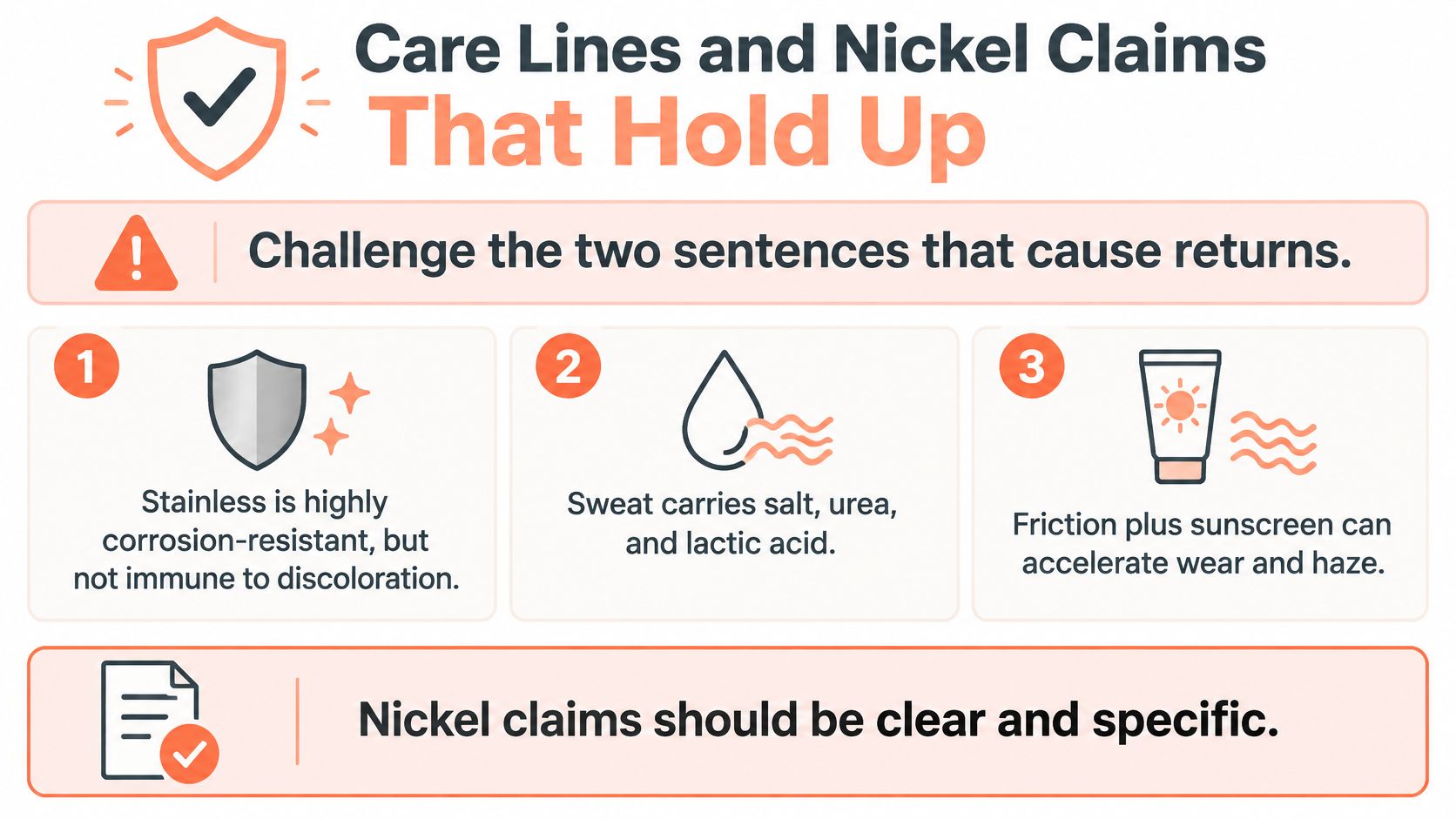
Hypoallergenic is a claim you have to prove, and most sellers who print it haven't. Drop it until you've got paperwork.
This checklist separates honest care advice from allergy claims that need evidence.
Four Care Lines You Can Paste
Give customers instructions they will follow. Four short lines cover nearly everything a stainless bracelet needs.
- Wipe after wear: A soft dry cloth lifts oils and salt film before they sit in the links.
- Check the clasp: A weekly tug on the clasp and jump rings catches a weak join before the bracelet drops off a wrist.
- Keep chemicals off: Bleach and abrasive polish don't belong on any finish, plated or not.
- Store it dry: Fasten the clasp, and don't leave links sitting damp in a closed pouch or gym bag.
Our stainless steel jewelry care guide expands those same lines for customers who want the longer version. Short instructions on the listing beat a detailed guide nobody opens.
Treat Nickel as Compliance, Not Copy
Both 304 and 316L contain nickel. The regulated measure is nickel release from the finished piece, and that is the number regulators test.
The World Stainless guidance on nickel release identifies an EU limit of 0.5 µg/cm²/week for bracelets and chains worn directly against skin, with a stricter 0.2 µg/cm²/week limit for pierced-body jewelry. If you can't point to results against that threshold, you don't have a sensitive-skin claim.
"Suitable for most sensitive skin" still leaves out people with a severe nickel allergy. They may need titanium or a verified nickel-free finding, and telling them so protects them and your store.
A 316L stamp doesn't prove the finished bracelet passes anything. Grade describes the alloy, not the clasp, the jump rings, or the plating a factory added later.
Ask for an EN 1811 nickel-release test on the complete piece, especially the clasp and jump rings, before any sensitive-skin wording goes on a marketplace listing. The report should name the standard, the finished product, and every component that touches skin.
Skip that step and a confident allergy claim turns into returns, complaints, and regulatory exposure in every market you ship to. One test report costs less than apologizing to fifty customers.
Verify Specs and Supplier Due Diligence Before You Order
Make the wholesale order conditional on paperwork, not on a low headline price. A cheap chain bracelet stainless steel line you can't describe accurately isn't affordable, it's a liability you'll resell.
The U.S. Federal Trade Commission Jewelry Guides state marketers must represent truthfully a product's type, grade, quality, quantity, metallic content, size, weight, durability, serviceability, origin, price, and value. Those fields must match across the quote, the sample in your hand, and the listing your customer reads.
Run the Eight Checks in Order
- Exact grade: Written as 316L or 304, never generic stainless steel.
- Construction: Solid or hollow, with width in millimeters.
- Finish: Plating method named, or polished with no plate.
- Fit: Inner length in inches and centimeters, plus clasp type.
- Origin: Country of origin stated on the quote.
- Marking: A quality mark or hangtag legible in a close-up photo, because small clasps hide poor stamps.
- Nickel evidence: EN 1811 paperwork if you'll make any sensitive-skin claim.
- Sample in hand: One piece you can fasten, tug, and photograph at the weld.
Then check the supplier behind the sample. Ask for a written sourcing policy, a list of factories and subcontractors, a risk assessment, a corrective-action procedure, audit evidence, and public reporting. A factory that answers with records is a safer reorder than one that answers with adjectives.
We sell a wide selection of stainless steel jewelry, with Stainless Steel Jewelry featured from $1.09, and we publish care guides for 925 Sterling Silver, freshwater pearl, stainless steel jewelry, and gold/silver electroplated jewelry. Price only means something once the eight fields above match, ours included.
Compare factories only after those fields line up across every quote. Place a small first order, confirm the mark and clasp in hand, and reorder only the widths and finishes that pass. That's how a low unit cost stays low.
Browse the stainless steel chain bracelets, clasps, and findings at JewelryBuyDirect, check each style against the eight fields above, and order samples of the grades and finishes your listings will claim. Stock the widths that pass your tug, kink, and close-up photo tests, and you'll build an affordable wall your customers keep instead of return.