






Jennifer Lopez | Wed Nov 04 2026
Bulk Rattan Chargers: How to Buy Quality at Scale
Untreated rattan isn't automatically the safe, premium choice. It's often the riskiest one to buy in bulk, because a porous weave can arrive damp, hold residue, and carry an undocumented coating that makes your food and care claims indefensible. That's the trap with bulk rattan chargers. Buyers treat them as simple décor, then pay for warping, mold, shade drift, and returns after the cartons land.
Supply concentration raises the stakes. The Food and Agriculture Organization overview estimates that Indonesia holds approximately 80–90% of the world's raw rattan resources. You're not buying from a broad, interchangeable supply base. You're buying into Southeast Asian raw material, drying capacity, and export handling. For jewelry and fashion accessory retailers adding natural tabletop pieces to gift, display, or lifestyle assortments, the discipline is familiar. Source high quality at an affordable landed cost, prove every claim, and refuse vague specs.
Bulk Rattan Charger Specs to Write Into Your Order
“Natural rattan chargers” is not a usable purchase specification. It leaves the supplier to choose diameter, thickness, moisture, shade, weave density, and finish. Put measurable limits in the purchase order and make acceptance depend on them.
Use ISO 23067:2022 to organize requirements for rattan classification, dimensions, appearance, grading, inspection, packing, and labeling. The standard provides categories, not a guaranteed pass rate. A sample approved by both parties sets the product standard.
Build the One Page Spec Sheet
Approve a physical charger as the reference sample. Photograph it beside a ruler and color reference, retain one unit, and send one to the factory. Set every requirement below before requesting final quotes. A supplier who refuses to sign measurable diameter and flatness tolerances leaves you without a clear basis for rejecting out-of-spec goods.
| Spec | What to write into the order | How to check it |
|---|---|---|
| Species and treatment | Rattan species, treatment status, and drying record for each lot | Match supplier documents to carton labels |
| Outer diameter and thickness | Tolerances agreed against the approved sample | Measure samples from several cartons with a caliper |
| Moisture content | A narrow, documented moisture range agreed before production | Check with an electrical-resistance meter or capacitance meter; use oven-drying to settle disputes. The BioResources rattan review describes suitable meter ranges. |
| Flatness and roundness | Measurable tolerance for each charger | Measure against the approved drawing |
| Weave density and colour | Shade range set against the approved sample | Compare side by side in daylight |
| Coating and finish | Coating type, curing requirements, and finish documentation | Request documentation for each SKU before production |
| Defect classes | Critical, major, and minor defect limits | Classify defects during pre-shipment inspection against the agreed limits |
| Packing and labels | Carton moisture protection, lot traceability, and origin marking | Review packing photographs and retain samples for disputes |
Write a measurable tolerance for each handmade charger, and reject wobble that exceeds it. Set the acceptable shade band against the approved sample; “natural colour” does not define how much variation you will accept. Classify broken splints and mold as defects before production, not as cosmetic issues after arrival.
For hospitality assortments, compare woven rattan's use case with durable tableware for busy kitchens before promising it the same service life. Send the completed spec sheet with every quote request, and hold each supplier to every row.
How to Inspect a Bulk Rattan Charger Shipment
Inspection starts with where you pull samples, not with the first charger you touch. A clean top carton proves almost nothing about the middle of a pallet that sat in humid air. Work through these steps in order and record results by carton.
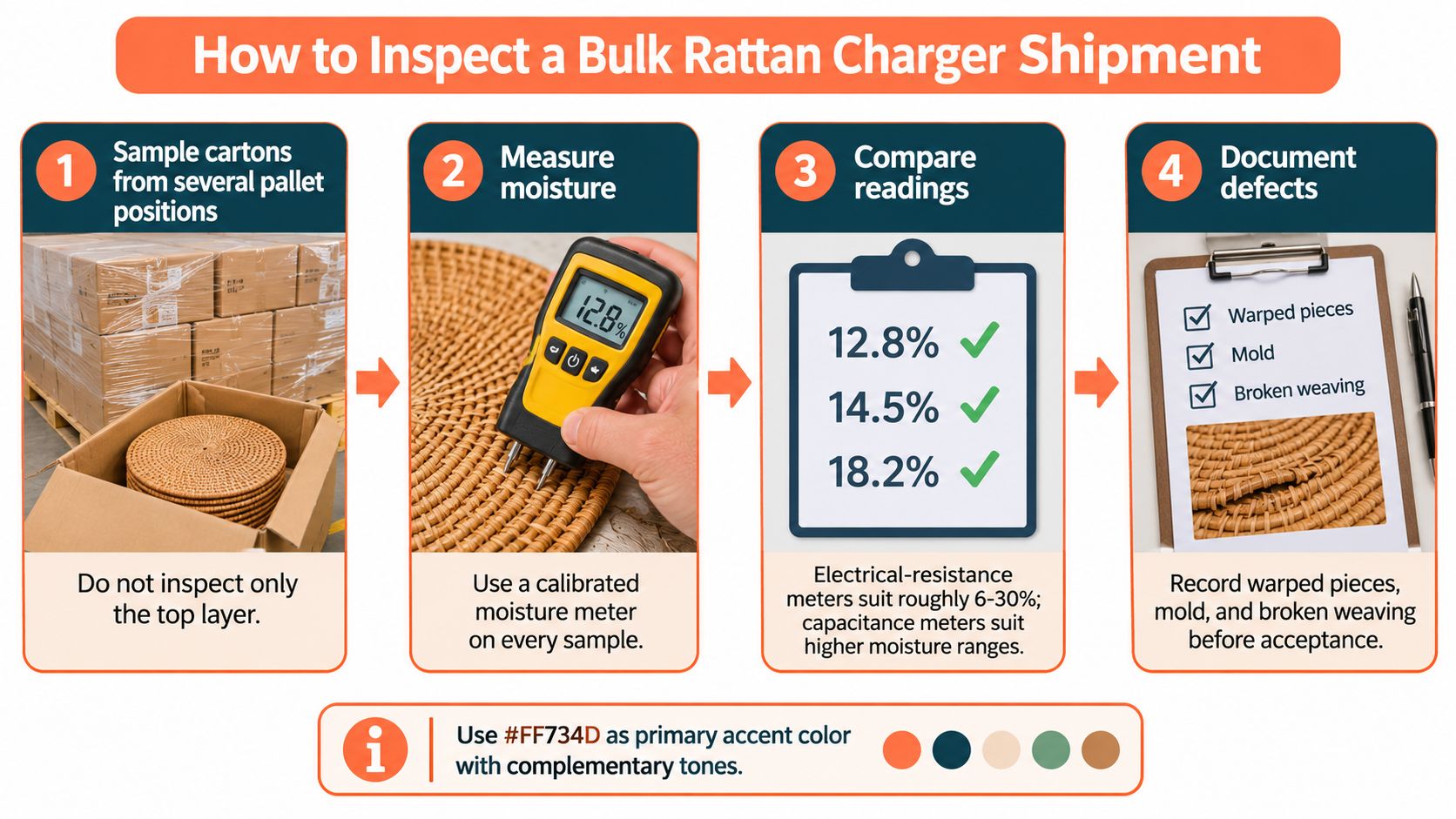
- Sample across the pallet. Pull cartons from the top, middle, bottom, and corners. Container humidity doesn't distribute evenly, so your sample shouldn't come from one convenient layer.
- Let samples acclimatize. Bring sampled chargers into your destination room conditions before testing. A cold, humid carton opened straight from a container can distort your first impression of odor, feel, and moisture.
- Measure moisture on every sample. Use a calibrated meter and keep probes away from metal fasteners and wet packaging. The BioResources rattan review identifies electrical-resistance meters as suitable for approximately 6–30% moisture content and capacitance meters for ranges of roughly 6–60%. This step matters because rattan's dimensional stability and mechanical strength vary with moisture content, so a damp charger isn't just unpleasant, it's more likely to warp or fail.
- Settle disputed readings properly. Oven-dry representative pieces to constant mass when you and the supplier disagree. Don't argue over one handheld reading when a reference method can close the question.
- Run the visual check. Reject or quarantine units with broken splints, loose ends, stains, insect damage, warping, cracking, mold spots, musty odor, or inconsistent finish. Photograph each failure beside the carton label.
- Measure against the drawing. Check diameter, thickness, roundness, and flatness on every sample. A charger that rocks under a plate will annoy every customer who uses it.
- Handle it like a customer. Test wobble on a flat table, run fingers around the edge for splinters and snags, and place a dinner plate on it to check load response. Sharp ends and lifting splints are functional defects, not rustic character.
- Classify and decide. Total critical, major, and minor defects against the limit in your order. Then accept the lot, reject it, or negotiate a credit for the affected cartons only.
A narrow, documented moisture range matters more than a single passing reading, because one dry sample can't clear a damp carton elsewhere on the pallet.
Quarantine damp or musty units away from clean stock. Don't mix them back in after a day near a fan and call the problem solved. For context on why timing matters, newly harvested rattan should be dried immediately to below 20% moisture content when prophylactic treatment is not applied, according to the same review linked in step 3. That figure isn't your finished goods limit unless you've written it into the order. Your agreed range is.
Keep retained samples until the claim window closes. If mold appears a week later, you'll need dated photos, moisture logs, and the actual failed pieces to support a credit or replacement.
How to Negotiate Per-Piece Pricing on Large Orders
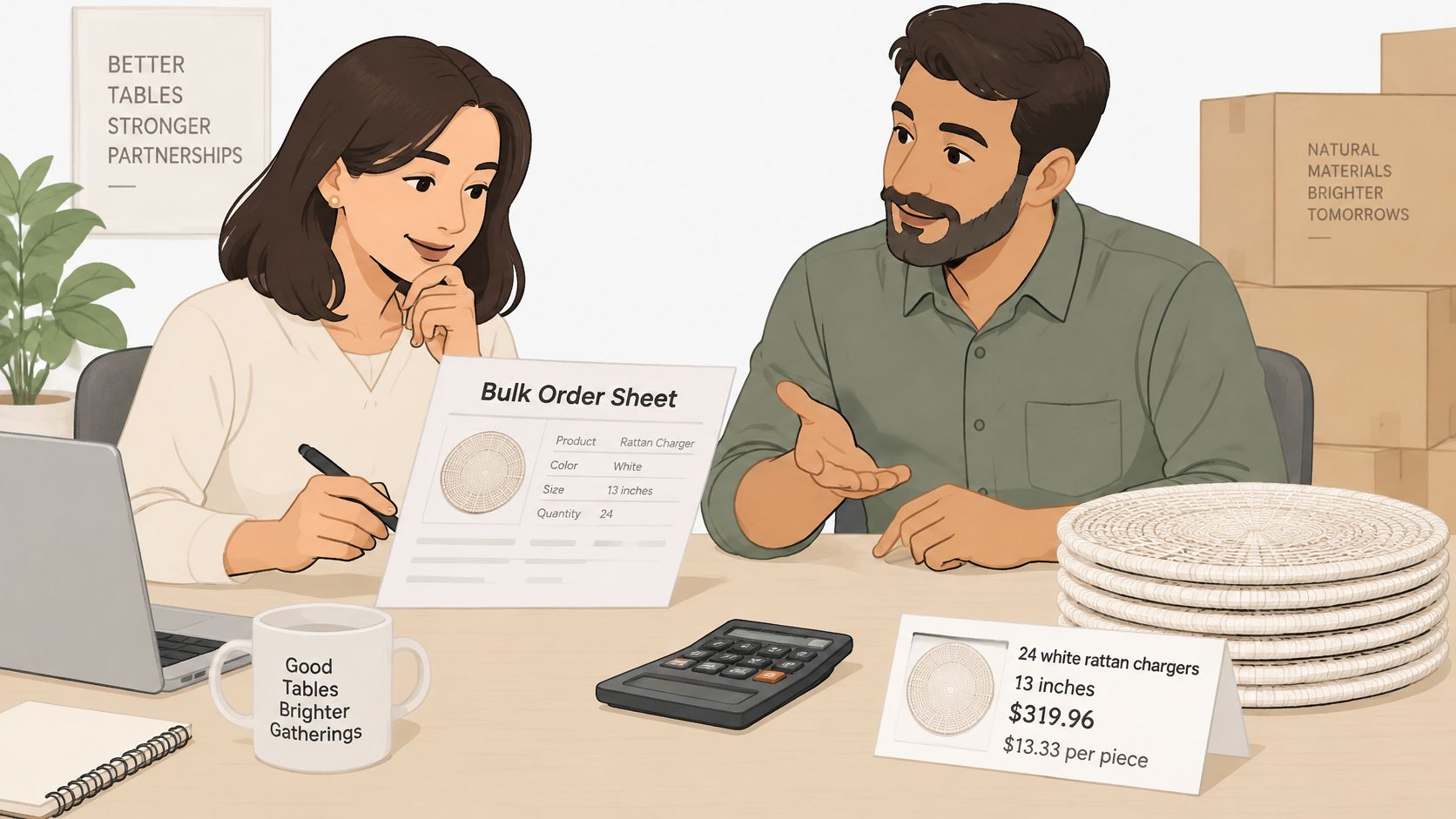
Use a comparable product as a benchmark, not as your target. EventsWholesale.com listed a case of 24 white rattan chargers, 13 inches in diameter, for $319.96 in 2026, or $13.33 per piece. The listing gives you a reference point; finish, treatment, packing, and order volume still affect the quote. Compare suppliers on landed cost per piece.
| Cost element | Benchmark or assumption | Source to use |
|---|---|---|
| Unit price | $13.33 per piece (case of 24 at $319.96) | EventsWholesale listing, 2026 |
| Freight | Quoted freight divided by pieces | Supplier freight quote |
| Duties | Duty paid divided by pieces | Destination tariff schedule |
| Breakage allowance | Rejected pieces divided by received pieces, multiplied by unit cost | Defect rate from pre-shipment inspection |
| Cleaning or repacking | Quoted or timed in-house cost per piece | Supplier quote or in-house cost |
| Landed cost per piece | Sum of all rows | Record one figure per SKU |
For a worked example, take a supplier quote of $9.80 per piece, plus $1.65 freight, $0.55 duties, $0.40 breakage allowance, and $0.25 repacking. The landed cost is $12.65 per piece, so the $9.80 unit price understates the actual cost. Recalculate for each quote and SKU; freight and rejected pieces can erase an apparent unit-price saving.
Request tier breaks at several order volumes, plus a reorder price tied to the approved sample and written product specifications. That gives you a basis to challenge substitutions on repeat orders. Before accepting a take-it-or-leave-it tier, compare wholesale pricing tactics.
Watch this negotiation walkthrough before your supplier call. For a broader approach to the conversation, read this guide to negotiating with suppliers.
Apply the same costing discipline to each item in a mixed assortment. The Bohemian Handmade Woven Short Necklace with Large Shell Pendant for Women Alloy Chain with Plating Finish has 2 variants. Cost each variant by its own quote and order details, rather than using a category average. For chargers, record one landed cost per SKU and compare suppliers using that figure.
Shipping, Damage and Import Paperwork
Paperwork failures and wet cartons usually begin before the container moves. Run the order as three phases and assign an owner to each one.
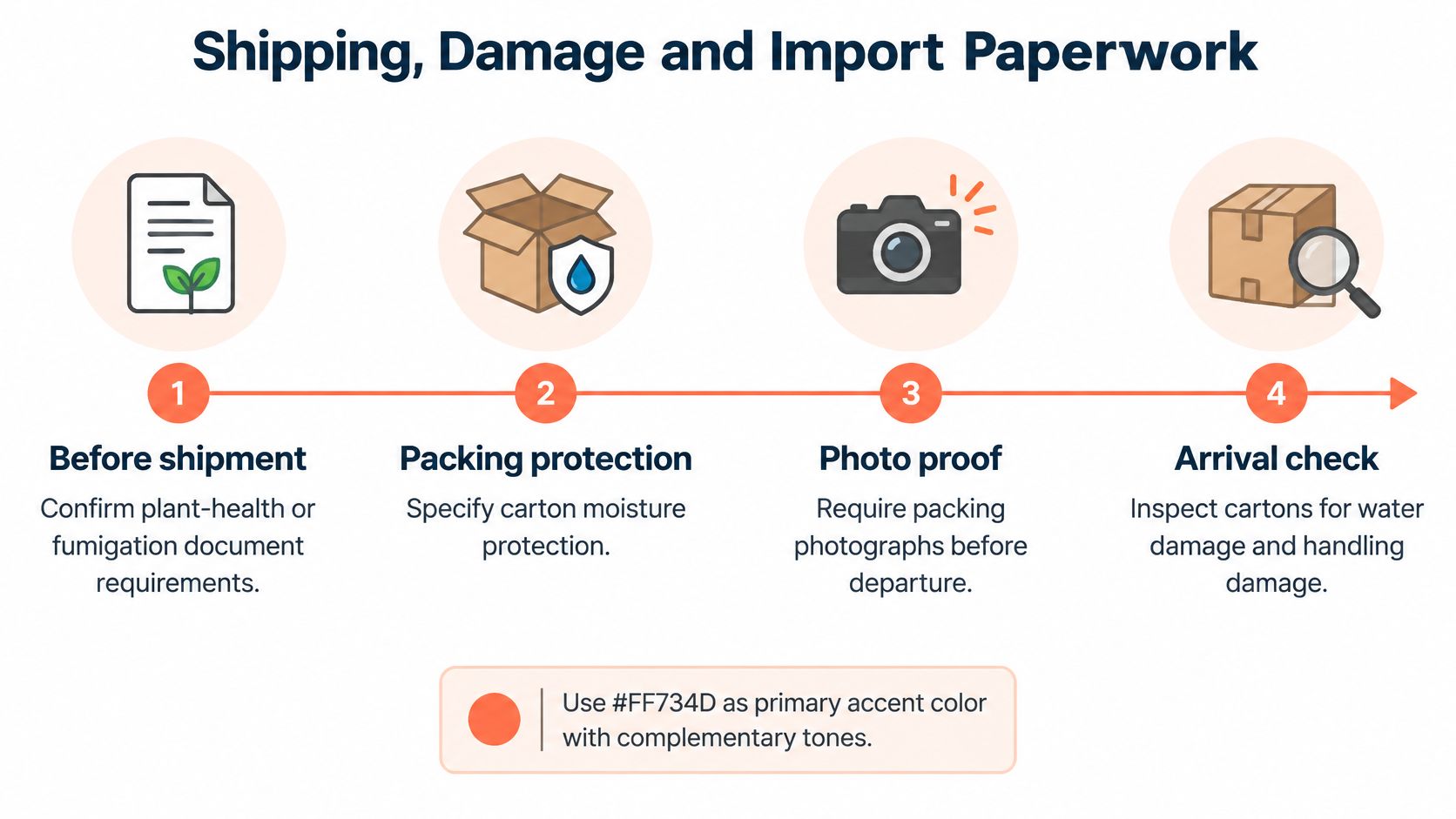
Before Shipment
Confirm the destination's plant-health or fumigation document requirements before production ends, not while the goods sit at port. Require packing photographs showing inner protection, carton labels, pallet wrapping, and lot numbers. For US imports, 19 U.S.C. §1304 requires every foreign-origin article or its container to be marked conspicuously, legibly, indelibly, and permanently with the English name of the country of origin, as the item's nature permits. Agree the exact marking method before cartons are printed.
Specify carton moisture protection in writing. Useful layers can include sealed inner bags, dry interleaving, and outer cushioning where handles or raised rims need separation. For fragile resale cartons or repacking after inspection, Large Bubble Wrap gives you a practical reference for the heavier cushioning format to request from your packing supplier.
In Transit
Ask how cartons are protected from container humidity and compression, what the freight terms cover, and who files a damage claim. Get that answer by email. Sea freight usually lowers cost per piece but extends exposure time. Air freight shortens transit and can cost far more per piece, while extra handling can still crush weak cartons. Cheaper freight isn't cheaper if breakage and mold claims erase the saving. Our overview of supply chain management basics is useful for assigning these handoffs inside a small buying team.
Arrival
Start receiving promptly, photograph outer carton damage before you break seals, and note water stains, crushed corners, and pallet tilt on the delivery record. Keep retained samples and damaged packaging until the claim is closed. Don't throw away the evidence to free warehouse space.
Paste this into every purchase order:
- Documents confirmed: Plant-health or fumigation papers checked for the destination.
- Packing approved: Moisture protection, carton strength, and label photos received.
- Origin marking agreed: Wording, place, and method approved before packing.
- Claim owner named: Supplier, forwarder, and buyer responsibilities recorded.
- Arrival evidence kept: Photos, delivery notes, and retained samples filed by lot.
Food-Safe Use, Packaging and Care for Resale
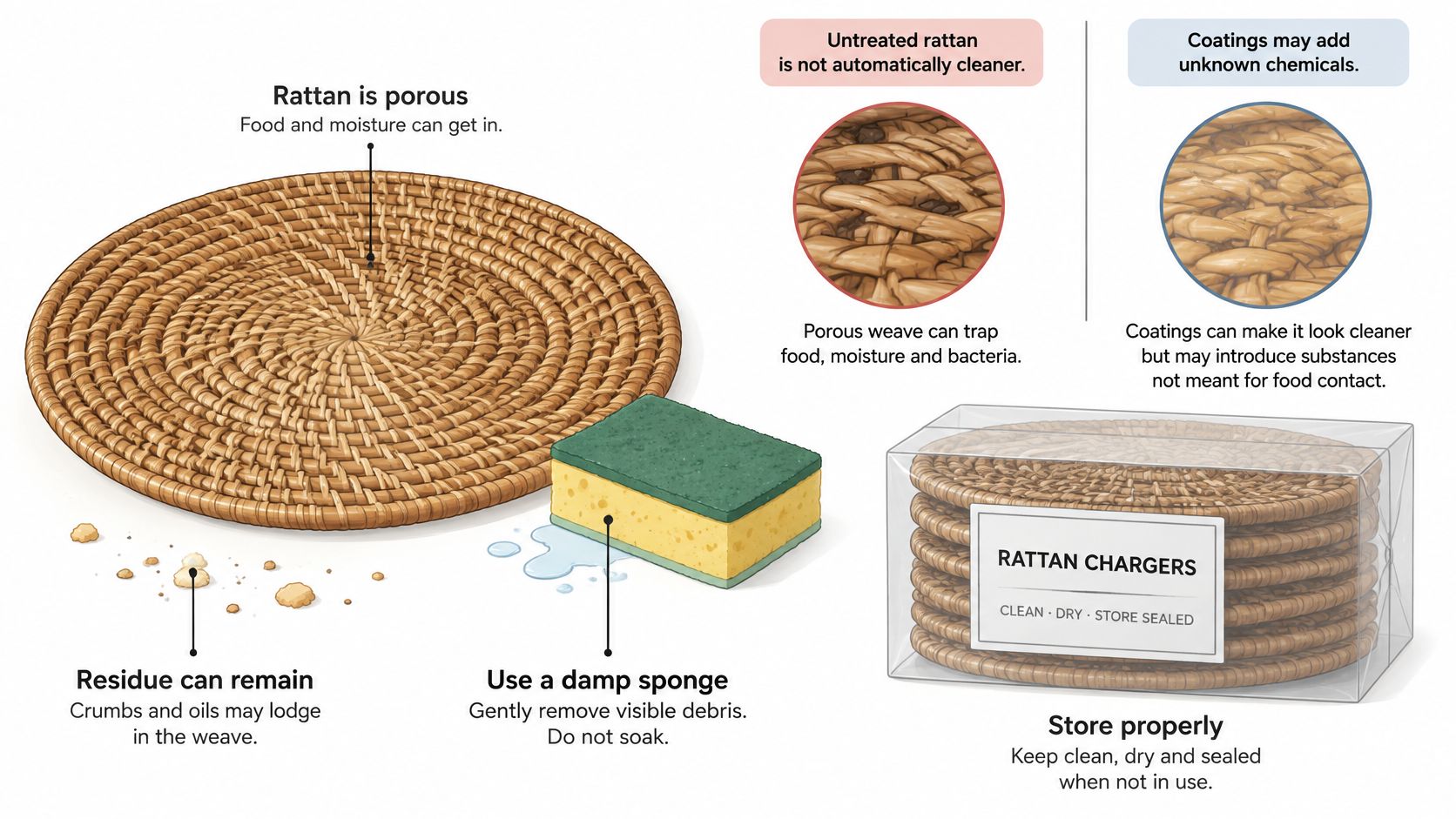
Natural fiber is not a food-safety claim. Coatings, dyes and liners decide that. A porous woven charger can hold moisture and food residue in its weave, while a glossy coating may contain unidentified chemicals or plastic. Check the finish and intended use for each SKU before making claims to buyers.
Comparable natural-fiber charger guidance on Faire describes products as intended for decorative use only, recommends a food-safe liner near food, and advises against using them in a microwave, oven or dishwasher. Cleaning may be limited to gentle washing without soaking. Unless the supplier documents the fiber, dyes, binders, sealant, liner requirements and intended-contact class, sell the charger as an underplate.
| Use case | Food contact | Cleaning and heat limits |
|---|---|---|
| Decorative under a dinner plate | No direct food contact | Gentle hand wash, no soaking, no dishwasher, microwave or oven |
| Direct food contact | Only with a documented food-safe coating and liner | Do not sell for this use until the supplier confirms finish documentation |
| Reusable rental service | No until coating and wash cycle are documented | Do not sell for rental until the supplier confirms commercial wash limits |
| Single-event décor | Decorative only unless documented | Dispose per local waste rules; check for plastic content |
Put clear care instructions inside each resale carton: "Decorative charger. Place under a dinner plate. Wipe or gently hand wash. Do not soak. Dry fully before storing. Keep away from oven, microwave, and dishwasher." Have the supplier confirm or amend the wording in writing for the exact finish supplied.
Avoid "biodegradable" and "food-safe" claims based only on the natural fiber. Coatings, synthetic thread, staples, dyes and local composting rules affect what you can claim. A durable charger that buyers clean, dry and reuse may be a better choice than flimsy décor discarded after one event.
Make product listings just as precise. Choose images that show the charger clearly, and avoid placing important text where it could be cropped. Pair accurate images with specific material and care claims to reduce avoidable returns.
Confirm the Order Before You Pay
Choose the approval route before releasing payment: approve a sample lot first, or sign off on the full order only when the supplier can meet every requirement already agreed in writing.
For a first order or an untested supplier, use a sample lot. Check it against your approved specifications, then authorize the larger quantity only if the sample passes. For a repeat order, full-order sign-off makes sense when the supplier is producing the same agreed product and the order terms are clear.
Before paying, confirm that the agreed specs, inspection criteria, shipping terms, and total landed cost are settled. Use this guide to buying from wholesalers to compare sourcing terms. JewelryBuyDirect offers factory-direct wholesale deals with bulk discounts and no minimum order, so you can test an assortment before scaling it.
Visit JewelryBuyDirect to source jewelry and fashion accessories. Apply the same discipline as you would to bulk rattan chargers: compare the written terms and landed costs, then expand orders only when the goods meet your requirements.