





Jennifer Lopez | Mon Nov 02 2026
Black Jump Rings Sizes, Gauges and Finishes
The usual advice to buy black jump rings by diameter and pick the darkest finish is bad buying advice. Say a bracelet photographs as solid black, then shows bright metal at every joint after a weekend on a wrist. The buyer didn't necessarily choose the wrong color. They chose a component without knowing what was underneath it or what would happen during assembly.
What Black Really Means on a Jump Ring
A jump ring is a short circle of wire, usually sold open, that connects a chain link, charm loop, clasp or ear wire. Its job is simple: pass through the adjoining parts, close cleanly and stay serviceable. Black describes its surface, not its metal, strength or skin-contact suitability.
That distinction matters when you're buying affordable findings for a business. A low-priced pack isn't economical if your assembler rejects the rings, your clasp binds or your customer returns a bracelet with silver-colored marks around every connection. Buy usable assemblies, not attractive bags of parts.
Think of the ring as a gate
The outside diameter is the circle you see. The inside diameter is the opening available for the chain and clasp, while the wire thickness is the material surrounding that opening.
A higher gauge number generally means thinner wire within the same gauge system. Thin stock is easier to manipulate, but it isn't automatically suitable for a heavier chain. Alloy, temper and the quality of the closure matter too.
- For fit: Measure the opening and the parts that must move inside it.
- For assembly: Check whether the wire passes through the charm hole without forcing it.
- For appearance: Judge the finish after opening and closing, not just while the ring lies untouched in its bag.
Buying rule: Order by base metal, measured size and named finish, never by the word black.
Photograph the connection, not just the color
Your product photograph should show a useful connection: several rings beside a chain end, with the joint visible. Compose the lead image for a 383:204 crop, keeping those parts within the central frame so the website doesn't cut off the subject.
Don't let the photo replace the specification. A matte finish can hide an uneven cut, and a dark background can conceal a gap. The receiving sample must tell you what the photograph can't: whether the ends align, whether the component moves freely and whether the finish survives your assembly method.
Sizes and Gauges That Actually Fit
Read a listing in this order: outside diameter, wire stock, inside diameter. If the seller prints only a diameter, ask which diameter it represents before you order.
Black jump ring sizes, wire and fit
| Size | Inside diameter | Typical fit | Pack note |
|---|---|---|---|
| Hypothetical 3 mm outside, 22-gauge wire assumed at about 0.64 mm | About 1.7 mm, calculated | Seed beads with suitable holes and tiny charm loops | Request a sample pack |
| 4 mm outside, 20-gauge | 2.4 mm | Fine trace chain and small links | Electrocoated brass, packs of 50 |
| Hypothetical 5 mm outside, 18-gauge wire assumed at about 1.02 mm | About 3.0 mm, calculated | Standard cable chain and clasps | Confirm wire thickness before bulk ordering |
| 6 mm outside, 1.0 mm wire | About 4.0 mm, calculated | Thicker curb, clasps and repairs | Black nickel, packs of 200 |
| 8 mm nominal size, 20-gauge | About 6.4 mm if the stated size is outside diameter and wire is about 0.81 mm | Larger links and sterling connectors | Black rhodium, packs of 50 or 100 |
| Hypothetical 10 mm outside, 16-gauge wire assumed at about 1.29 mm | About 7.4 mm, calculated | Several strands or cord ends | Sample with the actual cord assembly |
The listed compact example is concrete: in 2026, Fire Mountain Gems listed black electrocoated brass rings at 4 mm outside diameter, 20-gauge wire and 2.4 mm inside diameter, in packs of 50. In 2026, Tresor Jewelry listed 8 mm, 20-gauge open black-rhodium sterling-silver rings in packs of 50 or 100, but buyers should confirm which diameter the nominal size describes.
The heavy black-nickel example is a separate repair-pack specification discussed under ordering. The hypothetical rows are worked buying examples, not claims about available stock or universal gauge conversions.
Calculate the opening, then test movement
For round wire, calculate inside diameter by subtracting twice the measured wire thickness from the outside diameter. Use millimetres measured with calipers, rather than converting a gauge label and assuming the result is exact.
The compact brass ring shows why this matters. Its visible circle is substantially larger than its usable opening. A clasp loop might enter that opening yet leave too little space for the chain link beside it.
The heavier repair ring offers more room, but thicker stock still has to pass through the clasp eye. A larger nominal sterling ring offers more clearance only if the supplier's size convention matches your assumption.
- Check the smallest hole: The charm or clasp eye must accept the ring's wire.
- Check the crowded connection: Put every intended component inside the ring before assessing clearance.
- Check articulation: Rotate the clasp and chain through their normal movement. Reject a connection that wedges at an angle.
Match the finding to the assembly
Use the jewelry findings and components guide to distinguish the connector you need from a bail, split ring or other finding. A larger jump ring isn't always the right solution to an awkward attachment.
For an earring style such as Bohemian Geometric Round Resin Earrings Handmade Colorful Hoop Earrings Unisex, don't infer connector dimensions from the product name or overall silhouette. Inspect the attachment point before choosing replacement findings.
Leave clearance, but don't oversize a ring merely to avoid measuring. An oversized connector can make a small charm hang awkwardly. And a correct opening still isn't a pass if the coating flakes where you manipulate the ring.
Oxide, Plate, Anodizing and Powder Coat
The hardest black coating isn't automatically the best finding. A hard film can still crack when pliers bend the ring, while a softer finish may show wear sooner but be less conspicuous as it ages. Choose for the assembly process and finished use, not a hardness claim alone.
The comparison below separates the processes that sellers often group under the same color label.
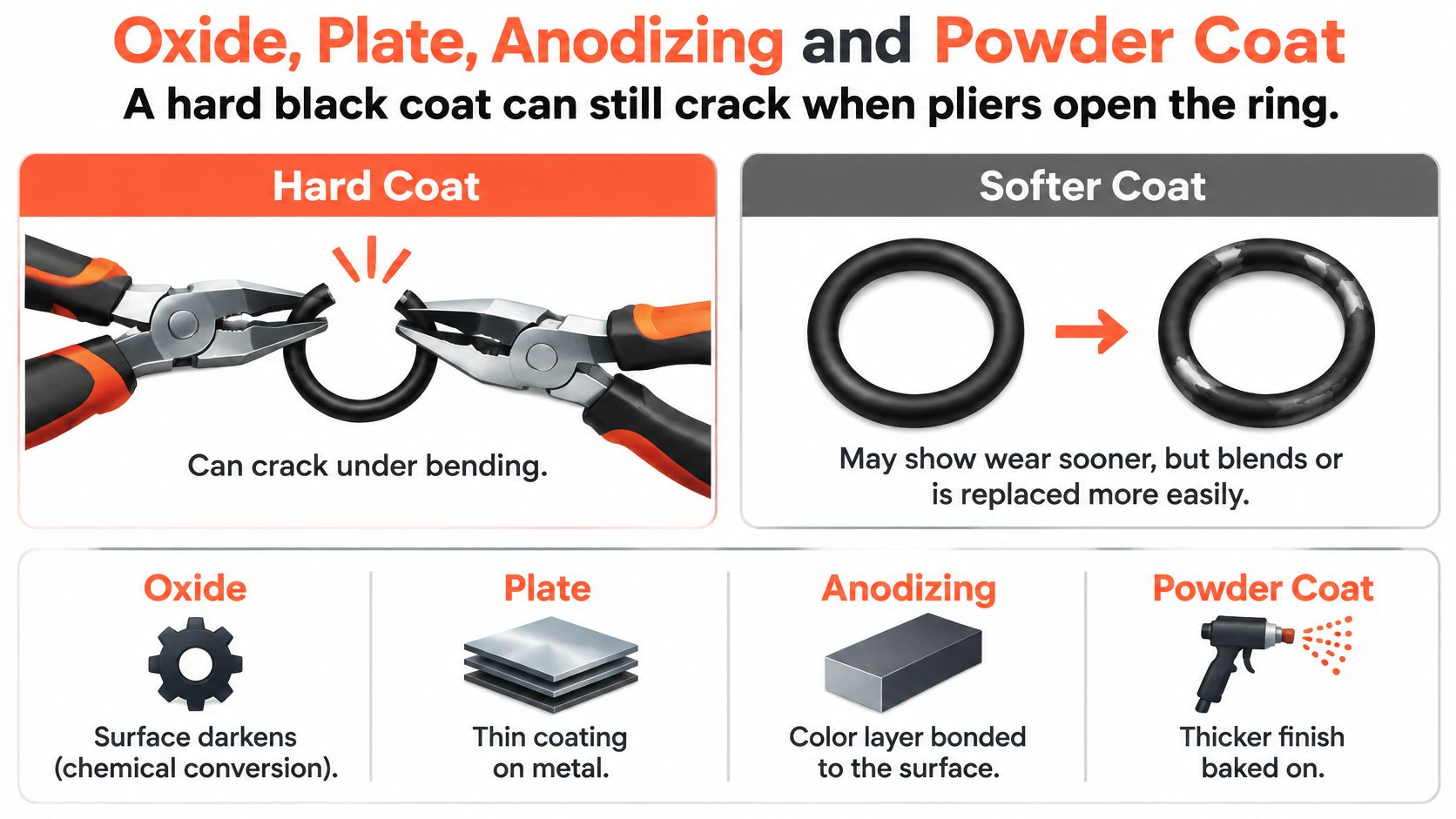
Black finishes compared for jump rings
| Finish | How it is made | Effect on size | Best job | First failure |
|---|---|---|---|---|
| Black oxide on steel | Chemical conversion to magnetite | Under 1 micrometre, almost none | Precision connectors that must retain their opening | Porous film needs oil, wax or lacquer |
| Blackened 300-series stainless | Specialized alkaline blackening | Very thin conversion layer | Sweat-adjacent findings with documented grade and seal | Scratches can reduce corrosion performance |
| Black nickel electroplate | Deposited plating, often on brass or alloy | Adds a thin layer | Affordable fashion chains and repairs | Contrasting metal can show at cuts and bends |
| Black rhodium | Precious-metal plate, commonly on sterling | Thin deposited layer | Dark-finished sterling assemblies | Contact points wear; compare replacement cost |
| Anodized aluminum or titanium | Grown oxide, dyed on aluminum or colored through oxide thickness on titanium | Limited added bulk | Lightweight color components | Forced bending can damage the colored surface |
| Powder coat | Applied polymer powder cured into a coating | Can reduce the opening | Bold matte fashion with generous clearance | Chips where pliers bite |
| PVD | Vacuum-deposited hard film | Thin deposited film | Surfaces that remain closed and experience rubbing | Bending or a fresh cut can expose the substrate |
Oxide needs a preservative
Gruppo Gaser's black-oxide guidance describes a conversion finish that turns the steel surface into magnetite, typically with a layer less than 1 µm thick. That minimal dimensional change is useful when your connection has tight clearance.
The same guidance describes the protection characterized by ISO 11408 as very limited and notes that untreated oxide may withstand only a few hours of salt spray. Its porous surface makes an oil, wax, lacquer or other preservative a functional part of the finish, not an optional upgrade.
Stainless requires its own process. Noramark's black-oxide process guidance describes specialized treatment for 300-series stainless, including an alkaline bath around 250–265°F and typical immersion of 15–30 minutes. Request the actual stainless grade, such as 304 or 316, because the blackened surface isn't proof that the original corrosion performance remains unchanged.
Separate the substrate from the coating
Black nickel and black rhodium are deposited finishes. Their underlying metals still determine what appears when the coating is breached and whether the component supports your finished-product material claim.
Powder coating needs particular attention around small openings. Measure the finished ring, not an uncoated drawing, and test the jaws you actually use in production. With anodized components, avoid forcing a misaligned closure just because the ring feels light.
For vacuum-deposited finishes, the guide to PVD coating on jewelry provides useful process context. Don't translate a coating's resistance to surface rubbing into a promise that it will survive repeated bending.
Boutiques also comparing substrates for bridal pieces can find durable wedding ring metals through Shapiro Diamonds. Keep that material-selection question separate from the performance of a bendable, coated connector.
Require base metal, finish process, topcoat and post-assembly wear evidence. If the supplier can't distinguish those items, you don't yet have a usable purchasing specification.
Nickel Claims Versus Real Skin Contact
Black, nickel-free, hypoallergenic and tested for nickel release aren't interchangeable labels. Black identifies appearance. Nickel-free is a composition claim that needs substantiation, while hypoallergenic shouldn't be treated as a guarantee that nobody will react.
A nickel-release test addresses a different question: what the article releases under the stated test conditions. A dark coating doesn't erase nickel in the alloy or underlying layers.
Apply the rule to the finished placement
For UK and EU sales, the Finnish Safety and Chemicals Agency's jewelry guidance describes nickel-release limits of 0.5 micrograms per square centimetre per week for direct and prolonged skin contact and 0.2 micrograms per square centimetre per week for pierced-body components; coated articles must continue meeting the applicable limit for at least two years of normal use.
Don't classify the finding solely by what the supplier calls it. A connector sheltered inside a necklace assembly presents a different contact question from an exposed anklet joint. A ring used in a body-jewelry assembly needs assessment according to its actual function, especially whether it enters a piercing.
A clasp that's handled regularly deserves attention, but handling alone doesn't settle the legal category. Assess how the finished article contacts the wearer rather than assigning every clasp the same classification.
A coating is part of the exposure question, not permission to ignore the metal underneath.
Ask for documents tied to the article
Build a product file that identifies what was tested and why the result applies to what you sell.
- Base alloy: Record the underlying metal and relevant grade, not just the finish color.
- Coating system: Identify the black layer, underlying layers and any seal.
- Contact category: Describe where the finding sits in the finished piece.
- Test standard and report: Check that the sample description matches the supplied component and that wear of the coating has been addressed where required.
The explanation of nickel-free jewelry claims helps distinguish a material description from release testing. Keep that distinction in your own customer-facing copy, too.
Comparable nickel-release regulation isn't in force in the United States in the same way, so a US-only hypoallergenic label doesn't establish compliance for European resale. Nor does a matte photograph or a tarnish-resistance claim answer a sensitive-skin customer's question.
Choose sheltered decorative connectors primarily for fit and appearance, while still describing their materials clearly. For rings that rest on skin or participate in a piercing assembly, require documentation appropriate to that use. A darker finish isn't a safety upgrade.
How to Inspect a Wholesale Pack
Inspect the first pack before committing to a larger purchase. Keep an approved sample beside the receiving sheet so later shipments can be compared against a physical reference, not your memory of a photograph.
Use the visual checklist for bench organization, then apply the purchasing checks below.
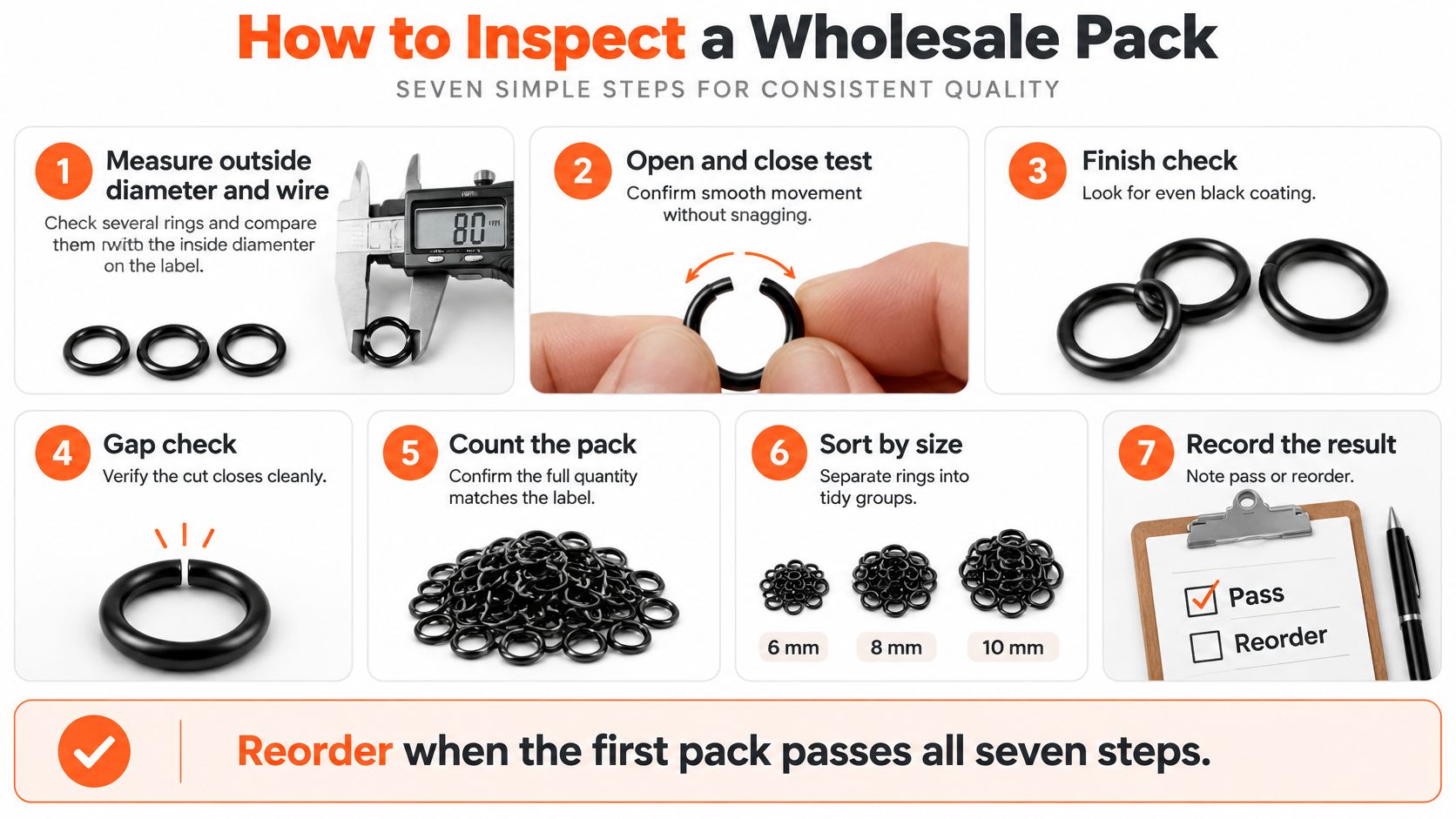
Run the receiving checks in order
- Measure the actual components. Use digital calipers on several rings, checking outside diameter and wire thickness against the labeled opening. Count the pack and separate mixed sizes before issuing stock to an assembler.
- Confirm the base metal in writing. Accept a clear alloy description, a specified stainless grade or sterling identification. Black metal isn't a material specification.
- Identify the complete finish. Record oxide, black nickel, black rhodium, anodizing, powder coat or PVD, together with any oil, wax or lacquer. Look for uneven coverage and debris around the cut.
- Request relevant durability evidence. Ask whether the evidence covers an intact ring or one opened and closed during assembly. ASTM's pin-abrasion standard provides a named abrasion method; request the applicable pin-abrasion or rotary-platform wear method, specimen description and results rather than a general durability certificate.
- File skin-contact documentation. For European resale, match the nickel-release paperwork to the intended placement. Don't assume a report for another component or coating color covers this pack.
- Open and close five sample rings. Use smooth-jaw chain-nose pliers, examine the cut and bending area under magnification, then run a fingernail over the closure. Reject snagging edges, misaligned ends and obvious coating damage.
- Write the listing from the accepted specification. State metal, size, wire and coating. Remove unsupported words such as premium, permanent and hypoallergenic rather than copying the supplier's sales text.
Make the report prove the claim
For stainless corrosion evidence, ask whether the report follows the relevant process specification. The previously described stainless process uses a MIL-DTL-13924D Class 4 benchmark of 96 hours in 5% salt spray before supplementary preservative treatment. That's a process benchmark, not a promise of equivalent lifespan on a wrist.
The FTC Jewelry Guides expect truthful representations of material characteristics, including type, grade, quality, metallic content, size, durability and value. Your listing should be no broader than the evidence in your product file.
Precious-metal language needs equal care. The FTC's revised Jewelry Guides discussion addresses coating descriptions, coverage, thickness and reasonable durability expectations. A black surface doesn't create precious-metal content, and a precious-metal coating claim requires the appropriate purity and amount disclosures.
Accept-or-return test: If all five opened samples flash a contrasting core, treat the pack as a color lot, not a durable finding.
Accept that lot only if the disclosed appearance and intended decorative use allow it. Otherwise, return it before the same fault reaches finished stock.
Matching Rings to Jobs and Ordering
Match the pack to the work on your bench. The cheapest connector isn't the best value if it creates an awkward joint or forces you to weaken the material description of the finished piece.
Use the project examples as a starting point, not permission to skip sample assembly.
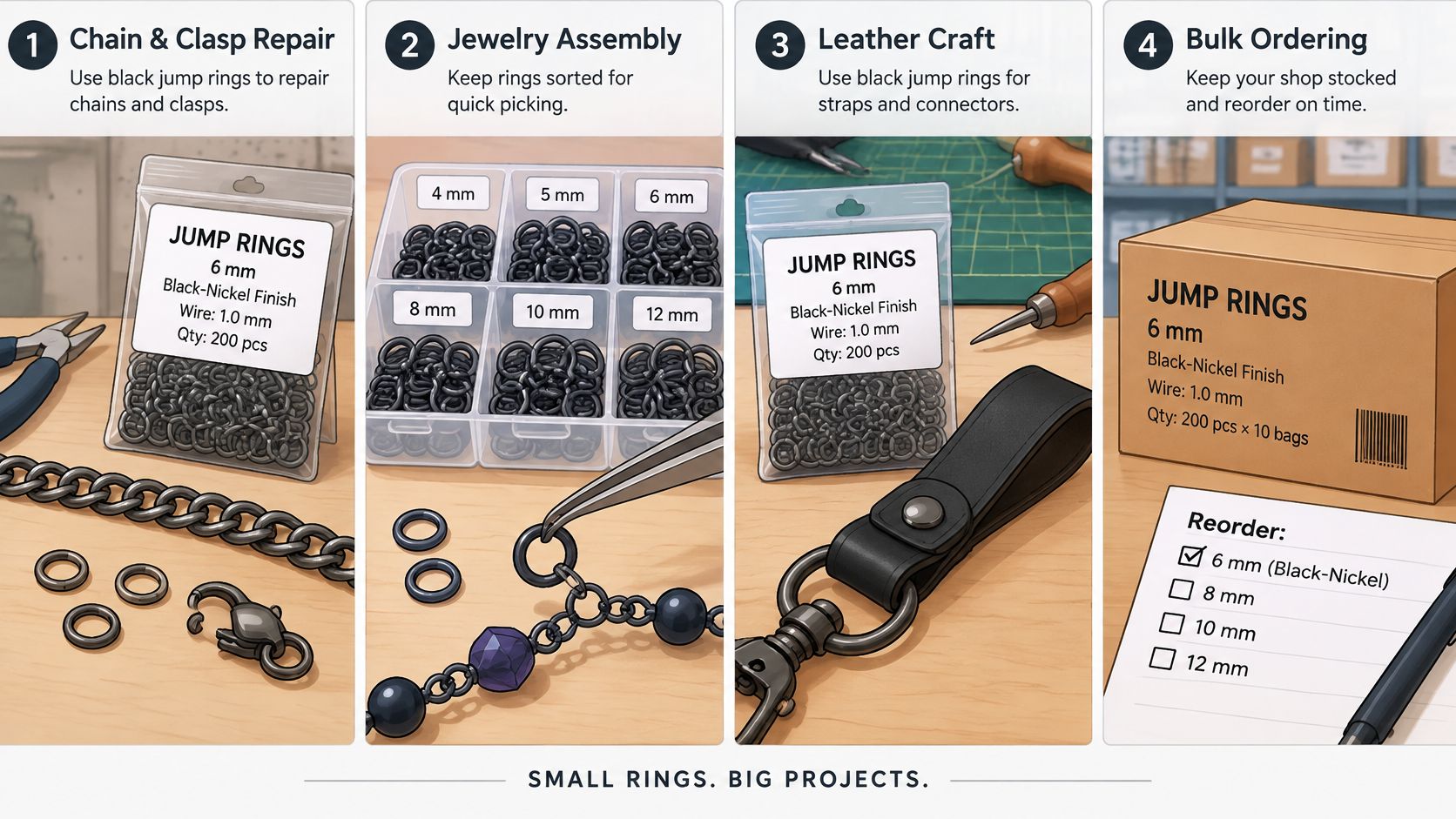
Choose for the job
Chain and clasp repair. For a curb-link or lobster-clasp connection, the heavy black-nickel format is a practical candidate. In 2026, Transglobal Trading listed 6 mm outside diameter, 1.0 mm wire rings in 200-piece packs, priced at $1.86 per pack at quantities of 50 or more. At that listing's pack price, finish suitability deserves more attention than shaving the purchase cost.
Dark-finished sterling. Use the sterling black-rhodium pack for a silver pendant or connector when its opening suits the assembly. Don't substitute a brass finding while continuing to describe the entire piece as sterling.
Light fashion assembly. The compact electrocoated brass pack is a sensible sample candidate for small charm dangles and trace-chain connections. Keep it out of applications that need frequent reopening unless your samples demonstrate acceptable performance.
Skin-contact pieces. Anklets, exposed bracelet clasps and body-jewelry joins require placement-specific documentation. Price and color don't resolve that decision.
For assembly, open a ring sideways with two smooth-jaw chain-nose pliers. Don't pull the ends directly apart, which distorts the circle and makes alignment harder. Replace a finding that exposes an unacceptable contrasting core rather than disguising the damage with a touch-up.
Use this demonstration alongside a hands-on test with your chosen ring and pliers.
Order from a locked specification
- Write the purchase specification: Base metal, outside diameter, wire thickness, inside diameter, finish and topcoat.
- Attach applicable documentation: Match skin-contact evidence to the actual finished placement and market.
- Preserve the material claim: Use findings consistent with the jewel you're selling.
- Approve the assembly: Account for rejected components and rework, not just pack price.
- Scale from a current seller: Measure an existing bestseller, assemble the sample connection and approve the opened findings before increasing the order.
Once that specification is settled, we offer direct wholesale jewelry at JewelryBuyDirect across Necklaces, Earrings, Bracelets, Rings, Body Jewelry and Jewelry Making. Our materials include 925 sterling silver, titanium steel, stainless steel, copper, gemstone and pearl, giving boutiques and small brands a broader assortment to evaluate against their buying requirements.
JewelryBuyDirect offers direct wholesale jewelry for boutiques, makers and growing accessory brands. Bring your measured connector specification and material requirements to JewelryBuyDirect, then compare suitable jewelry-making components and finished pieces before building your next order.