





Jennifer Lopez | Tue Oct 27 2026
Big Cross Pendants: Sizes, Weights and Wholesale Sourcing
A heavier cross isn't automatically a better cross. The FTC Jewelry Guides expect truthful representations of weight, metallic content, size and durability, not just an impressive appearance. For a wholesale buyer, a pendant that looks substantial but arrives without those specifications is an unresolved sourcing risk.
Buy big cross pendants as wearable assemblies, not isolated decorations. The pendant, bail, chain, surface finish and skin-contact materials must work together. Affordable jewelry becomes expensive inventory when customers complain about an uncomfortable weight, a chain that won't fit or exposed base metal.
Big Cross Pendant Sizes and Weights at a Glance
"Large" is the least useful word on a cross listing. One supplier's large is a daily-wear piece and another's is a pendant that dominates the chest, and buying without measurements converts that ambiguity into returns. Require four fields on every spec sheet before you assign a size tier: face height and width, total hanging height including the bail, depth and pendant-only weight.
The Morgan Library collection record documents a Byzantine gold cross measuring 72 × 51 mm, with a 10 mm suspension loop. Other museum references, including a Kerch pectoral cross and a Philippine gold cross, extend that scale range further. These historical examples show scale range; they do not describe today's retail sales mix.
Measured reference sizes for big cross pendants
| Reference piece | Size profile | What it tells a buyer |
|---|---|---|
| Morgan Library Byzantine gold cross, sixth to seventh century | 72 × 51 mm, 10 mm loop | Large wearable reference |
| Kerch Byzantine pectoral cross, seventh century | Compact gold face with substantial recorded mass | Gold weight reference, constructed from embossed and chased sheets |
| Philippine gold cross, seventeenth to nineteenth century | Wide-format face, broader than tall | Width reference; broad faces change chest coverage |
| Met Byzantine gold cross, approximately 500–700 CE | Largest reference in this set, with recorded depth | Oversized outer reference; depth signals relief and projection |
| Statement pendant drop, chain benchmark | 42–55 mm vertical drop | Pairing reference for a 3.5–5 mm chain |
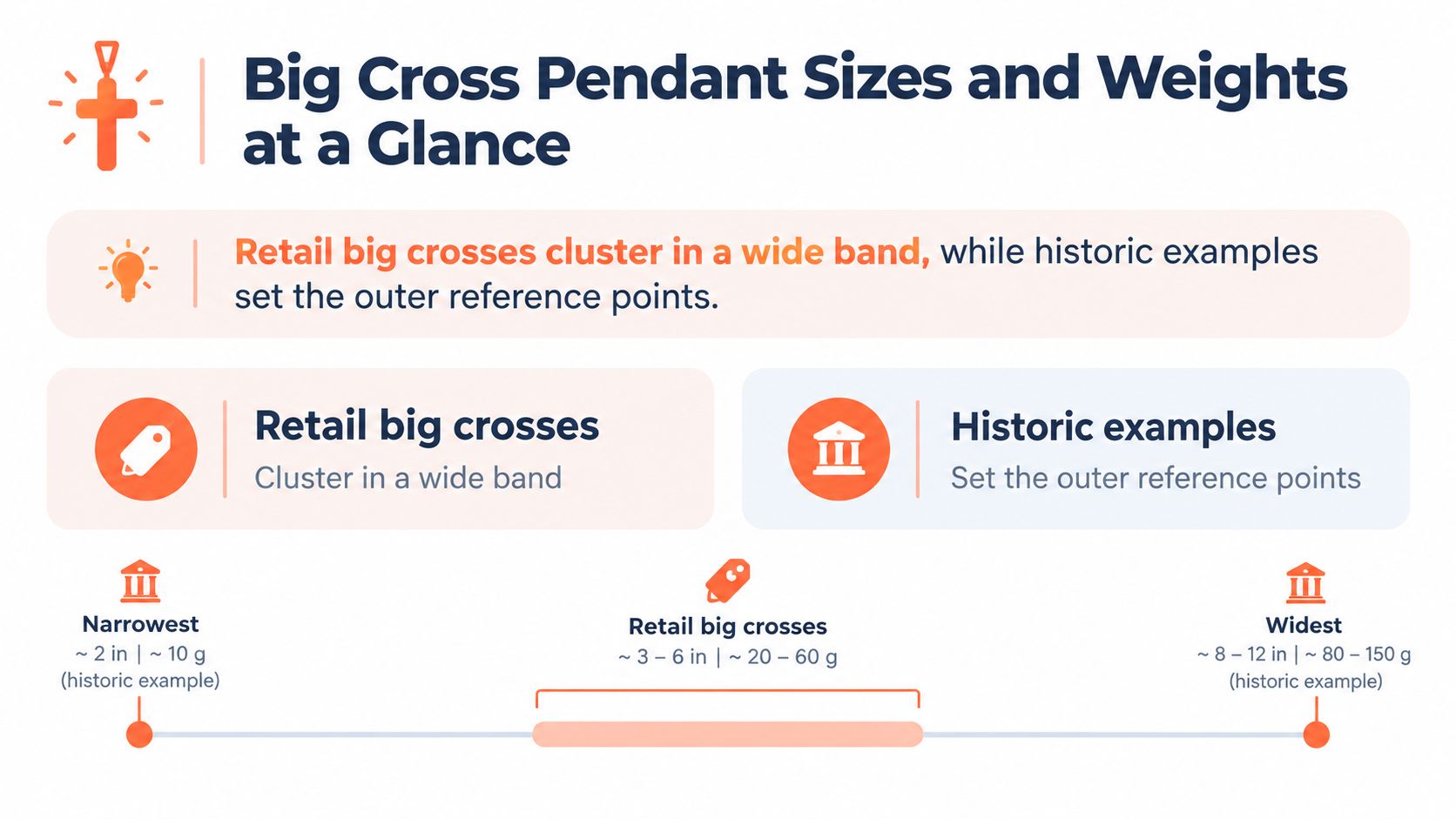
The Morgan example separates body dimensions from the suspension loop, a distinction worth copying into your spec sheet because suppliers measure hanging height differently. The Kerch piece shows why weight needs its own checkpoint: sheet-built construction carries real mass without wearing like a solid casting. The Philippine cross shows why width deserves its own listing field, since a broad pendant covers more chest than a taller, narrower design of similar height. Depth, as the Met piece illustrates, tells you how far the cross projects off the chest and how likely it is to catch on clothing.
Build size tiers from measurements
Use small statement, mid-size and large as internal merchandising labels, then publish the actual dimensions beside them so customers never guess what a tier means. Place the 42–55 mm statement-drop range in the tier that fits your assortment instead of treating it as a universal definition.
Treat weight as a quality-control checkpoint. Solid and hollow versions with similar outlines can differ substantially in mass, so weigh every SKU separately on intake and record whether the bail is included in the listed height. A pendant that arrives lighter than spec is usually hollow, thinner-gauge or smaller than quoted, and each of those changes how it hangs and how the finish wears.
For the website cover, prepare the hero image at 383:204. Keep the complete cross and bail inside the safe framing area so the website crop preserves the details customers use to judge scale.
Chain Pairing and Bail Clearance for Heavy Crosses
A big pendant is a weight hanging from a rope. The chain is the rope, and the clasp is the knot taking the strain. Buying a strong-looking pendant without checking its supporting hardware is poor assembly buying.
The BlueStone chain-pairing guidance recommends a chain weighing approximately 1.5–2.5 times the pendant, making a 6 g cross a pairing candidate for a 9–15 g chain. For statement crosses with a 42–55 mm vertical drop, it recommends 3.5–5 mm chain gauge. Treat this as a screening benchmark, not a substitute for checking construction and connections.
Chain weight targets by pendant weight
The calculated targets below apply that benchmark.
| Pendant weight | Chain weight target, 1.5–2.5× | Chain gauge guidance | Risk if the chain is too fine |
|---|---|---|---|
| 3 g cross | 4.5–7.5 g | 3.5–5 mm if drop is 42–55 mm; otherwise assess construction and fit | Light chain may still sag under a wide face |
| 6 g cross, benchmark | 9–15 g | 3.5–5 mm for 42–55 mm drops | Deflection and clasp strain |
| 12 g cross | 18–30 g | 3.5–5 mm if drop is 42–55 mm | Connector and jump-ring fatigue |
Start with the lighter row: low mass doesn't eliminate balance problems when a cross has a wide face. The benchmark row illustrates an ordinary pairing calculation. The heavier row requires more attention to the jump rings and clasp, not just a thicker-looking chain.
Excessive deflection lets the cross sag or twist. Repeated loading can also concentrate wear at connectors, so inspect the assembled necklace while it hangs and moves.
Measure the opening, not the outside of the bail
Record the bail's internal height and width, then physically pass the intended chain through it. Check the end fitting too, since a chain can fit while its terminal hardware cannot. Use this practical guide to pendant bail construction and fit when comparing attachment styles.
Don't confuse a complete-necklace weight with pendant-only mass. A catalog entry such as the Bohemian Handmade Starfish and Seashell Pendant Necklace for Women Stainless Steel Beach-Themed Jewelry is categorized as a necklace, so its listed weight shouldn't be repurposed as a pendant load specification.
Pairing rule: Publish pendant mass, hanging height, bail clearance and recommended chain gauge together. A visually delicate chain isn't an acceptable compromise if the assembly hangs badly.
Materials and Finishes That Hold Up to Daily Wear
A broad cross rests against skin and clothing, making its underside as important as its decorative face. For all-day wear, prioritize documented composition over an elaborate finish. Customers can't evaluate an undisclosed base metal from a polished product photograph.
The Danish Environmental Protection Agency's nickel guidance identifies an EU nickel-release limit of 0.5 micrograms per square centimeter per week for jewelry intended for direct, long-term skin contact, and explains that nickel exposure can cause lifelong allergy or eczema in susceptible people. A larger contact surface makes careful material selection especially relevant, but size alone doesn't establish compliance.
Base metals for big cross pendants compared
Relative costs below are purchasing categories, not quoted prices. Compare finished pieces with equivalent construction and documentation.
| Material | Daily-wear profile | Skin-contact note | Relative cost |
|---|---|---|---|
| 925 sterling silver | Tarnishes; needs appropriate polishing | Test documentation needed; not automatically nickel-free | Mid |
| Stainless steel | Durable, generally low-maintenance surface | Often selected for sensitive-skin ranges; confirm grade and testing | Low |
| Titanium | Lightweight; inspect the specified surface treatment | Confirm actual composition, not just titanium-colored wording | Mid to high |
| Copper | Darkens with wear and moisture | Skin discoloration is possible; assess coatings and alloy composition | Low |
| Unspecified alloy | Unpredictable composition and batch consistency | High uncertainty until composition and nickel release are documented | Low |
| Gold-plated alloy | Exposed edges and raised relief need close inspection | Assess both the coating and the underlying metal | Low to mid |
| Solid gold | No plated layer to expose; weight remains important | Alloying metals still require disclosure and assessment | High |
Sterling has a measurable meaning. Under the FTC's silver-labeling guidance, sterling silver must contain at least 925 parts per 1,000 pure silver, equivalent to 92.5%. For U.S. listings, silver-colored alloy and silver plating aren't interchangeable with sterling.
Choose documentation before decoration
For an affordable daily-wear range, start by comparing documented steel and sterling designs. Request the actual alloy designation, care method and relevant skin-contact testing. For titanium, verify that the supplier means titanium rather than a loosely named steel product.
A heavily plated oversized alloy pendant can create more customer-service exposure than a simpler, clearly documented design. The customer eventually wears the complete construction, not the finish name.
Hypoallergenic isn't adequate evidence on its own. Ask for the test report, identify which finished product it covers, and check that its material and finish match the purchase order. Don't extend a report for an uncoated sample to a differently plated production item.
Plating Thickness and Wear Checks on Sample Crosses
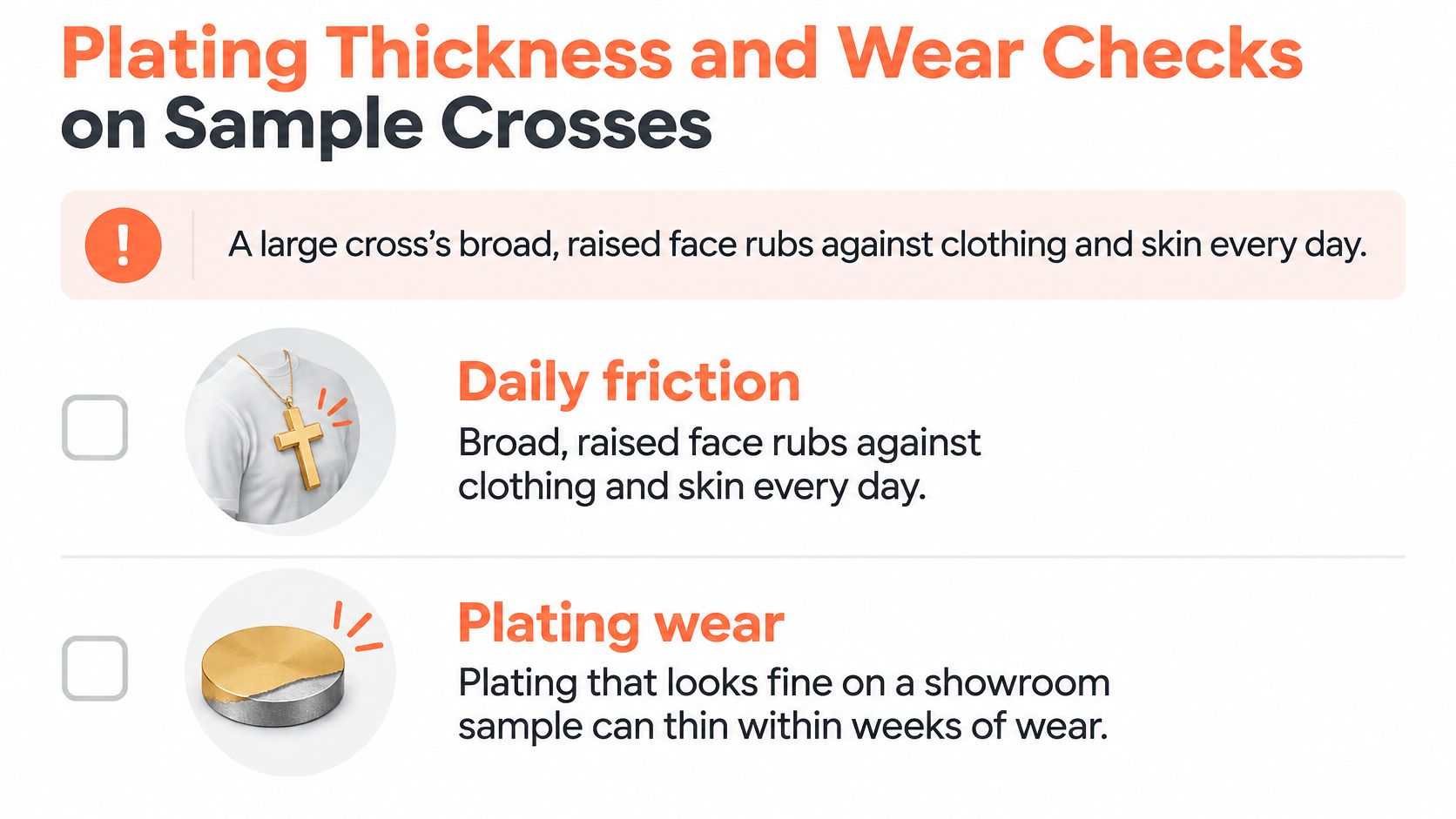
A large cross's raised face rubs against clothing, while its underside and bail encounter skin and hardware. A pristine showroom sample doesn't establish wear life. Your inspection must cover the exposed contact points, not just the broad center panel.
Use this visual guide to identify where contact deserves attention.
The Jewelry Project finishing specification guide identifies approximately 1 micron as a commonly used plating target for pendants and earrings; finishing guidance also cites approximately 0.1–0.2 microns of rhodium for useful wear resistance on sterling silver. These aren't interchangeable quality grades. Coating metal, preparation, geometry and friction all affect performance.
Inspect the coating as a system
- Request the complete coating specification. Obtain base-metal composition, plating material, nominal thickness and tolerance. A nominal target without an acceptance tolerance doesn't tell your inspector what passes.
- Ask for representative X-ray fluorescence records. XRF provides a practical nondestructive way to assess coating thickness. Require identification of the sample and measurement locations rather than accepting an unexplained instrument screenshot.
- Examine exposed geometry first. Use a loupe to check arm tips, raised relief, corners and bail edges. Look for color changes, roughness, bare spots and inconsistent coverage.
- Compare exposed and recessed areas. Inspect under neutral lighting and turn the cross through different angles. Recesses may look excellent while the features customers touch already show weak coverage.
- Record results by batch. Save the supplier specification, sample photographs and inspection decision together. Keep an approved reference sample so subsequent deliveries have a physical comparison.
Reject defects before customer wear
Thin projections and sharp edges concentrate contact and are harder to protect consistently than sheltered surfaces. Reject a batch that arrives with exposed substrate or visibly worn edges rather than planning to explain those defects through care instructions.
Use the guide to gold-plating longevity to develop care language that matches the finish. Don't turn an occasional-wear coating into a daily-wear promise through optimistic copy.
The following video can accompany staff training, while the written acceptance specification remains the purchasing standard.
Design Families and the Buyers They Suit
Stock design families with distinct customer purposes. A plain devotional cross and a heavily ornamented fashion pendant may share an outline, but they shouldn't share identical copy, photography or buying assumptions.
These silhouettes provide a useful visual starting point.

Match the silhouette to the purchase
- Plain cross: Make a simple shape the core of an everyday devotional range. Compare face dimensions, edge smoothness and pendant mass before choosing between near-identical versions.
- Crucifix: Position the figure explicitly for Christian shoppers and faith-related gifting. Show a close-up so customers can examine the figure and relief.
- Celtic knot cross: Use interlaced designs for customers seeking knotwork, bohemian styling or layered looks. Inspect openwork for rough internal edges that can catch fabric.
- Gothic or ornate cross: Assign these to alternative-fashion merchandising. Deep relief and projecting details require extra finish inspection, so budget inspection time accordingly.
- Engraved or personalized cross: Build the offer around gifting and occasions. Confirm the usable engraving area, placement and production approval process before accepting personalized orders.
Religious meaning isn't a modern marketing invention. The Metropolitan Museum of Art dates its substantial Byzantine gold cross to approximately 500–700 CE, records dimensions of 9 × 6.8 × 1.2 centimeters, and identifies it as the largest known cross worked in opus interrasile, decorative openwork cut into thin metal. Its documentation connects cross pendants with prayer, protection and miraculous assistance.
Separate trend traffic from devotional intent
According to Accio's Amazon trends analysis, gold and silver cross-necklace search volume increased 16.84% month over month in June 2025. Separately, Accio's Christian-jewelry trend coverage describes an early July 2025 peak coinciding with pop-culture visibility, including Love Island USA, alongside seasonal interest in August–September and around December. Those observations don't establish that every searcher wants religious jewelry.
Accio's men's cross-necklace analysis reports men's trendy cross-pendant necklace search volume rising from 190 in May 2025 to 218.6 in September 2025. That supports testing a dedicated men's selection, not assuming every oversized design belongs in it.
Keep faith-led and fashion-led photography, keywords and landing pages distinct. Let customers choose the meaning rather than assigning it to them.
After a trend spike, retain proven designs through gift, devotional and personal-style placement. Reorder against actual sell-through by design family, finish and size, not search interest alone.
Writing Metal, Plating and Size Claims That Hold Up
Write the listing as the customer's purchasing specification: a named metal, a qualified finish description and dimensions that match the approved sample. Those details give your team a measurable quality-control target before the pendant ships.
The FTC's gold-description guidance says gold wording must be adequately qualified when an item isn't composed throughout of gold or a gold alloy; describing a plated cross as 14K gold can imply a solid-gold product. The guidance also addresses sufficient coating thickness and coverage for reasonable durability.
Replace vague wording with a verifiable record
Use wording such as stainless steel with gold plating, followed by the supplier-confirmed plating material, nominal thickness and intended wear conditions. Publish that wording only when the product file supports each element. On a large cross, incomplete finish details carry real risk: constant skin and clothing contact makes thin or poorly documented plating a direct cause of wear complaints.
Hold the product when the supplier has not provided a coating thickness. Thick plating and long-lasting finish are placeholders, and they create the same problem as missing weight: the customer receives a promised experience your warehouse cannot inspect or reproduce.
Build each product page from these fields:
- Metal identity and fineness: Record the substrate separately from surface color and coating.
- Finish construction: Include plating material, application method, nominal thickness and relevant durability qualifications.
- Pendant measurements: Separate body height, total hanging height, width and depth.
- Weight: Identify whether the measurement covers the pendant, chain or complete necklace.
- Compatibility: Publish internal bail clearance and the recommended chain specification.
- Wear and care: State supported use conditions and the cleaning method appropriate to the finish.
Make missing information a publication stop
A blank critical field means the item isn't ready to publish. Mark a field inapplicable when the product lacks that feature by design. When the supplier has not provided the value, mark it pending and pull the item from the publishing queue.
Have the person writing the listing compare it against the approved sample and purchase order. This catches descriptions copied from a similar-looking item with a different substrate or coating.
For U.S. sales, align material wording with the applicable Jewelry Guides before publishing. For EU-facing skin-contact products, retain the relevant conformity documentation with the product record.
Publication gate: If your customer-service team couldn't verify a claim from the product file, remove the claim or obtain the missing evidence.
Choosing a Wholesale Source and Ordering a Test Batch
An oversized cross magnifies every sourcing shortcut. Under-declared weight, a tight bail or thin plating turns into returns and complaints fast, so choosing a supplier is really choosing a quality-control partner. Match the sourcing model to your store's order rhythm: a boutique testing unfamiliar silhouettes needs flexibility, while a retailer replenishing a proven design needs repeatable production.
Compare landed unit cost: freight, applicable duties, inspection time and the share of stock that arrives unsellable. The unit price that matters is the one attached to heavy pieces your customers can actually wear.
Wholesale sourcing models for big cross pendants
| Sourcing model | MOQ | Pricing basis | Best fit |
|---|---|---|---|
| No-MOQ platform: JewelryBuyDirect | No minimum order quantity | Factory-direct; the platform states pricing 15–30% below market averages | Dropshippers, small boutiques and individual-design testing |
| Traditional factory direct | Obtain a written minimum by design, finish and customization | Factory pricing; terms set per supplier | Repeat runs of a proven design |
| Local wholesale distributor | Confirm opening-order and reorder minimums | Distributor pricing; obtain a delivered quote | Quick restock of familiar styles |
Those stated terms also include 7-day returns, damage protection and buy-now-pay-later options. Confirm current terms in writing and compare them against other quotes. A return window only helps after a defect reaches you; it never inspects the batch.
Private-label availability isn't established by the sourcing model. Get written confirmation of branding options, setup charges, artwork approval and reorder terms before committing to packaging spend.
For a structured due-diligence process, Reddog Consulting Group explains how to vet wholesale suppliers before placing orders. Use that process to confirm supplier identity and commercial terms before evaluating the pendant itself.
Run the first order as an acceptance test
- Send your product-record template. Require written confirmation of dimensions, pendant-only mass, bail clearance and intended chain pairing. Resolve measurement definitions before ordering.
- Obtain material and coating records before paying. Confirm that documents identify the actual finish and construction you're purchasing. For skin-contact pieces, the substrate and coating records are the product. A generic factory certificate isn't a finished-product specification.
- Select a deliberately mixed sample set. Include different sizes and, where available, plated and unplated designs. This reveals whether the supplier controls both geometry and finish consistently.
- Measure before approving. Use a digital scale for mass and calipers for dimensions and bail clearance. Inspect projecting details under a loupe, then assemble the intended chain and check movement.
- Release only accepted designs. Photograph defects, quarantine failed items and request a written resolution. Judge edges and raised details against the wear standard set in the sample-plating inspection step, and keep any piece that fails out of saleable stock.
Record who approved each sample and retain it as the reorder reference. Confirm the start point, exclusions and reporting procedure for any return window, and report damage immediately with photographs.
Affordable sourcing means controlling the cost of a saleable, accurately described product. Preserve that standard when you expand into other jewelry and fashion accessories, rather than lowering inspection requirements for inexpensive items.
JewelryBuyDirect offers wholesale jewelry and fashion accessories with no minimum order quantity, making it an option for testing big cross pendants before committing to a deeper assortment. Visit JewelryBuyDirect, shortlist designs by material and dimensions, and request the weight, bail and finish documentation before placing your test order.