





Jennifer Lopez | Fri Oct 30 2026
Acrylic Beads Wholesale Buying Guide for 2026
Buying the biggest bag at the lowest per-piece price is bad advice. When you're buying acrylic beads wholesale, the winning lot is the one you can turn into sellable jewelry without hours of sorting, then reorder in the same shade and hole six months later. A cheap carton isn't a bargain if your maker can't string it or your next delivery no longer matches your product photos.
For boutiques, marketplace sellers, and small accessory brands, acrylic makes sense when you buy for usable yield, lightweight designs, and repeatability. Negotiate the specification before the discount, and treat compliance paperwork as part of the product, not an optional extra.
PMMA Acrylic Beads Properties and Shipping Behavior
Acrylic's low weight helps keep statement jewelry comfortable and shipping weight manageable. The lot still needs to survive drilling, assembly, and handling: rough holes or a shade shift can turn a low quote into sorting, rework, and returns.
PMMA, or polymethyl methacrylate, is a light, color-stable plastic suited to volume jewelry for boutiques, online shops, and small brands. The PMMA technical sheet published by Teknik reports a density of approximately 1.19 g/cm³ and moisture uptake of about 0.30% after 24 hours at 23°C under ISO 62. Its impact figures also matter: the Teknik PMMA technical sheet reports notched impact strength around 1.3–2 kJ/m², compared with unnotched Charpy values around 10–17 kJ/m².
A bead's body and its drilled opening face different stresses. A narrow letter-bead bridge, a rough hole edge, or a crimp pressed hard against the surface can become a crack starting point. Check samples as finished components, not just as loose beads.
For large earrings, layered bracelets, and color-led necklaces, keep the assembly gentle and the care instructions simple:
- Inspect hole edges: Use a jeweler's loupe to check for chips, melt rings, and cloudy drilling fuzz.
- Test the assembly: String the actual cord, spacers, and closures, then drop-test the finished sample over a tray.
- Avoid forced fits: Don't push oversized cord through a tight opening or squeeze a crimp directly against the bead.
- Protect the finish: Keep samples away from hot cars, acetone, alcohol-heavy cleaners, and nail products that may haze or craze the surface.
Buy a defined material, not a vague plastic description
PMMA has an established industrial supply chain. Sumitomo Chemical's PMMA report projected overseas demand, particularly in China, to reach approximately 3 million metric tons annually by 2027. That projection concerns resin demand, not bead output. It does not guarantee consistent molding, drilling, or coating in a finished bead lot.
Write the order around PMMA resin identification, the exact hole requirement, coating type, and a retained production sample. Those details give you a basis for comparing the delivered lot with the approved sample and requesting the same specification on a reorder.
Practical rule: Approve the bead after assembly, not just while it's loose in a sample bag.
Include a care card that recommends wiping with a damp cloth. Clear cleaning instructions help prevent avoidable surface damage and customer-service complaints.
Sizes and Hole Diameters to Spec First
A bead that matches your color story but not your cord is dead stock. Set the outer size and finished hole together, then approve both on a sample before placing a volume order. The ranges below are starting specifications to test, not guaranteed fits. Ask the supplier to confirm the usable hole after coating.
Acrylic bead sizes, hole clearances, and common uses
| Outer size | Starting cord or hole specification | Typical wholesale use |
|---|---|---|
| 4 mm | Specify clearance for fine cord or wire | Spacers and small jewelry, subject to an appropriate safety assessment |
| 6 mm | Specify clearance for fine cord or wire | Everyday bracelets and earring drops |
| 8 mm | Test with 1 mm elastic or thin leather | Stretch bracelets and stacks |
| 10 mm | Test with 1 mm elastic or leather cord | Common fashion bracelet size to test |
| 14 mm | Specify clearance for the full cord or multi-strand bundle | Bold cuffs and necklaces |
| 16 mm | Test with 2 mm cord and confirm clearance | Chunky resort and festival lines |
| 20 mm | Test with 2 mm cord and check wall thickness | Focal beads |
For stretch bracelets, sample 8 mm and 10 mm beads first. Compare their visual scale, comfort, and spacer proportions. Choose smaller beads for subtle accents and larger ones when the bead should dominate the design.
Photographs cannot confirm a hole's usable diameter. A wide entrance may narrow at the center, and coating can reduce the opening.
Specify clearance rather than a nominal match
A 1.0 mm hole paired with 1 mm elastic leaves no allowance for coating, cord variation, or a rough bore. Specify enough clearance for the cord to pass without stretching, shaving, or forcing it.
Oversized holes create a different problem. A 4 mm hole through a 6 mm bead leaves little material around the bore. Check the wall, shape, and assembled piece under load before approving that combination.
Request a 20–50-piece strike-off in the exact proposed color, finish, and hole size. Pass the intended cord through ten beads, then check whether the design's crimp or jump ring also needs to pass through the opening.
- Measure the body: Use digital calipers for outer dimensions. Record rondelle thickness separately.
- Check the bore: Use pin gauges or known-diameter test wire at both entrances and through the center.
- Write the tolerance: Put a proposed tolerance such as ±0.2 mm on the purchase order only after the supplier confirms it can meet it.
- Name the geometry: Specify rounds, rondelles, cubes, bicones, chips, and letter beads separately.
Use a jewelry findings and components checklist to plan connections and closures alongside the bead specification.
Don't borrow specifications from a finished-product listing
The Bohemian Style Beaded Bracelet and Anklet for Beach Vacation Surfing Handmade Round Beads Jewelry is a finished bracelet listing. Use it for merchandising direction, not as evidence of bead material or hole diameter.
Lock the hole specification before negotiating price. A bead that cannot be strung into your design becomes sorting loss, no matter how low the per-piece quote.
Acrylic Against Glass Resin and Wood
Choose acrylic when the line is color, weight, and price. Choose glass when customers will pay for clarity, a colder hand-feel, and a more substantial piece. Choose resin for sculptural forms or inclusions, and wood when grain and texture are part of the design.
Give the verdict before the debate. Don't buy a material because it looks impressive loose in a tray; buy it because its strengths match the product you intend to sell.
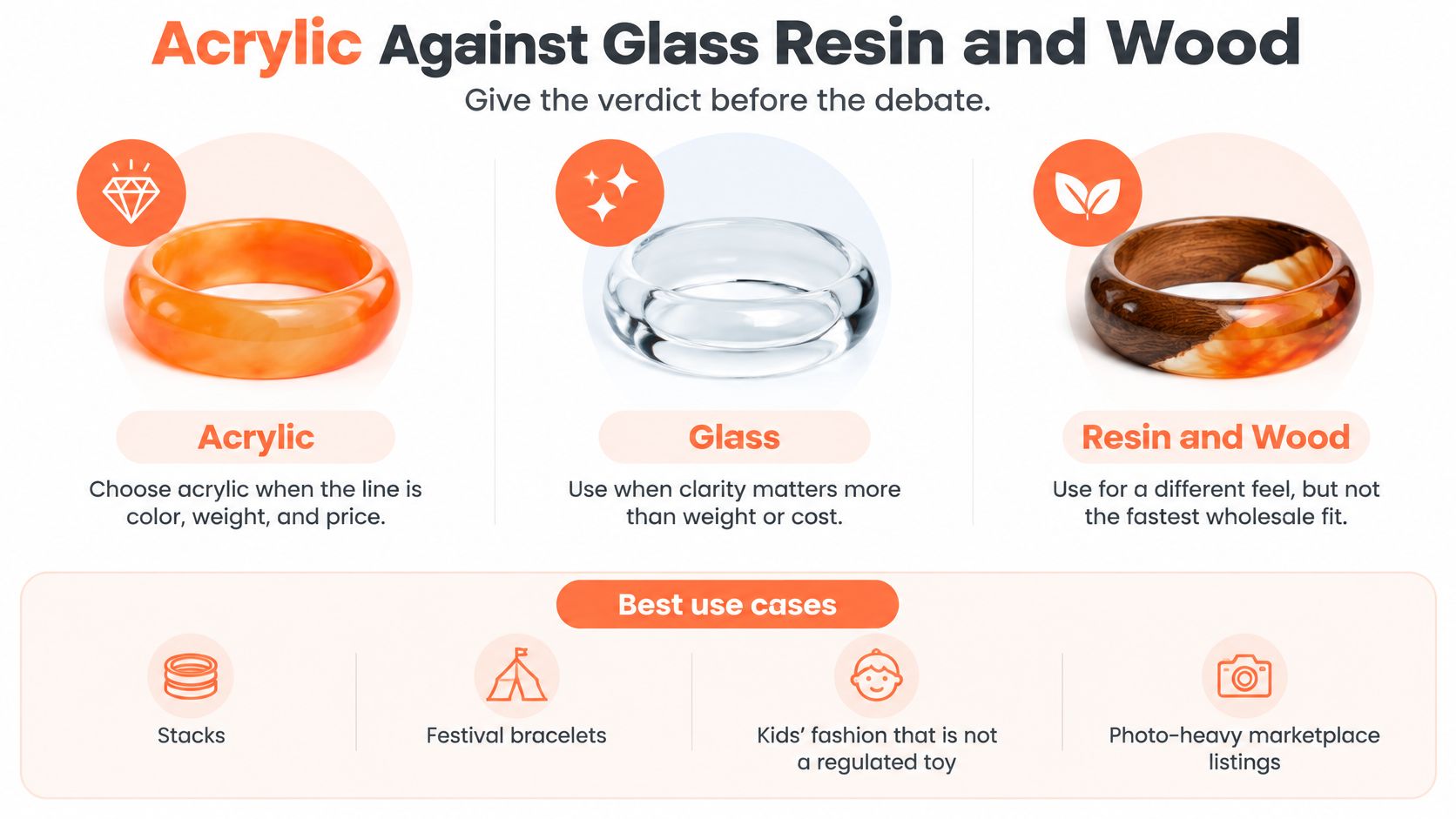
Compare the work each material creates
Acrylic, glass, resin, and wood for wholesale jewelry
| Material | Weight and wear | Surface and breakage | Color repeat | Landed cost | Wholesale fit |
|---|---|---|---|---|---|
| Acrylic PMMA | Lightweight, comfortable for stacks | Can scratch; notches can initiate cracks | Strong when resin, colorant, and lot are controlled | Affordable component with light freight | Volume fashion and coordinated color stories |
| Glass | Heavier, colder hand-feel | Resists scratching but can chip or break | Consistent production can support matching; handmade effects need selection | Allow for protective packing and damaged pieces | Premium focals where weight is acceptable |
| Resin | Fillers and inclusions affect weight | Check for softness, yellowing, and tackiness | Tint and glitter distribution need close approval | Include cure inspection and rejected pieces | Sculptural or inclusion-led designs |
| Wood | Light to medium, warmer feel | Can dent, swell, or release dye | Grain makes exact matching harder | Include sorting and color matching | Texture accents beside acrylic |
Acrylic with a metal-look finish needs a wear check at raised edges. Rub the sample against neighboring beads and examine the high points. A bright coating that scuffs quickly will disappoint customers even if the underlying bead remains intact.
With resin, reject persistent odor or tackiness rather than assuming packaging caused it. With wood, look inside the bore for chips and fibers that catch cord, and test dyed samples against a damp white cloth. With glass, inspect the packing method as carefully as the bead surface.
Build an assortment, not a wall of one material
For a boutique, I'd use acrylic as the volume color story, glass for selected focal pieces, and wood as a texture accent. An all-acrylic display can look flat or overly plastic under warm shop lighting, especially when every surface has the same gloss.
A handmade glass bead buying guide is useful when you want a contrasting focal rather than a direct acrylic substitute. Judge that focal by its role in the finished piece, including balance, weight, and replacement availability.
Buy the material your customer will appreciate while wearing the piece, not just while viewing its thumbnail.
For marketplace volume, favor acrylic's color range and manageable weight. For bridal or metal-heavy edits, consider glass or metal where the hand-feel supports the price. For boho texture, combine wood with acrylic rather than expecting either material to supply every visual detail.
Children's fashion needs separate scrutiny regardless of material. Calling a design fashion jewelry doesn't, by itself, determine whether it falls outside toy or children's-product requirements.
Colors Finishes and the Price Levers
The lowest per-piece quote can become the most expensive lot if the shade or hole changes on reorder. Ask suppliers to price the bead, finish, customization, and packaging separately, then compare quotes against the same acceptance criteria. Reorder consistency matters more than a small discount you cannot repeat.
Start with the finish. A plain molded bead and a metallic-coated bead may share a shape, but their production and inspection needs differ.
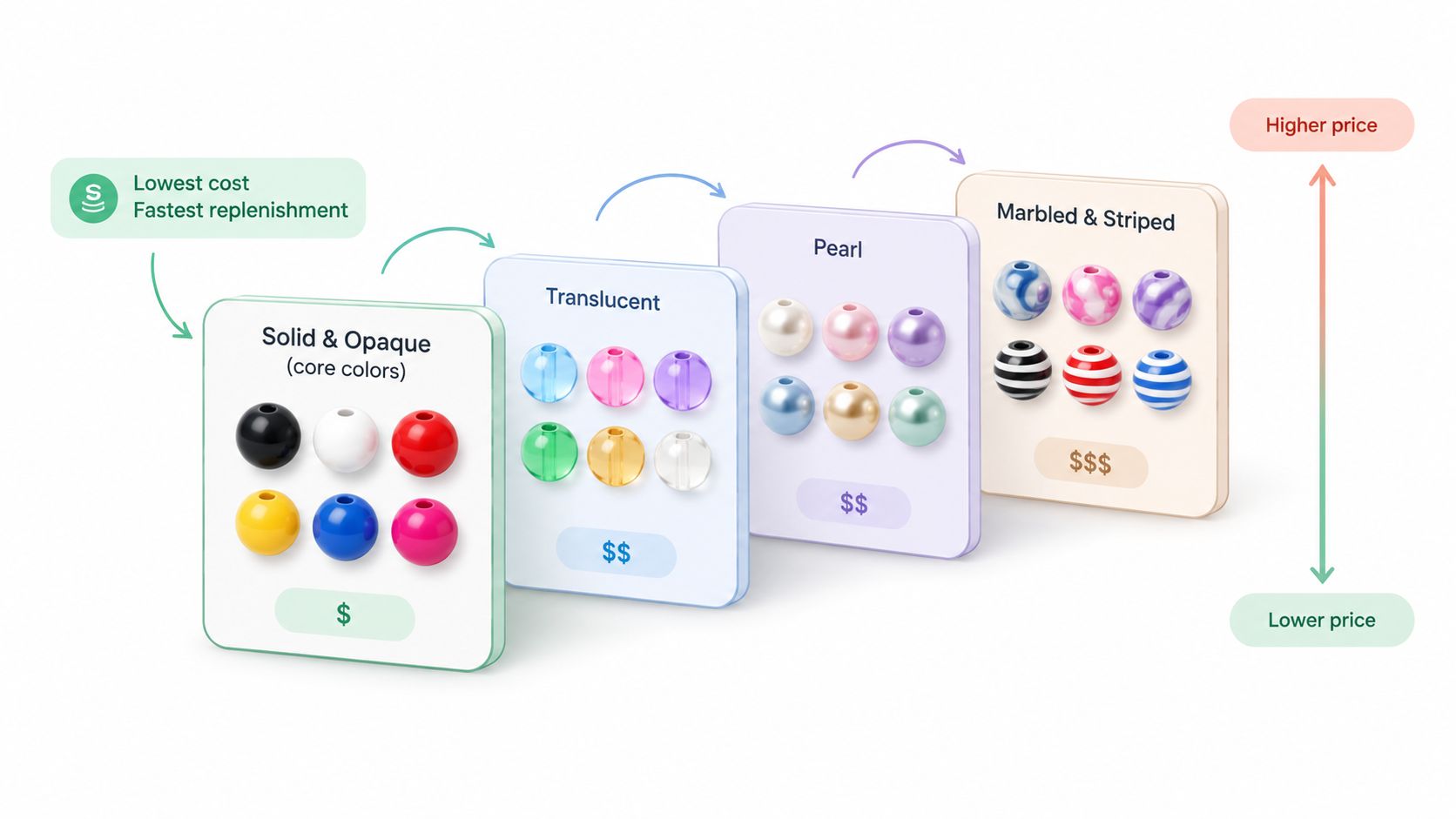
Rank the choices before requesting a discount
- Surface treatment: Compare molded color with painted or sprayed finishes, metallic vacuum or plated effects, and protective clear topcoats. Ask what each layer does and how the supplier checks adhesion.
- Shape complexity: Quote rounds and rondelles separately from letters, flowers, and large geometric forms. Inspect corners, narrow bridges, and mold seams rather than accepting one general quality promise.
- Color effects: Solid opaque black, white, and core brights are sensible replenishment candidates. Pearl, marbled, striped, translucent, and glow effects need clearer approval standards.
- Customization: Physical color matching, tighter hole tolerances, header cards, and mixed-color packs add work. Pay for them when they support a repeatable collection, not because customization sounds premium.
Don't assume every factory uses the same price ladder. Request comparable quotes for the same specifications, then choose effects your customers will pay for. For coated beads, compare samples in daylight and warm indoor light. A finish that looks gold in a factory image may read orange beside your existing findings, so check it against the chain, spacers, and clasps you plan to use.
Calculate the cost of usable stock
Usable bead cost = purchase cost, inbound freight, inspection, sorting, and rework divided by accepted beads.
Consider a hypothetical quote with 10% mixed-color or off-hole pieces, compared with a slightly higher quote carrying a written defect allowance under 2%. Those figures describe a buying scenario, not industry benchmarks. Use them to compare the cost of rejected pieces, replacement assemblies, and supplier claims.
For the purchase order, define what counts as a defect and how the supplier will handle it. For example: “Color mismatch or off-spec hole: maximum 2% of the lot; replace or credit defects above that allowance.” Get approval samples and reorder terms in writing, including the shade and hole specification.
For a proposed first fashion assortment, test eight to twelve core colors in 8 mm and 10 mm, two metallic finishes, and one seasonal neon or pearl effect. This gives you coordinated options without tying up cash in forty one-off shades. Keep the repeat-order budget focused on shades and finishes you can specify consistently.
Safety Limits That Keep a Lot Sellable
The lowest per-piece quote can become the most expensive lot if paperwork fails a market check or the shade and hole cannot be reordered. Set the destination market and intended wearer first, then check the bead, its coating, and any other materials in the assembly.
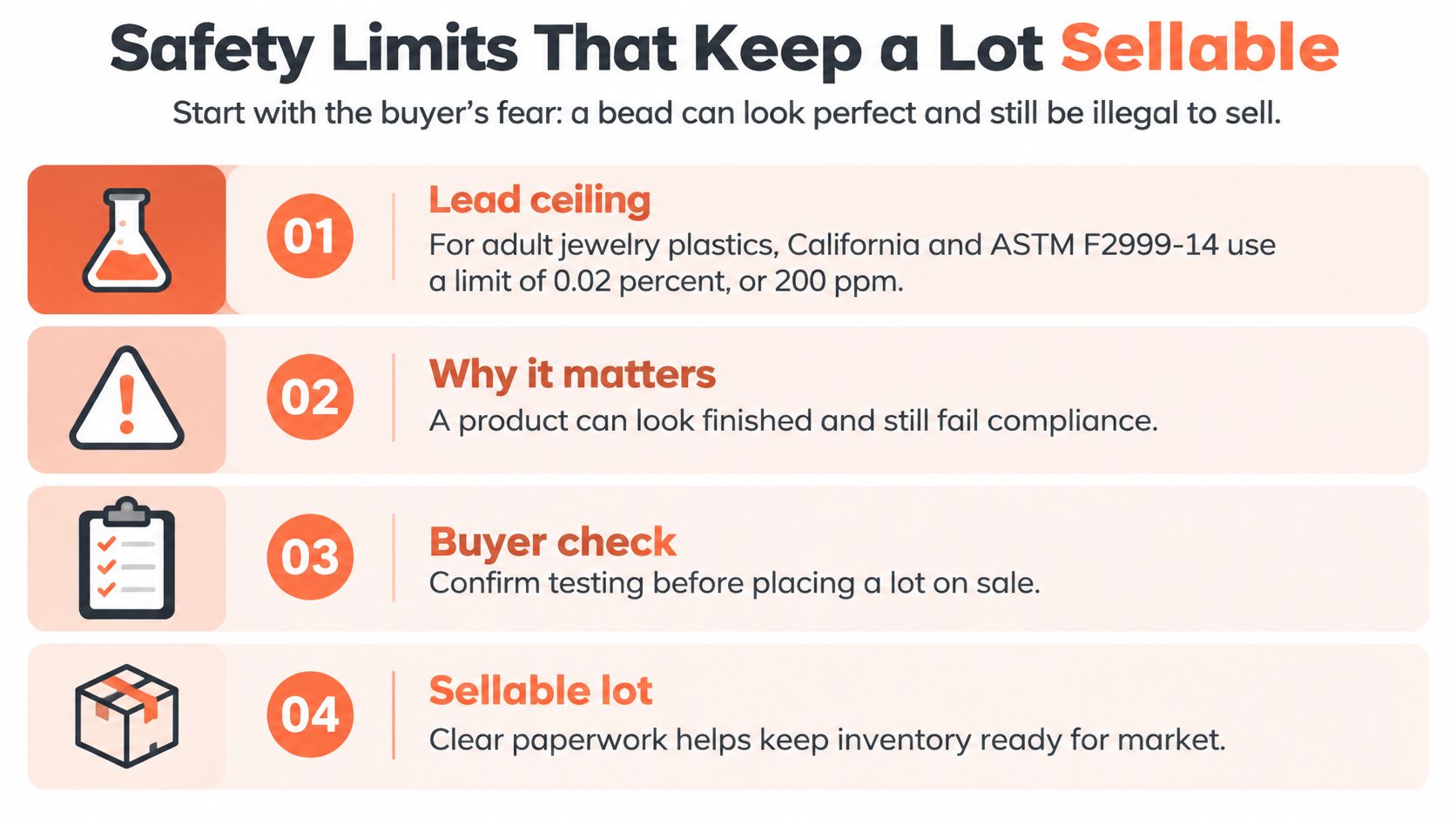
Match the report to the market
Use this table to match each limit to its category and source. The figures are not interchangeable pass marks.
Lead and cadmium limits by market
| Category | Substance | Limit | Source |
|---|---|---|---|
| Adult jewelry plastics, including acrylic beads | Lead | California: below 0.02% (200 ppm); ASTM F2999-14: maximum 200 ppm | California DTSC jewelry-law fact sheet; ASTM F2999-14 |
| Children's jewelry, every accessible component | Lead | No more than 0.01% (100 ppm) | California DTSC jewelry-law fact sheet |
| Applicable jewelry components | Cadmium | Below 0.03% (300 ppm) | California DTSC jewelry-law fact sheet |
| Surface coatings, soluble cadmium | Cadmium | Below 0.0075% (75 ppm) | California DTSC jewelry-law fact sheet |
| Jewelry, any individual part | Lead | Must not reach or exceed 0.05% by weight | London Borough of Bromley jewelry guidance |
| Jewelry metal | Cadmium | 0.01% (100 mg/kg) limit | London Borough of Bromley jewelry guidance |
A report only helps if it represents the product you plan to sell. Ask whether the tested samples cover the bead, pigment, coating, and finished assembly, and keep batch identification with the report.
Don't confuse threaded beads with a blanket microplastics ban
The European Commission's REACH restriction guidance describes restrictions on intentionally added synthetic polymer particles that meet specified criteria. Its explanatory material treats beads and sequins intended for threading or sewing as articles outside that restriction.
- Identify the form: A manufactured bead intended for threading is not automatically the same product category as loose glitter.
- Confirm the use: Document whether the item is intended to be threaded, sewn, incorporated, or dispersed.
- Check the destination: Get specialist advice for uncertain particle-like products or unusual applications.
- Describe it accurately: Call a bead an article for threading or sewing only when that is its genuine intended use.
Before import, request a material declaration, representative lead and cadmium reports, coating details, and batch identification. Send children's, chewing, sensory, and toy-like claims to a specialist before placing the purchase order.
Place a Repeatable First Order
A low per-bead quote can turn expensive after sorting, remakes, and mismatched replenishment. Build a small assortment around designs you can assemble, inspect, and reorder to a retained physical standard.
Start with three sample assemblies: a stretch stack using 8 mm and 10 mm rounds on 1 mm elastic; a geometric cord cuff with matte rounds, pearl-coated ovals, and a 14–16 mm focal on 2 mm cord; and a lighter necklace with 6 mm translucent spacers. These dimensions are starting specifications, not fit guarantees. Assemble each design with its intended findings and wear-test it before placing a production order.
Follow a controlled order path
- Set the specification. Record shape, outer size, finished hole, coating, and a physical color standard. Send the supplier a marked sample, not a screenshot alone.
- Limit the first buy. Choose a mixed test lot, especially if cash is tight. Keep two beads from each color sealed and labeled as a match set.
- Check the finished assembly. String, drop, and light-test it. Choose packaging that keeps finishes likely to rub against each other separated.
- Get lot records. Request batch identification, polymer identification, a colorant note, hole tolerance, agreed defect criteria, and representative chemical reports.
- Approve replenishment before dispatch. Ask the supplier to compare the new lot with your retained sample. Inspect it before combining it with existing stock.
Use this bulk jewelry-making bead purchasing guide to plan quantities around finished designs. Show in the assembly bill which components can serve several products.
Keep traceability through replenishment and dispatch
The EU regulation on preventing plastic-pellet losses sets obligations for specified pellet-handling operations, with provisions scheduled to apply at different times. It does not create a blanket ban on beads. Keep polymer-handling and lot records so you can identify the material used in a shipment and connect it to the relevant batch.
Ask each factory the same questions: Who made the lot? Which resin and colorant went into it? Which record identifies it later? Clear answers give you a better basis for replenishment than a discount alone.
Preserve lot identification through picking and packing once approved stock arrives. The ServeApps guide to streamline Shopify order fulfillment offers operational context for keeping dispatch organized as orders grow.
Mixed shades and off-hole stock lead to sorting, remakes, delayed shipments, and product photos that no longer match what customers receive. Before approving a reorder, compare the new lot with the retained sample for shade and hole fit, then confirm that its batch records are complete.
JewelryBuyDirect offers wholesale jewelry, fashion accessories, and jewelry-making components, making it one sourcing option to assess against these checks. Visit JewelryBuyDirect to build a small first order around approved designs, then confirm material, hole, finish, and documentation before scaling your acrylic bead assortment.