





Jennifer Lopez | Sat Oct 31 2026
925 Sterling Silver Wholesale Quality Guide
The most common advice about 925 sterling silver wholesale is also the easiest way to make an expensive mistake: look for the stamp, compare unit prices, and buy the cheapest attractive designs. A stamp is a claim, not a receiving inspection. A low quote means little when the delivered alloy, finish, or paperwork doesn't match what you'll sell.
Buy affordable jewelry and fashion accessories by controlling what arrives, not by trusting what photographs well. Verify the batch, specify the surface treatment, calculate landed cost, and reserve reorders for styles that pass inspection and sell at a worthwhile margin.
What 925 Sterling Silver Means for Buyers
Start with a buyer's test: can the supplier connect the material description on your invoice to evidence for the goods in the carton? If the answer is no, you haven't established that you're buying sterling, however convincing the stamp looks.
Sterling is a minimum fineness, not a color. The FTC's jewelry buying guidance states that sterling silver, sterling, and 925 representations require at least 925 parts per 1,000 pure silver, equivalent to 92.5%. That definition should appear in your purchasing specification, not just the product title.
Inspection starts with the item, but it shouldn't end with the mark.
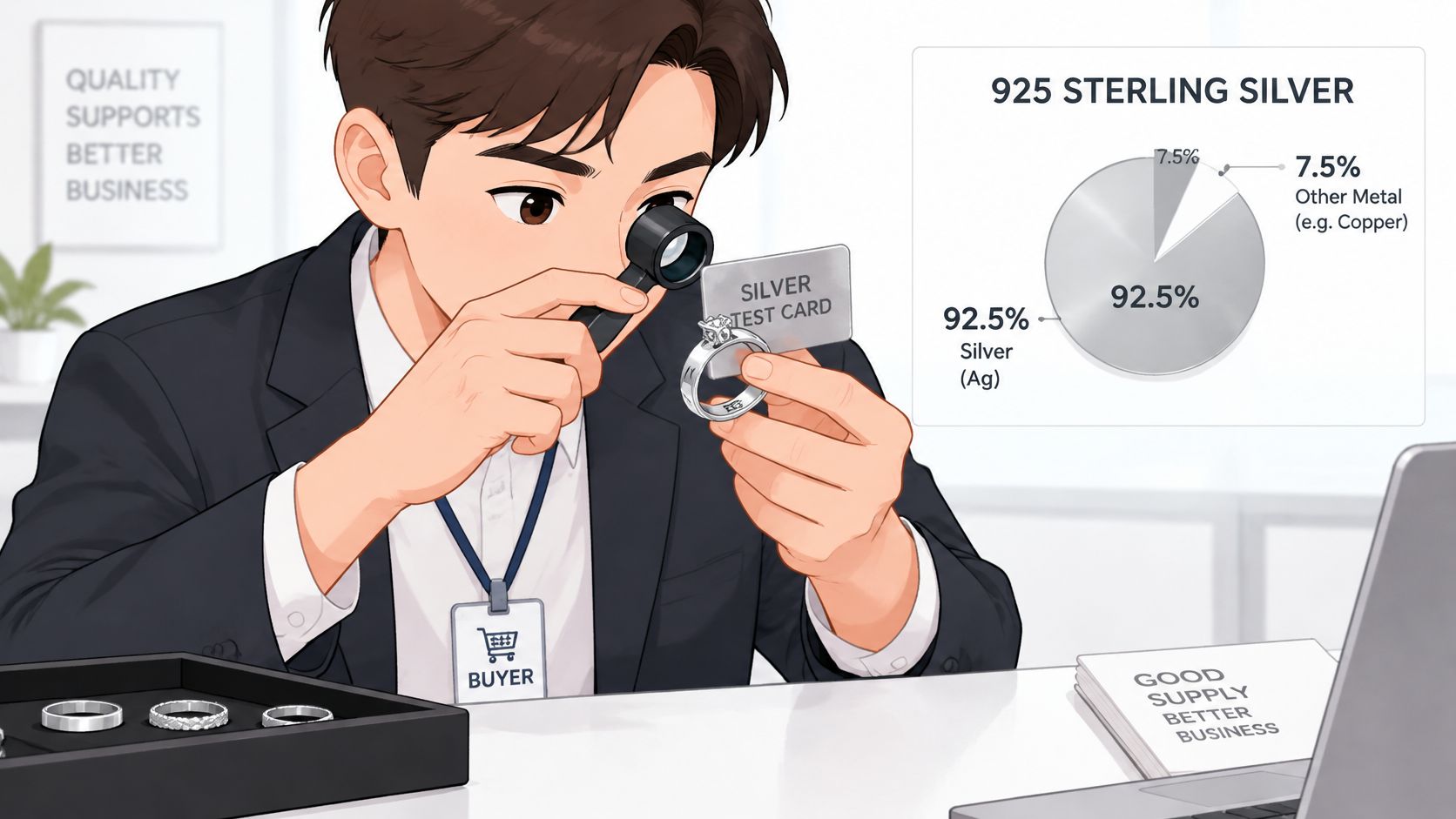
Buy the alloy, not the appearance
As Tiffany's account of sterling silver explains, the alloy contains up to 7.5% other metals, commonly copper, to improve hardness and durability. That makes sterling practical for rings, chains, ear wires, and findings that need to hold their shape.
The designation doesn't independently certify every clasp, post, stone, solder joint, or coating. Ask for a component specification, especially when a decorative face and its functional parts could use different materials.
Recognized silver grades aren't interchangeable. The UK Hallmarking Act's fineness schedule recognizes 999, 925, 830, and 800 silver standards; the corresponding percentage thresholds below follow directly from those parts-per-thousand designations.
Silver claims wholesale buyers should not treat as equal
| Claim | Silver threshold | Typical wholesale use | Buyer check |
|---|---|---|---|
| Fine silver 999 | At least 99.9% | Soft or specialty pieces, not everyday findings | Mark and specification say 999, not sterling; assay supports the claim |
| Sterling 925 | At least 92.5% | Rings, chains, earrings, components | Stamp plus batch assay or appropriately interpreted XRF |
| 830 silver | At least 83% | Some traditional European silver | Separate grade, price, description, and matching assay |
| 800 silver | At least 80% | Lower-grade silver articles | Matching material evidence; never merchandised as 925 |
| Silver plated | Thin silver over base metal; no sterling threshold for the core | Fashion price points | Base metal and plate named, no solid-sterling claim |
| Silver-colored alloy | No precious-metal minimum | Trend accessories | Sold as fashion metal, not sterling |
Use a receiving vocabulary across suppliers
This is a substantial international purchasing category. In 2024, silver-jewelry exports under HS 711311 were led by Thailand at approximately $1.918 billion, followed by the EU at $1.155 billion and India at $1.153 billion, according to UN Comtrade. Those figures include silver jewelry broadly, not just sterling, so an exporting country's reputation cannot authenticate your lot.
Keep grade names consistent across purchase orders, invoices, stock records, and retail descriptions. Otherwise, a cheaper material can enter your assortment under an expensive promise.
Packaging deserves its own budget line, too. Once you've settled dimensions and presentation requirements, you can find jewellery gift boxes through Packaging Panda and include their cost in your buying calculation. A good box supports presentation; it never substitutes for material verification.
Finishes That Change Look and Cost
Think of a finish as clothing on the alloy. The underlying sterling can remain unchanged while the surface looks bright white, warm, or deliberately aged, and buyers should specify that surface as carefully as the metal beneath it.
Use the visual comparison to separate appearance from composition.
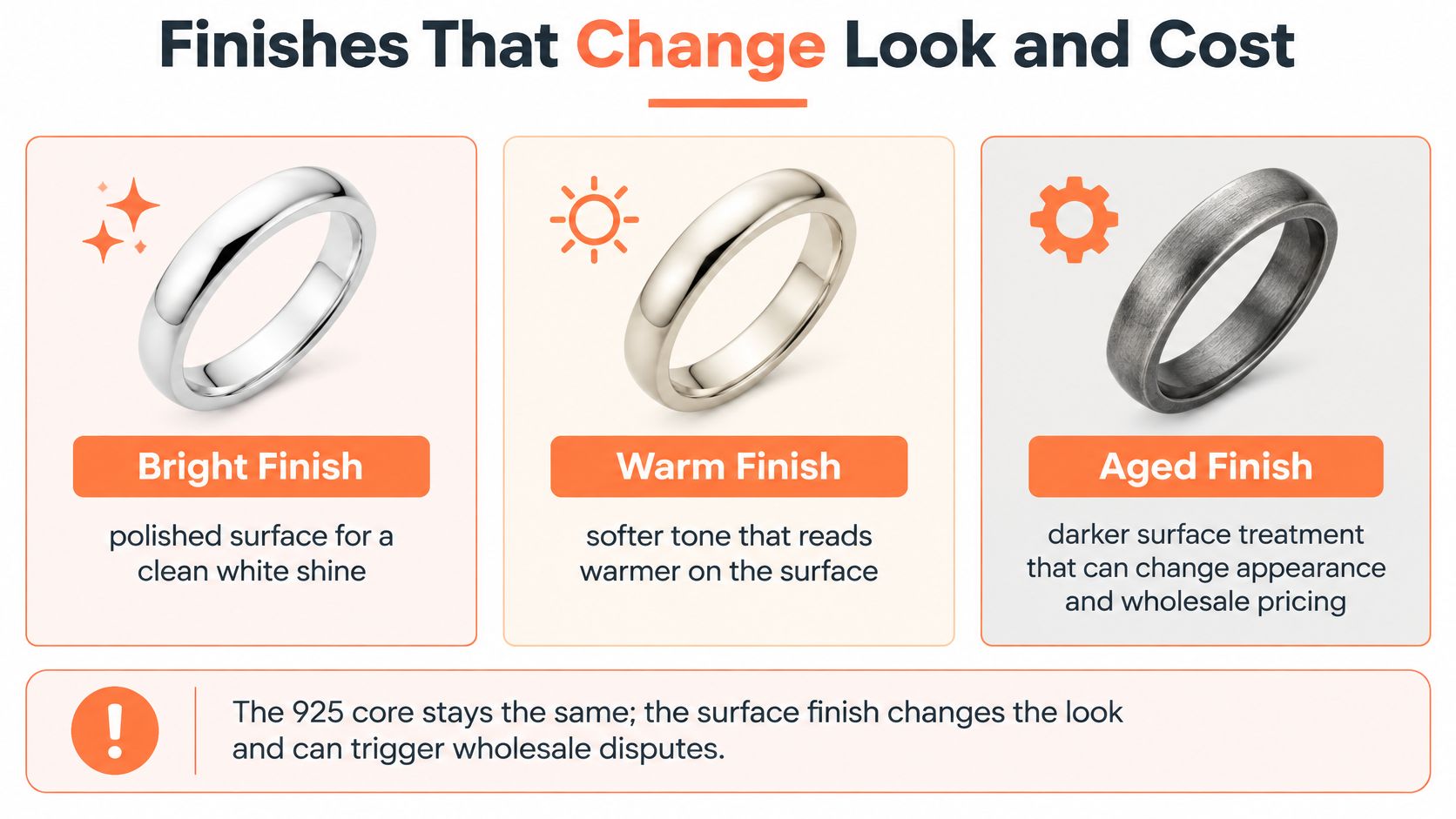
Specify what the customer will actually touch
Bright polished sterling needs a reference sample for polish quality. Inspect recesses, edges, and the backs of earrings, not just the face under showroom lighting.
Rhodium-plated sterling needs a separate finish specification. Record whether the treatment covers the entire piece, including exposed findings, and ask how the supplier checks coverage and wear at high points.
For warm yellow or rose tones, name the plating metal and thickness target. Gold-colored plating over sterling doesn't turn the underlying alloy into gold, just as a silver-colored coating doesn't establish a sterling core. Our explanation of sterling silver versus silver-plated jewelry helps keep those retail descriptions separate.
Finish rule: If the supplier can't describe the surface treatment, don't promise its durability to your customer.
Judge intentional effects against a sample
Oxidized recesses should look intentional and consistent with the approved sample. Inspect textured motifs and evil-eye details for uneven patches, polishing residue, and accidental staining rather than accepting every dark area as an antique effect.
For clear protective coatings, inspect edges and joints for pooling or lifting. Request the coating's care requirements before writing customer instructions, and don't use the same polishing advice across bare, plated, and deliberately darkened surfaces.
- Name the base: Record the alloy independently of the finish.
- Define coverage: Specify which posts, clasps, backs, and decorative surfaces receive treatment.
- Approve appearance: Keep a physical reference sample under consistent lighting.
- Attach care instructions: Make cleaning advice part of the approved product record.
A listing such as Bohemian Minimalist 925 Sterling Silver Teardrop Baroque Pearl Earrings Asymmetric Design identifies a design, not a complete finishing specification. Treat the product name as the starting point for questions about the surface and components, not as their answer.
Use the video alongside physical samples, not instead of examining them.
How to Evaluate Wholesale Suppliers
Vet the supplier before paying for samples. A polished catalog can help you shortlist designs, but only precise answers and traceable documents justify a purchasing relationship.
Run a document-first vetting sequence
- Send a written specification. Include fineness, finish, plating thickness where relevant, component materials, stones, dimensions, and tolerances. Ask the supplier to return the quote against that specification rather than substitute its catalog wording.
- Request lot-specific analytical evidence. The report should identify the sample, batch, measured result, method, and laboratory. The ISO silver-alloy analytical standard describes a volumetric determination method; recognized methods such as ISO 13756 or ISO 11427 aren't interchangeable labels for an XRF scan. Ask the laboratory which method fits the material and whether surface plating complicates interpretation.
- Establish responsibility for the mark. Get the responsible business's identity in writing. For UK goods, government hallmarking guidance explains the sponsor or maker, metal-and-fineness, and assay-office elements of a complete hallmark, subject to applicable hallmarking requirements.
- Map testing to the destination and customer. SGS's jewelry services identify REACH and CPSIA compliance as relevant considerations. Children's jewelry needs a different compliance review from an adult necklace; don't accept a generic skin-safe statement for either.
- Control sample selection. Require a finished-jewelry sample drawn from the actual production lot, with a record of who selected it. SGS's silver-assay service describes representative preparation for concentrates and bullion, including drying, mixing, and dividing, but those procedures aren't instructions for sampling finished earrings. Preserve finished pieces intact and agree on suitable laboratory preparation.
- Compare the commercial terms. Put MOQ, lead time, replacement terms, freight responsibilities, and inspection arrangements beside the quoted price. Walk away when the supplier won't identify its tester or connect the report to the offered goods.
Require evidence that answers a purchasing question
Supplier evidence to request before the first order
| Evidence | What it proves | Red flag |
|---|---|---|
| Written PO spec | Agreed fineness, finish, plating thickness, and component requirements | Specification says only sterling |
| Batch assay or XRF report | Measured silver content for the sampled lot, within the method's limitations | One catalog-wide certificate |
| Accredited lab report | Named analytical method, result, and relevant accreditation | Unaccredited letter |
| Maker or sponsor mark | Who stands behind the silver mark | Anonymous stamp |
| Nickel and CPSIA or REACH tests | Evidence addressing applicable skin-contact and children's-product requirements | No relevant test for plated or colored items |
| Pre-shipment sample | Appearance and construction of a representative lot sample | Sample from a different production run |
For supplier discovery, the sourcing apps listed on PlatformDTC can help organize potential channels. Apply the same evidence requirements to every channel; an app listing isn't a quality audit.
Pricing and Assortment for 2026 Sterling Buys
Don't buy sterling on the assumption that demand rises automatically with fashion interest. JewelryNet's report on the Silver Institute's demand outlook gives the market signals summarized below: fabrication contracted, further demand weakness is projected, and recycling is forecast to rise.
What should change a 2026 sterling buy
| Driver | Signal | Buying response |
|---|---|---|
| Jewelry fabrication | Down 8% in 2025 to 189.3 million ounces from 205.1 million ounces | Cut depth on heavy styles |
| 2026 demand outlook | Projected to fall another 9% to 178 million ounces | Smaller test orders and faster rotation |
| Recycling supply | Forecast above 200 million ounces, first time since 2012 | Use recycled claims only with batch proof |
| Metal versus making | Metal cost can change independently of labor and finish | Separate metal exposure from other landed costs |
| Finish add-ons | Rhodium or gold plate requires additional processing | Price the finish apart from the sterling core |
| Failed incoming tests | Retesting and returns add expense | Reject mismatched documentation before scaling |
The fabrication comparison is a weight measure, not a dollar value.
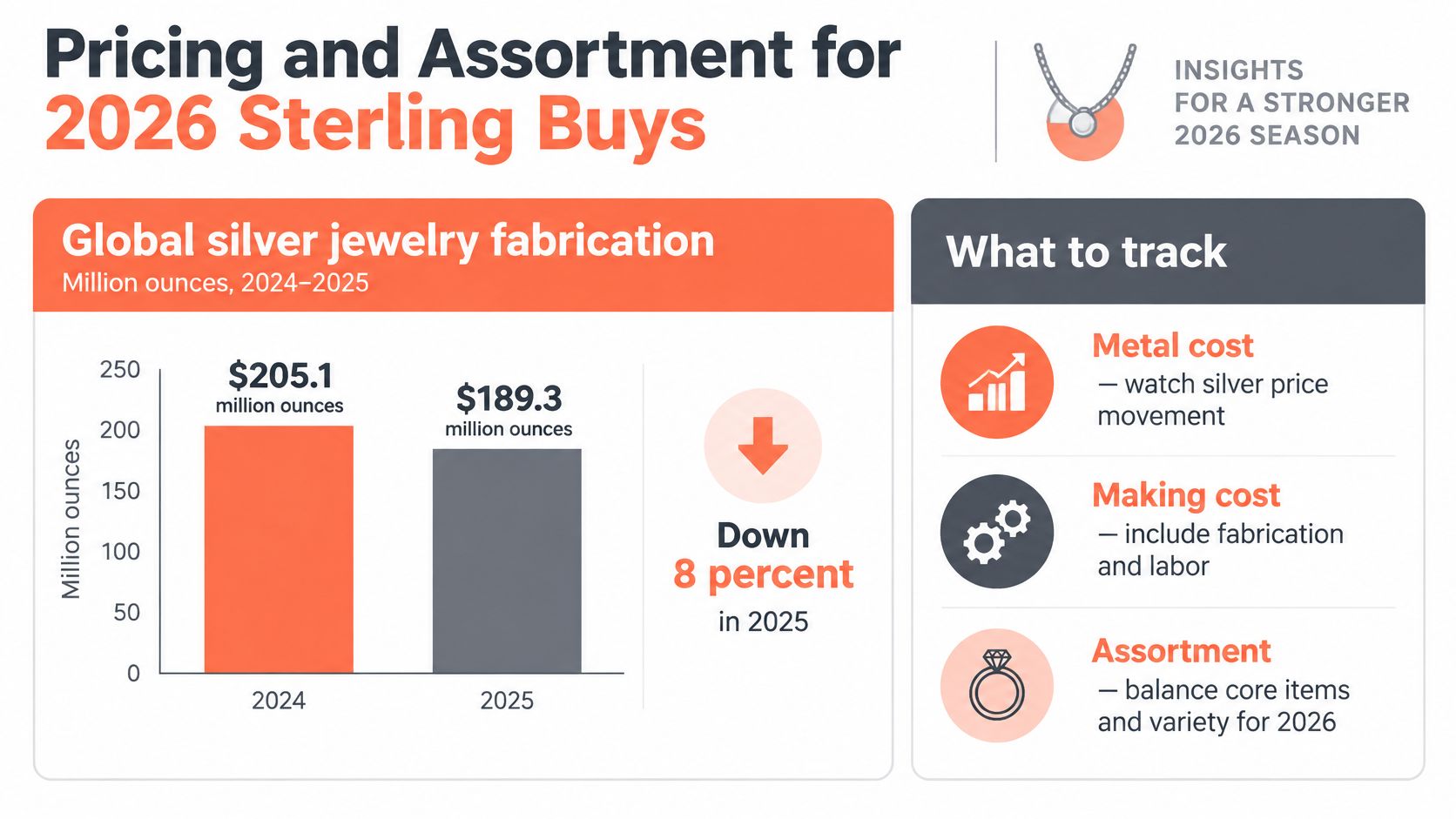
Separate metal exposure from making cost
The Silver Institute reports that the average silver price increased 21% in 2024. Don't assume the supplier's next quote will preserve the margin from your last purchase.
Build landed cost from the invoice price, freight, duties, brokerage, inspection, packaging, and an allowance for defects or returns. Then calculate landed cost per saleable unit, because damaged or rejected pieces don't generate the revenue needed to cover the shipment.
Use gram comparisons carefully. Divide by documented sterling-alloy weight when comparing similar constructions, not by gross weight that includes pearls, stones, or packaging. If you want a pure-silver equivalent, use the verified fineness and metal weight rather than treating the whole item as precious metal.
Our guide to how much 925 silver costs per gram provides context for that comparison. A gram calculation remains a purchasing tool, not a substitute for judging workmanship.
Give core styles depth only after testing
A baroque-pearl teardrop stud and an evil-eye hoop are useful design prototypes for an accessible core assortment. They aren't automatically lightweight merely because their silhouettes look delicate; confirm actual metal weight, construction, and wearing comfort before choosing them for a low-exposure buying strategy.
Keep heavy cuffs and wide bands in the test budget until customers demonstrate demand. Separate proven replenishment styles from motif experiments so a slow seller doesn't consume the money needed to restock a reliable design.
Buy depth with sell-through evidence. Buy novelty with money you can afford to leave in stock.
Set a written metal-price movement threshold that triggers a quote review before the next purchase order. Recalculate the entire landed cost rather than applying a blanket increase to every style.
Keep stainless steel, titanium steel, copper, and plated fashion accessories in clearly labeled material categories for price-sensitive shoppers. Don't downgrade an existing sterling listing, and don't claim recycled silver without evidence covering the supplied batch. Sell design, workmanship, and verified composition rather than suggesting that heavier always means better value.
A Receiving Check Before You Reorder
A receiving bench needs a written acceptance sheet and clear authority to hold stock. Apply the same checks to every delivery, then separate any questionable pieces before they reach retail or fulfillment inventory.
Use this checklist at the receiving bench.
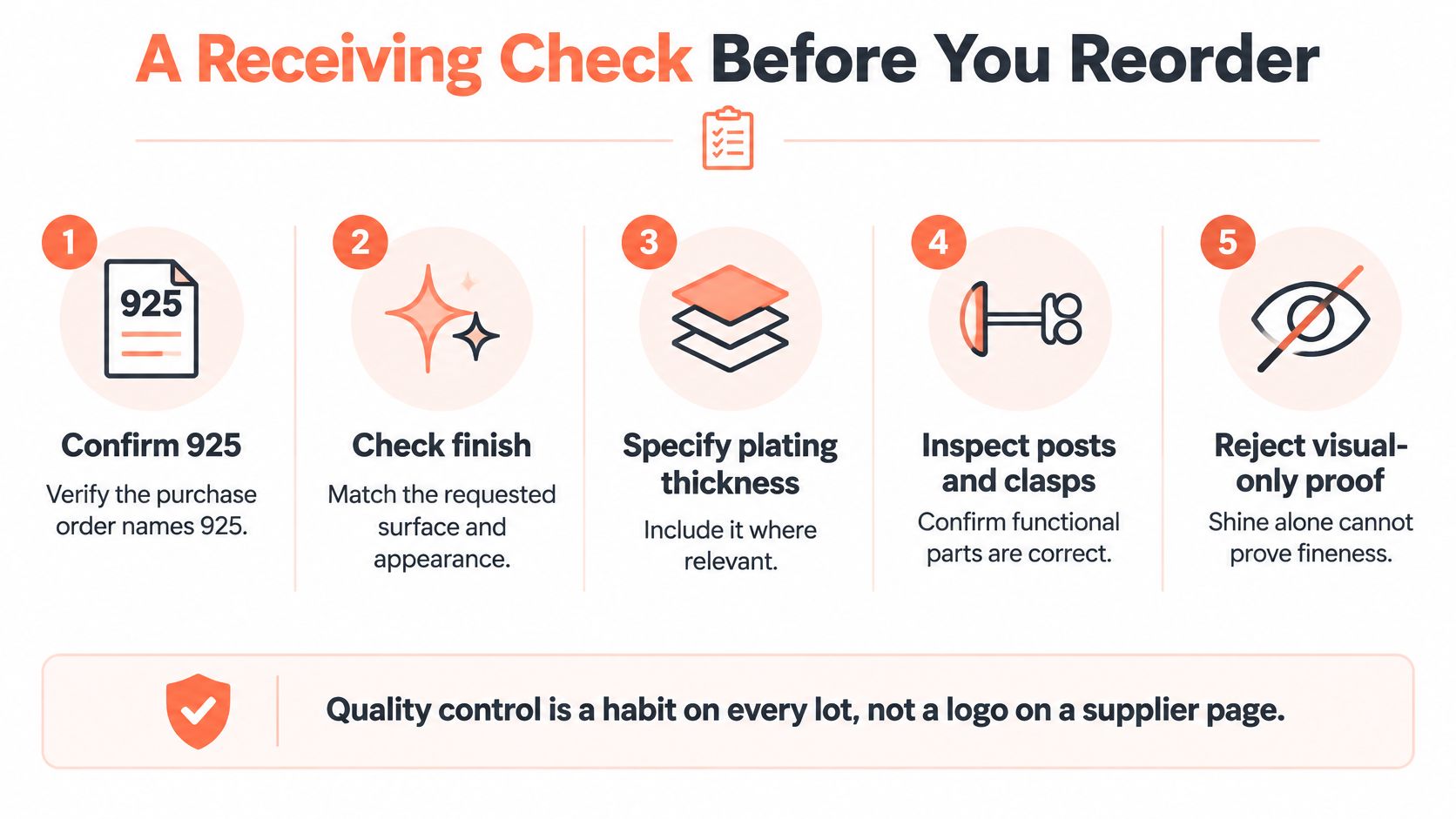
Follow the intake path in order
- Match identity first. Compare carton labels, invoice lines, style identifiers, and the purchase order. Keep similar finishes separate until you confirm each style.
- Inspect marks under magnification. Photograph each mark and compare it with the approved style records. Hold pieces with unclear or inconsistent marks for review.
- Weigh and measure samples. Use a calibrated scale and calipers to check the agreed specification. Inspect both earrings in a pair, clasp action, post alignment, sharp edges, and stone security.
- Retain a batch sample. Label it with the receipt date, supplier, style, and lot identifier. Store it apart from retail stock so you can compare it with any later complaint.
- Reconcile the laboratory result. Confirm that the tested sample and batch match the delivery. Interpret XRF results in light of surface and construction; a plated surface may not represent the underlying core.
- Check the article for destination-market safety. Match the finished piece, its components, and its intended customer to the applicable testing requirements. Fineness alone does not establish chemical safety.
- Quarantine discrepancies. Physically segregate held goods and block them in the inventory system. Record the reason and who may release them.
- Authorize replenishment separately. Receiving a shipment does not approve the next order. Make that decision after reviewing the inspection and records.
Keep a pass-fail sheet beside the goods
Use the bench sheet to set practical hold triggers and measurable limits for each style. Record actual readings alongside the agreed specifications, and quarantine pieces that fall outside them.
Bench checks and quarantine triggers
| Bench check | Record at intake | Quarantine trigger |
|---|---|---|
| Pair consistency | Weight, dimensions, and visible finish of both pieces | One piece differs from its mate or agreed specification |
| Clasp and posts | Clasp action, post alignment, and secure closures | Clasp fails to close, post is bent, or closure is loose |
| Edges and surfaces | Scratches, sharp edges, plating coverage, and color consistency | Sharp edge, exposed base metal, or finish visibly outside the approved sample |
| Stones and settings | Stone presence, alignment, and setting security | Missing, loose, or visibly misaligned stone |
| Tarnish and residue | Condition as received, photographed before cleaning | Darkening or residue obscures the finish or prevents a reliable comparison |
| Dimensions and weight | Calibrated scale and caliper readings against the purchase specification | Any reading falls outside the agreed tolerance |
For storage-related darkening, document the received condition before deciding whether it calls for rejection or care. The guide to why sterling silver tarnishes can help distinguish tarnish from a finish discrepancy. Keep disputed pieces unpolished until their condition has been recorded.
Place the First Order Only After the Lot Clears
A low unit price earns a place in your assortment only when the lot meets its written specification and leaves room for margin. Approve a small commercial order after the sample and available batch evidence support the exact style you plan to list. Inspect the shipment on arrival before releasing it for sale.
If a lot fails, hold the affected style and redirect the buying budget until the discrepancy is resolved. A discount does not offset an unexplained material mismatch.
Scale the styles you can defend
Keep the assay, invoice, origin documents, approved finish sample, and intake photographs together. Assign one person to close discrepancies; an unresolved email does not clear stock.
Use a consistent release process:
- For held goods: Record the missing evidence or failed characteristic and the required remedy.
- For cleared goods: Publish descriptions supported by the specification and test records.
- For replenishment: Review sell-through, returns, actual margin, and the current supplier quote.
- For merchandising: Use accurate product photographs and finish descriptions. Prepare the website cover image at 383:204 so important content is not cropped.
JewelryBuyDirect sells direct wholesale jewelry with no minimum order quantity, so retailers can place small test orders and scale as demand develops.
Reorder the lot you can substantiate, in the styles your customers buy.
Choose a manageable first assortment and calculate its full cost, including the costs that determine landed margin. Keep enough cash available to replace a winning style. Affordable sourcing means buying saleable quality at a sustainable cost, not filling a carton at the lowest quoted price.
JewelryBuyDirect offers direct wholesale sterling silver jewelry and fashion accessories with no minimum order quantity. Visit JewelryBuyDirect, shortlist styles against your written specifications, and scale only the lots that clear inspection and deliver your required margin.